Nine presidents in 10 years – this figure tells a lot about the current state of Peruvian politics.
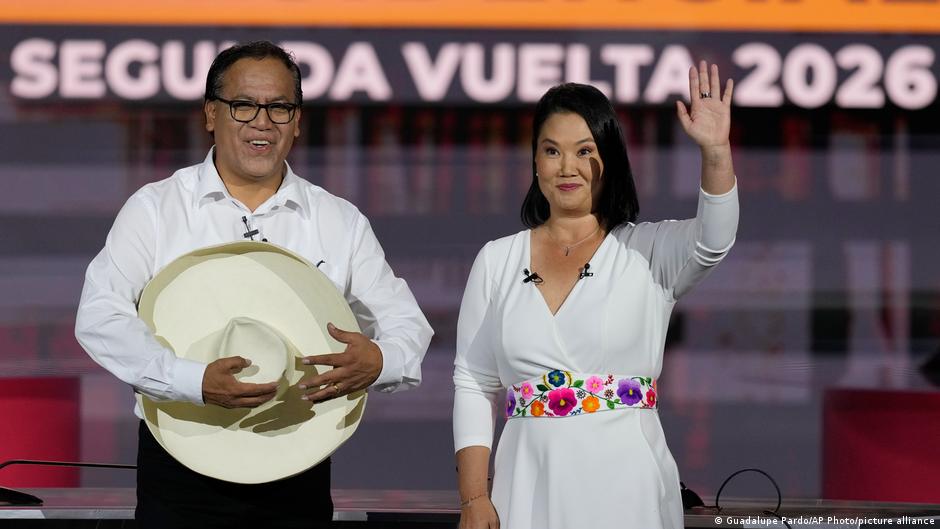
Voters will return to vote on Sunday. This time, they will choose between Keiko Fujimori, leader of the conservative Popular Force party, and Roberto Sánchez, the candidate of the leftist Together for Peru. Whoever prevails on the ballot, Peruvians will vote in an atmosphere of deep distrust of institutions, political fragmentation and growing concern over insecurity.
For many observers, the central question is not only who will win the presidency, but also whether Peru will be able to break out of the cycle of political crises that has characterized the past decade.
The first round exposed the weakness of Peru’s political system. Keiko Fujimori led with only 17% of the vote, while Roberto Sánchez took about 12%, highlighting a fragmented political landscape in which 35 presidential candidates competed. The result shows the extent to which both finalists lack widespread support and they enter the second round amid a deep crisis of representation.
For Alonso Cárdenas, professor of political science at Antonio Ruiz de Montoya University, the roots of the problem go much deeper than a simple electoral contest.
“There is a massive discrediting of the ruling class,” Cardenas told DW. According to the political scientist, widespread public disapproval extended to Congress, the presidency, and the judiciary. “This is a very serious process of explosion within the system of political representation.”
Johanna Piper, a researcher at the German Institute for Global and Area Studies, agrees that the election reflects a long-running crisis. “People are not happy or satisfied. They have no trust in politics, the government or Congress,” Pieper told DW. She also points to the divided society between Lima and historically marginalized areas, particularly the Andean highlands.
Fujimori and his father’s legacy
Keiko Fujimori has once again put the country’s best-known — and most polarizing — political figure at the center of a campaign. She is the daughter of former President Alberto Fujimori, who ruled Peru between 1990 and 2000.
The movement known as Fujimorismo has shaped Peruvian politics for decades. Its supporters point to economic stabilization and the fight against the Maoist guerrilla group Shining Path. However, critics highlight deep-rooted authoritarian tendencies, corruption scandals, and serious human rights violations during his father’s tenure.
Political scientist Fernando Tuesta recently wrote on
According to Tuesta, the power of Fujimorismo cannot be denied, but the resistance it generates is also undeniable. For Pieper, that opposition remains a deciding factor. “I don’t think it has diminished,” she says of anti-Fujimorismo sentiment. He noted that Fujimori received only 17% of the votes in the first round and had already lost three times. “Many Peruvians know that Keiko Fujimori’s party has contributed to the country’s instability.”
On economic policy, Fujimori stands for the continuity and defense of Peru’s existing market-based model. At the same time, Pieper warned about the risks of illiberal stances and growing political influence on the judiciary, as well as networks of corruption.
If she wins, she can count on strong allies in Congress. This will probably strengthen his ability to rule, but it will not automatically reduce social tensions.
Sanchez: A lesser-known challenger
Roberto Sanchez is much less well known. The candidate of the Together for Peru coalition has apparently changed his political stance during the campaign.
According to Pieper, Sánchez initially called for a greater role of the state in the economy, criticized the neoliberal economic model, and advocated the drafting of a new constitution. He has since adopted a more liberal tone, emphasizing macroeconomic stability, central bank independence, and supporting private investment.
Cárdenas sees parallels with former President Ollanta Humala, who took a more pragmatic course after winning office. He considers a sharp shift to the left unlikely.
However, the institutional hurdles facing Sanchez will be considerable. Congress remains the major center of power and is dominated by conservative forces and Fujimorismo. Piper therefore believes there is a high risk that the Sanchez presidency will be politically weakened and forced to rely on fragile coalitions to govern.
Focus on security, organized crime
While political polarization is a big talking point, it is the everyday problems that concern most citizens.
“Insecurity is the main concern of the population at present,” Pieper said. Both candidates will have to provide solutions to rising crime and expanding organized criminal networks.
Cárdenas painted a bleak picture, saying the state was rapidly losing control in many areas. Extortion, contract killings and illegal gold mining are spreading, while essential public services such as health care and education are deteriorating.
The two candidates may also set different foreign policy priorities for the nation.
According to Cárdenas, Sánchez will likely seek closer cooperation with the left-leaning governments of Brazil and Mexico.
In contrast, Fujimori would likely rely more heavily on conservative governments in the region as well as the United States. She would likely favor closer ties with Washington and politicians such as Argentina’s President Javier Meili or Ecuador’s President Daniel Noboa.
Pieper agrees and says that cooperation with the US under Donald Trump would be more likely under Fujimori than under Sanchez.
Elections will not automatically resolve the political crisis
Whatever the outcome, some experts expect rapid stabilization of the country.
Pieper points out that Peru’s parties have been weakly institutionalized for decades. If political discontent continues to grow, more radical anti-establishment candidates may gain prominence in the future.
The next president will have to do more than win elections: He will have to try to rebuild trust in institutions and give new legitimacy to a political system that, for many Peruvians, has long lost touch with their everyday lives.
This article was originally written in Spanish.