
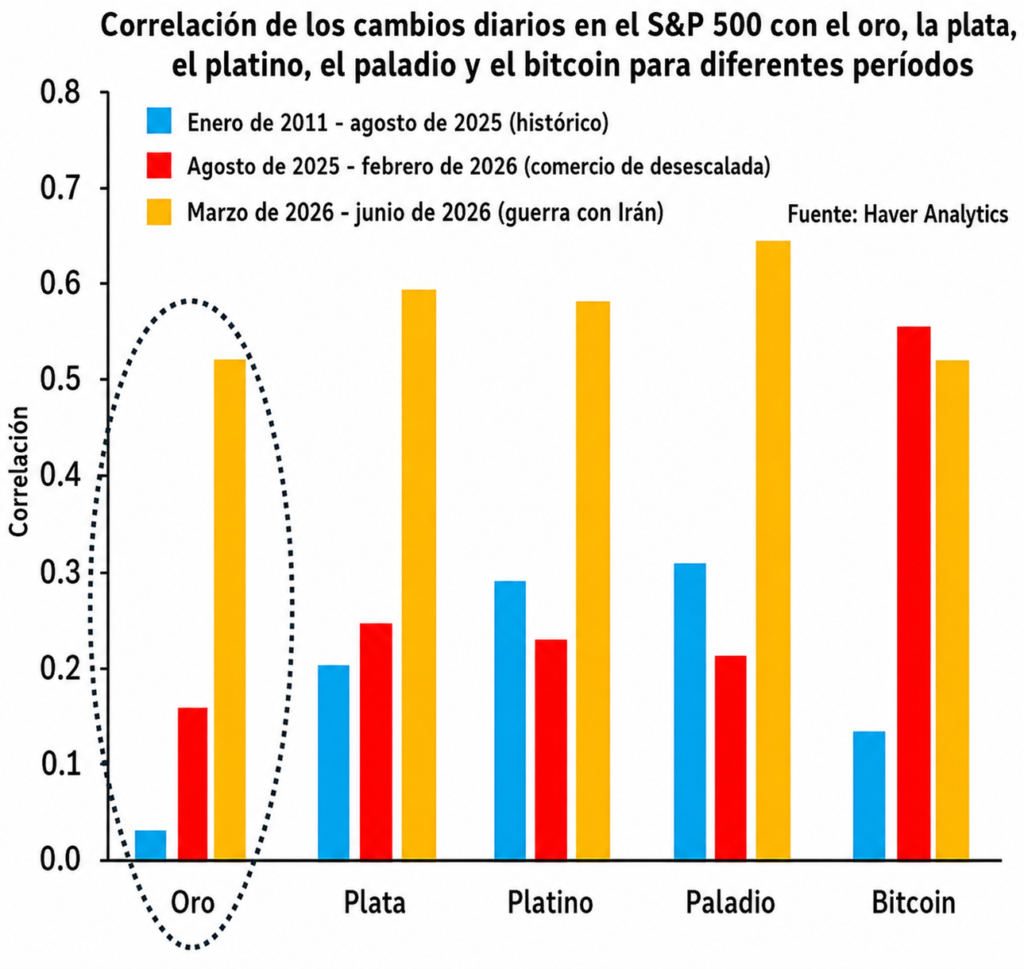
Gold’s correlation with the S&P 500 went from almost zero to levels similar to those of bitcoin.
Some analysts believe gold is losing some of its ability to diversify portfolios.
For generations, gold has been seen as the ultimate safe haven asset in periods of economic uncertainty, geopolitical tensions or financial turbulence. However, a recent analysis suggests that this historical characteristic could be changing. The precious metal would be showing behavior increasingly similar to that of assets considered risky, including bitcoin, moving away from the defensive function that the markets traditionally attributed to it.
The correlation between gold and the S&P 500 index went from practically non-existent levels to records comparable to those observed in bitcoin, this is the conclusion reached by economist Robin Brooks in his article “Has gold lost its safe haven status?”where he assures that the metal no longer moves so independently from the stock marketsbut increasingly responds to the same factors that affect other risk assets.
According to Brooks, this change began to become evident from the end of 2025. In times of high geopolitical tension, when historically gold used to benefit from investors’ search for refuge, the behavior was different, as CriptoNoticias explained. The data analyzed by the economist show that between 2011 and much of 2025, Gold maintained a near-zero correlation with the S&P 500 index, reinforcing its reputation as an effective diversification tool.
The change can be clearly seen in the following graph prepared with data from Haver Analytics. While between 2011 and August 2025 gold maintained a practically zero correlation with the S&P 500, During the following months this relationship increased significantlyespecially in the period marked by the geopolitical tensions of 2026. The behavior reinforces the argument that, at least recently, it has begun to react to the same macroeconomic factors that drive other assets, including bitcoin.
The phenomenon coincided with the expansion of the so-called “devaluation trade”, a strategy based on the expectation that high levels of public debt and expansionary monetary policies they will end up eroding the value of fiat currencies. This narrative attracted a new wave of buyers to the gold market, significantly expanding the base of investors interested in the metal.
The numbers support that trend. According to the World Gold Council, Global demand for gold reached record levels during 2025, exceeding 4,900 tons between investment, jewelry, technology and official purchases. At the same time, the total value of gold mined and available in the world exceeded 31 billion dollarsconsolidating it as one of the most important assets in the global financial system.
Brooks believes that part of this transformation can be explained by the growing participation of retail investors. Unlike traditional buyers, these participants tend to react more quickly to changes in market sentiment and volatility. As a consequence, gold could be incorporating dynamics more typical of assets driven by expectations and investment narratives than by historical safe haven fundamentals.
Another element that reinforces this thesis is the decoupling between gold and the real rates of US Treasury bonds.. Traditionally, when real yields rose, gold’s appeal tended to decline because the metal does not earn interest. However, in recent years real yields have remained high and even They exceeded 2% at some timeswhile gold continued to reach all-time highs. This breakout suggests that new forces are influencing price formation.
Despite this, the economist does not consider that gold has lost its usefulness. Central banks continue to accumulate reserves of the metal and official purchases have exceeded 1,000 tons annually for four consecutive years, a sign that it continues to be perceived as a long-term strategic reserve. However, it warns that its behavior could be evolving towards a more volatile inflation hedge that is sensitive to market sentiment.
Not all analysts share this interpretation. For the economist specialized in bitcoin Daniel Arráez, Gold’s behavior does not necessarily mean that it has lost its refuge statusbut both the metal and bitcoin would be responding to common factors such as increased debt, monetary expansion and the search for protection against currency depreciation. In the same line, JPMorgan analysts they maintain that Both assets have benefited from the so-called “devaluation trade”so the higher observed correlation could reflect a shared macroeconomic environment rather than a definitive loss of gold’s historical role as a store of value.
The big question is whether this phenomenon will be temporary or whether it represents a structural transformation. What seems clear is that gold no longer behaves as predictably as it did in the past. For investors, the debate is not minor: it is a market valued at more than 31 trillion dollars that could be redefining one of the characteristics that for generations supported its reputation as a safe haven.