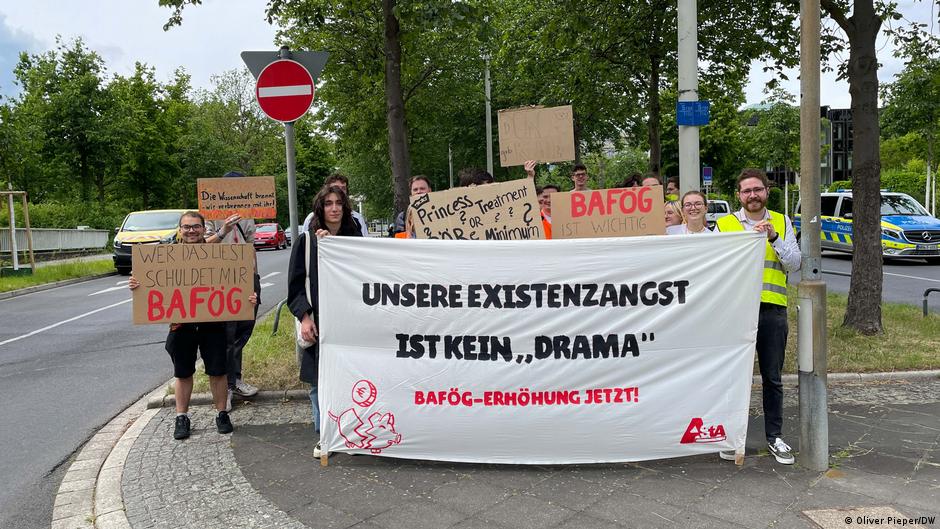
Vibke Jaeger is 23 years old and works part-time 12 hours a week, helping young refugees with job applications. She is also studying Politics and Society at Bonn University. Jagger is one of the 66% of students across the country who work to afford their studies – and at the moment many of them are not particularly happy with the federal research minister, a member of the conservative Christian Social Union (CSU) party.
Jagger explained her position to DW: “I was disappointed, because once again there are cuts to the social sector, and decisions are being made over the heads of young people. When Dorothy Barr says students are privileged and they don’t really need an increase in BAFOG. [state assistance for studies]That’s quite an audacious statement for a federal research minister to make.”
Germany’s BAföG reform is in jeopardy
This is currently causing considerable frustration among many of the approximately three million students in Germany, above all why Federal Research Minister Dorothy Baar argues that the reform of the Federal Training Aid Act (BAFOG), as stipulated in the governing coalition agreement, is not currently a priority for them.
Barr argued: “It is no tragedy if students hold jobs alongside their studies – many also gain valuable experience for life and their careers in the process.” He further said that there would be no fully padded, all-inclusive course of study, as he said, because the situation of students in Germany is, in his words, “very privileged”.
Background: Germany’s coalition government, consisting of the center-right Christian Democratic Union and Christian Social Union (CDU/CSU) and the center-left Social Democratic Party (SPD), agreed to raise the housing allowance included in the BAFOG for students not living with their parents from the current €380 to €440 per month ($438 to $507) starting in the upcoming winter semester. From 2027 onwards, BAföG standard rates were also set to gradually increase from the current €475 ($548) to the level of basic income support (currently €563, or $650). The additional cost of the reform for the current legislative period was estimated to exceed €1 billion ($1.15 billion).
Working part-time long hours is ideal for most students
Vasco Silver is one of approximately 500,000 students in Germany who receive state support for their studies. At €740 ($856), the monthly funding that physics and astronomy students receive in Bonn is slightly above the average rate of €657 ($760). Although support levels have increased steadily in recent years, they fail to keep pace with the rising cost of living.
That’s why the 27-year-old father and student also works eight hours a week — rent, in particular, consumes a large portion of his income. “BAföG should ensure that anyone can study regardless of their social background. But it is no longer fulfilling that role.” It angers him when the German Research Minister suggests that students can always do a little work. “The reality is that two out of three students already do so. Everyone in my circle who receives the BAföG also works part-time.”
One in three students are at risk of poverty
For many students, life is nothing but privilege. According to the Federal Statistics Office, more than a third are actually at risk of poverty. Along with rising prices, on top of that there are skyrocketing rents that are pushing students into financial hardship. On average, they spend €512 ($591) per month on rent alone – and in major cities like Munich, Hamburg or Frankfurt, this figure can easily exceed €300.
Can Germany really afford to cut back on education, of all things, and risk losing many of its brightest minds in doing so? In Wiebke Jäger’s circle, a fellow student left studies altogether because he could no longer get a BAföG. The situation is complicated by the fact that the administrative process for financial aid is often slow and cumbersome – both Jagger and Silver had to wait up to six months for a decision. However, Jagger is most frustrated by the way the government communicates, as well as the lack of concrete proposals to reduce the financial burden on students.
“I can’t remember the last time I heard a statement from the German government and thought: ‘Well, this is the right approach.’ Instead, it’s always the same: cuts are made somewhere, and a particular social group is singled out, portrayed as too lazy, or told they should be doing more. “This is not the way to make policy that will motivate people to participate in democracy.”
students stopped arguing
It is unclear whether the BAFOG reforms will ultimately be implemented – the SPD has urged its coalition partner to adhere to the provisions set out in the coalition agreement.
Meanwhile, the opposition is increasing pressure: the Left Party has introduced a motion in parliament titled “A BAFOG that allows people to stay and study”. It is demanding a return to full, non-repayable grants, as was the case until 1974. Currently, students must repay 50% of the state support they receive for their education, up to a maximum of €10,010 ($11,568).
For now, Vasco Silver says he would like to see at least one research minister who actively advocates for students’ concerns. He would ask the minister: “Ms. Barr, why aren’t you fighting for students and science? Why are people talking about us instead of us? We young people are willing to compromise, as long as it doesn’t always come at the expense of the same generation.”