
According to the model used by GDP, bitcoin would be worth about $700,000 in 2025.
For Saylor, the maximum potential price of bitcoin is $10 million.
Bitcoin maximalists often repeat the “∞/21,000,000” mantra. Some nocoiners say “refute that fallacy” casting doubt on the supply of twenty-one million, at least in theoretical terms. In this note, on the contrary, what I want to cast doubt on is infinity, and find a reasonable limit to which the purchasing power of 1 BTC could reach.
He infinity in that formula represents fiat money, which is sometimes confused with value, giving us to understand that 1 BTC can be worth infinite.
A colleague of this medium, Nicolás Antiporovich, wrote a note in 2024: It’s the market capitalization, stupid! There, he alerts us to hasty predictions about altcoin prices. In most cases, those making these predictions do not consider the net amounts of value that must flow into an altcoin to cause the expected price increases.
For an asset to rise in price, its market capitalization must increase, a figure that is then divided by the circulating units. For example, if we have an asset with 1 million units that are worth 1 dollar each, each new dollar that comes in will increase its price by USD 0.000001, needing another million dollars to reach a value of 2 dollars per unit. If we talk about percentages, The larger the capitalization, the more volume is required to have a significant impact.
I want to draw attention to this same thing but applied to bitcoin. How much value can we expect the asset to absorb? The answer to this question depends largely on the form of calculation that is applied, and whether bitcoin is understood as a means of exchange or a means of savings.
Medium of exchange, BTC over world GDP
My first inspiration to do this work is a study by Juan Carlos Vérez Mato titled “Deflationary dynamics of Bitcoin in the face of Hyperbitcoinization: Free market and price stability“, published by the IFEB.
While the goal of this study is not exactly to predict a high in the price of BTC, it does so as part of its development. The model it uses calculates the price based on global GDP and the circulation speed; That is, consider BTC as a medium of exchange in constant motion and assumes a relatively low amount of coins immobilized by hoarding and loss, which give a circulation of BTC 18,000,000. That is, consider that the use of BTC as a means of savings will only be 3,000,000 units or less, something quite marginal.
Global GDP was approximately USD 100 trillion in 2025. The study makes BTC price projections for 2025, 2030, and 2040 based on their model, adjusted to the ~$100,000 May 2025 price. Their predictions are as follows:
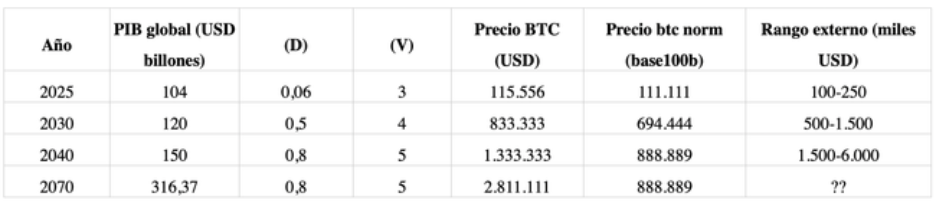
The formula used is: Pb = GDPD/SV
Where:
- Pb: BTC Price
- GDP: Global GDP
- D: Adoption, with a value between 0 (0%) and 1 (100%). It is used multiplied by GDP, as seen in the formula, so it represents the percentage of GDP that is “bitcoinized”, which is traded using BTC.
- S: Supply or circulation of BTC, which the author always sets at 18,000,000 by discounting lost and hoarded coins.
- V: Circulation speed. Indicates the number of times a unit of BTC passes from one person to another. It is generally estimated by dividing the value of GDP by the amount of currency in circulation. The author does not calculate it in this work, but rather offers hypothetical values.
Vérez Mato’s model estimates that with an adoption of 80% and a speed of 5, BTC would have a price of USD 2,811,111 per unit.
The model that we will see below is different and yields other results. Instead of estimating the price of BTC based on global GDP (which measures the production of goods and services), it does so based on hoarded wealth.
Savings medium, BTC on the treasured value
Michael Saylor, in his presentation of Bitcoin 2026 said the following: “The ultimate goal is to bring the price of Bitcoin to 10 million per coin and turn Bitcoin into a 200 billion network.” If we start from the previous model, this statement makes no sense: if the global GDP is around 100 trillion, how could Bitcoin accumulate twice that?
To understand it, we first have to know the model with which Saylor makes his predictions, although without giving its original creator the credit he deserves. This model is that of Jesse Myers (Croesus_BTC), explained in the article “Bitcoin’s Full Potential Valuation“ from 2023.
This model assumes the perspective that Bitcoin does not compete in an industry, since an industry concerns to a specific need for a good or service that companies offer and for which customers pay, whose total sum is the economy (GDP). The economy produces value (profits), but that value is stored in savings assets. The value stored in all these assets is not GDP (the value in motion) and is much larger than it.
Different assets have different maximum limits of value that they can accumulate. If we represent all savings vehicles together as a large box that stores value, and each particular asset as a smaller box within it, there is a realistic limit to the size that each of these boxes can have.
This is because the valuation of each asset category is limited by key variables. In the case of raw materials or commodities, their valuation is limited by the new supply. For example, gold increases by about 2% each year, so the value held in gold decreases by that same amount. In the case of Bitcoin, the supply is fixed and predictable.
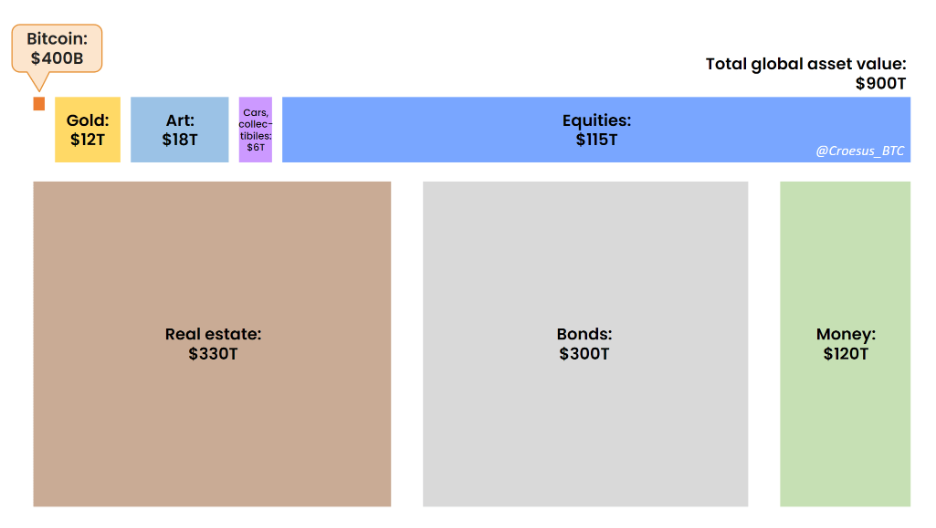
The total potential market for bitcoin is the world’s net assets of $900 trillion.
In 2023, the global bitcoin allocation was 0.05%. 400,000 million dollars, against a total of 900 billion. That is one 2000th of the value of global assets. At the time of writing this note, May 2026, the market capitalization of BTC is 1.47 trillion dollars, triple what it was in 2023, but only 0.16% of that total.
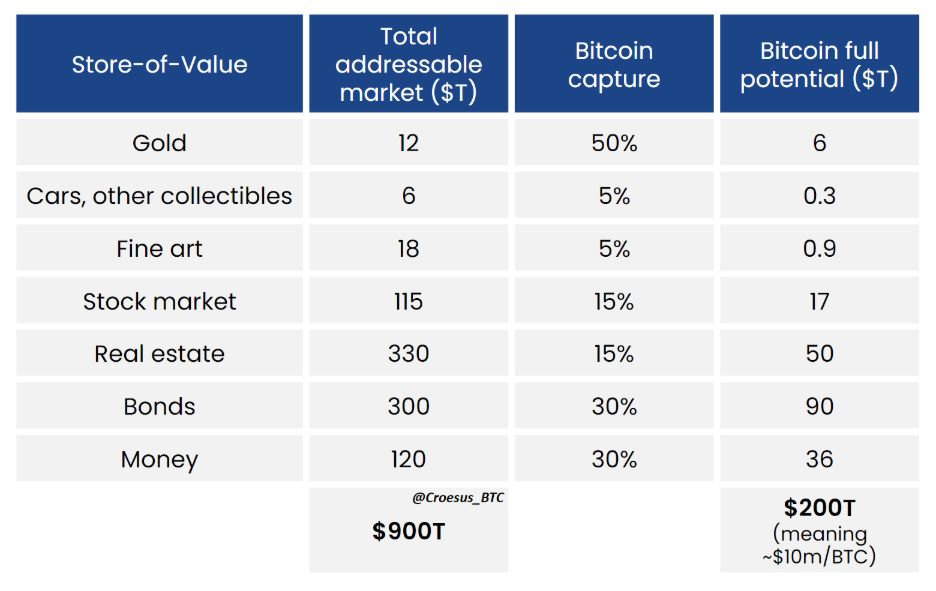
According to Myers’ most conservative estimates (taken by Saylor), Bitcoin could absorb 25% of the stored value, 225 trillion, and its unit price could reach a maximum potential of 10 million dollars.
Conclusion, contrasting the two models
Each model is based on a different idea of hyperbitcoinization. For Vérez Mato, hyperbitcoinization means a widespread use of BTC as a medium of exchange, an idea related to the original proposal of the concept made by Krawisz in 2014but that ignores its function as a means of savings. On the other hand, for Myers, hyperbitcoinization (although he does not use that term in his work) consists of a movement of value from other means of savings to BTC.
Having presented both models, I consider that Myers’s is more accurate and Vérez Mato’s is too conservative. I will explain why below.
I consider that Vérez Mato’s work falls short when considering the use of BTC as a means of savings. Not only because it makes a calculation based on GDP, a measure of production and not fixed value, but also because it assigns a marginal value to those hoarded coins. Let’s remember one of its fundamental assumptions: the circulation of BTC is 18,000,000, which means that in its model only 3,000,000 BTC are lost or hoarded.
That estimate seems misguided to me, I think the reality must be rather the opposite, based on River’s BTC distribution data, which I already cited in another of my articles.
Here we have that there are 1.57 million lost coins, 968,000 coins in Satoshi wallets, that is, 2.53 million unrecoverable. That leaves us with a very small margin for hoarding, only 462,000, of which Strategy already has 843,738 (as of 05/30/2026), close to double that amount.
On the other hand, Alfredo Roisenzvit’s estimate of the supply of bitcoin in the market, presented in his presentation “What really moves the price of Bitcoin” at LABITCONF 2025. 7.8 million in inactive addresses, 15 million in long-term holders, 3 million in short-term holders, with a downward trend, and another 3 million deposited in exchanges.
That gives you an estimate. between 2 and 4 million BTC in circulation. That is, the proportion between BTC in circulation and hoarding seems to be the inverse of what Vérez Mato proposes: 2 to 4 million in circulation and 17 to 19 million in hoarding.
If instead of calculating such a high currency we put one tenth (1.8 million, close to the Roisenzvit minimum) in Vérez Mato’s 2030 model, the result would be a price of USD 11,111,111.11 and a capitalization of USD 233,333,333,333,333, values very close to the Myers model.
Although Myers and Saylor do not give a time frame for their predictions like Vérez Mato, they consider that 25% market share as a potential ceiling on the adoption of BTC as a means of savings, indicating a possible stabilization of the price at that point.
Vérez Mato makes extremely conservative predictions until 2070 and also considers that at that point the price will stabilize. Therefore, without knowing when we have a fairly precise amount: we can expect BTC at USD 1,000,000 and up to USD 10,000,000, but after that it would be very rare to see cycles and volatility like the ones we are used to now. It will probably continue to rise, but more progressively and steadily.