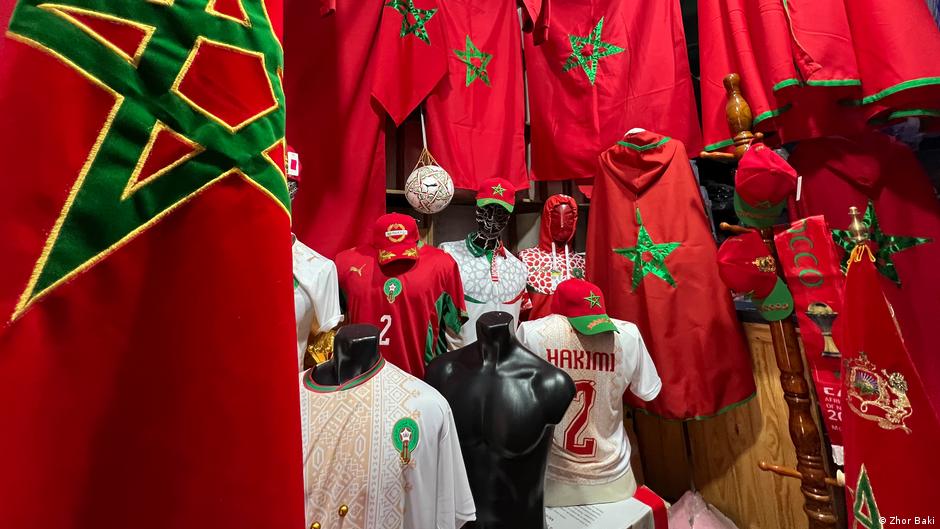
For Moroccan fans, one thing is certain: the national team’s 1-1 draw against Brazil in the opening match of the 2026 World Cup was just the beginning. He hopes that after the historic journey in the semi-finals of the 2022 World Cup, his team will once again create history. However, while attention is currently focused on this month’s tournament, Morocco is already looking towards 2030. Along with Spain and Portugal, the state would host the World Cup that year.
For Morocco, hosting the World Cup means much more than having a global sporting event in the country. The North African country made five unsuccessful bids to host the tournament before the contract was finally awarded by FIFA in December 2024.
Observers say the World Cup is considered one of King Mohammed VI’s most important prestige projects and part of a broader modernization strategy. At the heart of this strategy is the country’s successful national football team.
“The World Cup serves as a catalyst for Morocco’s economic development,” Steven Hoefner, director of the German political Konrad Adenauer Foundation’s office in Rabat, told DW. The country is going through a period of profound structural change, he said. In the face of climate change and drought, the importance of agriculture is decreasing, while industry, services and tourism are expanding.
Isabelle Wehrenfels of the Berlin-based German Institute for International and Security Affairs (SWP) also agrees that the importance of the World Cup goes beyond sports. “The World Cup has many dimensions,” he told DW. The government is using the tournament to “promote its modernization policy and legitimize major domestic investment”.
Moroccan “soft power”
Morocco is currently investing billions in stadiums, airports, rail lines and roads. A study by the Spanish think tank Real Instituto Elcano described the 2030 World Cup as an instrument of Morocco’s “soft power”. The tournament aims to improve the country’s international image, attract new investments and strengthen Morocco’s position in Africa, with the authors detailing that “the goal is to create an attractive image of an open, tolerant and emerging country capable of managing projects at the highest level.”
Another goal is international visibility, which Hoefner describes as “a central objective of Moroccan leadership”. Since Morocco has neither large oil nor gas reserves, it is increasingly relying on its political and cultural influence. Hofner, who recently wrote a study on Moroccan soccer policy, said the World Cup aims to present the kingdom as a modern economic and investment hub.
Protest by Gen Z
However, there is controversy regarding these investments. Thousands of members of the generation born around the turn of the millennium, known as Gen Z, protested against World Cup plans last year. “These protests were specifically directed against large-scale infrastructure projects,” Wehrenfels recalled. He said critics argue that money spent on stadiums and prestige projects is being diverted from other sectors such as education and healthcare.
Hoefner sees Gen Z’s opposition as being less against the World Cup and more about the question of whether stadium projects should take priority over investments in education and health care. He estimates that long-term acceptance will depend on whether the population actually benefits from the investment.
This highlights the World Cup’s connection to one of the country’s central challenges: according to a Analysis According to the American think tank Carnegie Endowment for International Peace, Morocco has indeed made significant progress over the past 25 years. Life expectancy, income and educational attainment have increased; The country has invested heavily in infrastructure and is now Africa’s largest automotive exporter. However, at the same time, the authors pointed to high youth unemployment, regional disparities, and shortcomings in the education system. “Morocco’s successes to date are undeniable, but the road ahead will be fraught with obstacles,” the study said.
sustainability concerns
These mixed feelings are also reflected in Moroccan society. “Many people complain about the rising cost of living, but are also proud of the changes they are seeing in their cities,” Werenfels said. New transport links, sports facilities and public amenities are viewed positively. Additionally, relocation and demolition for new construction projects have also had social consequences.
So the question of whether the World Cup will outweigh sustainable development or expensive prestige projects is a subject of intense debate. “When it comes to infrastructure for sport alone, there are certainly questions about its long-term use,” Hoefner said. The planned Hassan II Stadium near Casablanca, which is set to become the world’s largest football stadium, with about 115,000 seats, will have to prove it can sustain long-term use, he said.
environmental concerns
There are also environmental concerns. “Morocco is facing serious water problems,” Wehrenfels said. This raises questions about how sustainable tourism is in the long term and whether some growth may come at the expense of other economic sectors, particularly agriculture, he said.
Despite this, many are hopeful that hosting the World Cup could spur growth. Real Instituto Elcano also drew a historical parallel: just as the 1992 Olympic Games reestablished Spain on the international stage, the 2030 World Cup could be a similar turning point for Morocco.
However, whether these expectations will be met depends on more than just new stadiums and successful football matches. The real test will be whether Morocco can combine economic modernisation, social development and prestigious national projects. So the 2030 World Cup is not just a major sporting event. It is a test of the country’s future development path and the political vision of the royal family.
This article was originally published in German.