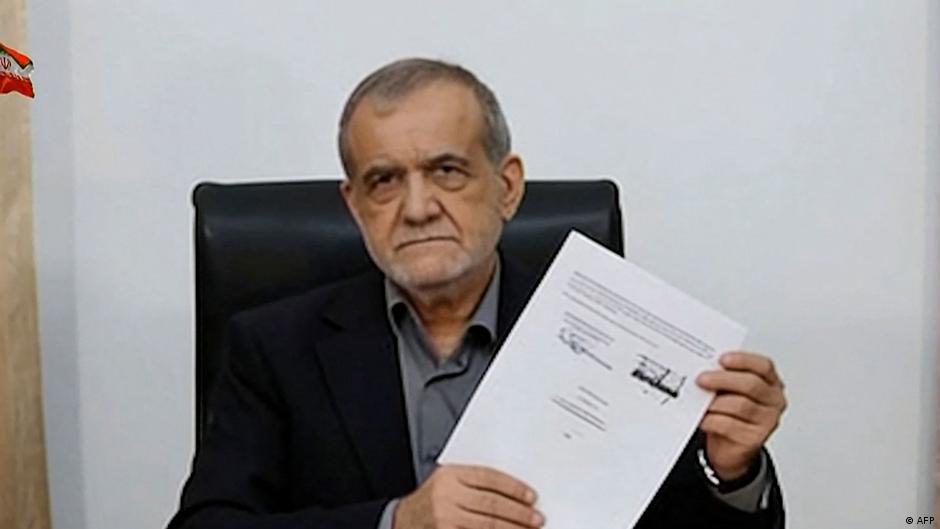
On Wednesday evening, the US and Iran signed the so-called “Islamabad Memorandum of Understanding”, extending the ceasefire and opening a 60-day phase of technical talks during which key points of contention are to be resolved.
The signing was originally scheduled to take place in Switzerland on Friday, but pressure had increased after days of speculation about the details of the agreement. Trump signed the document at the Versailles Palace outside Paris after attending the G7 summit hosted by France on Lake Geneva. Iranian President Masoud Pezeshkian signed it digitally from Tehran.
“It appears that there is political will on both sides to continue negotiations, which is encouraging,” Middle East analyst Fatemeh Aman told DW.
“At the same time, the most difficult questions have not yet been resolved. For this reason, I would rate the prospects as cautiously positive, but far from certain,” said Aman, who has worked at the Middle East Institute and the Atlantic Council think tank.
Iran’s nuclear program is a matter of controversy
Iran’s nuclear program remains one of the central points of contention between Washington and Tehran. Preventing Iran from producing nuclear weapons has been cited as one of the primary objectives of Trump’s February 28 strike on Iran along with Israel.
The text of the MOU states that the Islamic Republic of Iran affirms that it has no intention of developing or acquiring nuclear weapons. The Iranian leadership has consistently and officially maintained this position in the past.
Additionally, the agreement contains specific provisions regarding the management of stocks of highly enriched uranium. According to the agreement, both sides intend to clarify the status of stored enriched materials through mutually agreed mechanisms – specifically, near-weapons-grade uranium enriched up to 60%.
The plan calls for reducing the stockpile at the site under the supervision of the International Atomic Energy Agency (IAEA). Details are to be given in the final agreement.
“If the American side now believes that it can agree to a deal with Iran because they have promised not to make a nuclear bomb, then it fails to recognize that they have promised not to make a nuclear bomb. [the Iranian regime] “He promised this often but has repeatedly undermined every agreement,” Omid Nouripour, vice speaker of the German parliament, told DW.
Sanctions relaxation as a condition for negotiations
It remains to be seen whether an initial agreement will allow enough time to fully negotiate the long-running dispute issue, which could take longer than the initial 60-day window for negotiations.
“The central challenge is likely to be the balance between Iran’s nuclear commitments and sanctions relief,” Aman said.
“Iran will seek meaningful economic gains and assurances that those gains can be sustained. In the meantime, the United States will focus on the scope of Iran’s nuclear activities and the mechanisms necessary to verify compliance.”
Lebanon included in comprehensive ceasefire
The MoU also gives priority to the immediate and permanent cessation of hostilities on all fronts, including in Lebanon, by the signatories and their allies.
Following the outbreak of the Iran War and the assassination of Iranian Supreme Leader Ayatollah Ali Khamenei, the Lebanon-based militia Hezbollah joined the war with its supporters in Tehran, firing rockets at Israel. Israel launched airstrikes on targets in Lebanon and seized a strip of territory in the south of the country.
Israel, America’s most important ally in the region, views the deal with Iran with suspicion and is not a signatory. It is considered important to prevent hostilities between Hezbollah and Israel from derailing the talks.
Opening Hormuz is the first step
One aspect of the agreement that is scheduled to take immediate effect is the restoration of shipping traffic through the Strait of Hormuz, a key step towards stabilizing global energy prices. The process of restoring oil production and shipping to pre-war levels could take several months.
The preliminary agreement states that Iran will take immediate measures to reopen the Strait of Hormuz to global oil shipments. In return, the US would lift the blockade of Iranian ports and Iran would once again be able to sell its oil without any restrictions.
During the 60-day period, Iran has agreed to allow “safe passage of commercial vessels without charges for only 60 days”. This is to be followed by negotiations with Oman to “define the future governance” of the strait.
Before details of the agreement were made public, Vice President J.D. Vance said the US was hoping for the strait to be “toll free” for the “long term”. This raises another potential point of contention should Iran impose controls on shipping in the future.
money for iran
Additionally, the US and its allies in the region are planning to set up an investment fund of about $300 billion (€262 billion) to rebuild Iran.
The US also intends to work towards removing all US and UN sanctions imposed on Tehran. However, this will come into effect only if a final agreement on Iran’s nuclear program is reached after a 60-day negotiation phase.
Vice President Vance told Fox News on June 15 that Iran could gain access to billions of dollars of funds provided it met the obligations set out in the agreement. The fund could be financed by frozen Iranian assets as well as investments from other countries.
“The agreement states that they will not receive even one percent of American funds,” he stressed.
Shortly after the initial agreement between the two countries was announced, he stressed that it was not a “second nuclear deal” under President Obama, which drew criticism from some Middle East countries at the time. Vance also claimed that the Gulf states “love the Trump deal.”
Nouripour said, “If you make 300 billion available to the regime now, it is a stagnation – and not for the prosperity of the people in Iran, but for more aggression, for more military dictatorship.” “If you lift all sanctions now, as has now been agreed, it will delegitimize the regime. And that is not a good day.”
Important role of Gulf countries
The support of regional artists played a decisive role in passing the MoU. Apart from Pakistan, Qatar, Oman, Saudi Arabia and United Arab Emirates were also included in this.
“These countries did not support the implementation of the 2015 nuclear deal because they feared that rapprochement between Iran and the United States could come at their expense and that Washington would ignore its traditional partners in the region,” Sina Azoudi, a professor of Middle East politics at George Washington University, told DW.
Azoudy said Arab states in the Middle East support a preliminary US-Iran agreement that would end hostilities and allow the region’s energy industry to restart.
The analyst said Iranian attacks on U.S. bases and their logistics infrastructure in the region “have made it clear to Arab states that the U.S. presence does not provide absolute security and may sometimes even create additional risks.”
Iran has also demonstrated that it has the ability and will to disrupt shipping traffic and thereby interfere with oil exports, Azodi said, adding that building alternative pipelines and transportation routes would take a long time and would not be a completely satisfactory solution, as such pipelines could also be hit by Iranian missiles.
“The main question now is how the implementation of this agreement will proceed in practice,” he said.
This article was translated from German