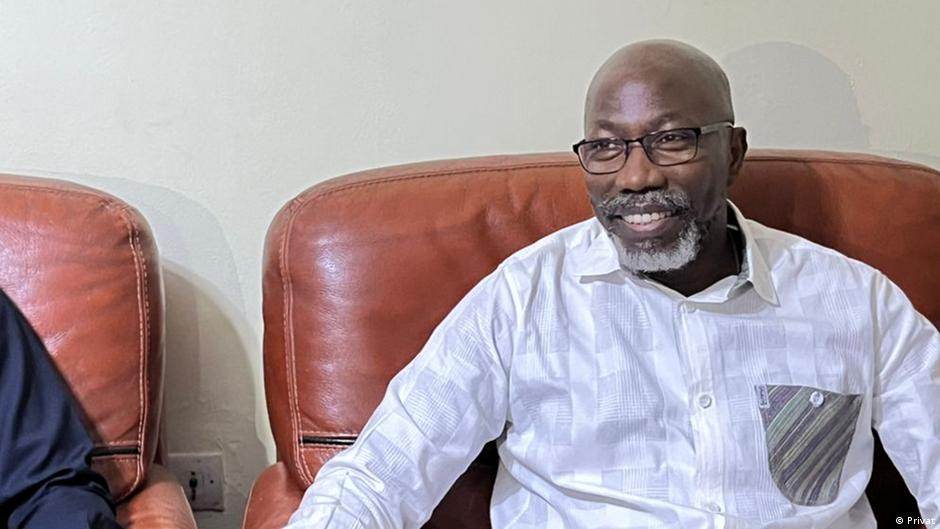
Nearly seven months after the military coup in Guinea-Bissau last year, the continued detention of opposition leader Domingos Simões Pereira, leader of the African Party for the Independence of Guinea and Cape Verde (PAIGC), has become an international issue.
A Guinea-Bissau military court earlier this month ordered Pereira to remain under house arrest following fresh questioning over allegations of plotting a coup against the military government, AFP reported, citing his lawyer.
While Portugal and other Portuguese-speaking states are demanding his release, the military leadership in the West African country’s capital, Bissau, rejects the criticism as interference in national sovereignty.
What was the reason for Perera’s arrest?
Three days after the presidential election, on November 26, 2025, Guinea-Bissau was waiting for the official announcement of the results by the National Electoral Commission, as most of the votes had already been counted.
At 12:40 pm local time, gunfire and panicked screams echoed around the Rashtrapati Bhavan and the National Election Commission building. Two hours later, a statement announcing the army’s takeover was broadcast on state broadcaster TGB.
The electoral commission said on December 2 that it could not complete the election process because armed men seized ballots and vote counts from its offices and destroyed servers storing the results, Reuters reported.
A National Transitional Council took over governance and, under international pressure, announced new presidential and legislative elections for December 6, 2026.
Among the first arrested was Domingos Simões Pereira, leader of the African Party for the Independence of Guinea and Cape Verde (PAIGC) and one of the country’s most prominent politicians.
Pereira said shortly before his arrest, “This regime knows it lacks legitimacy; it was not elected by the people.”
“Its power rests entirely on force. We refuse to accept that,” he told DW. “We demand that the political process in our country proceed in accordance with the Constitution.”
Pereira was placed under house arrest in January after being accused of involvement in at least two coup attempts in 2023 and October 2025.
Lawyer: No legal basis for detention
Pereira’s lawyer, Roberto Indeke, said his client had not been formally provided with any legal justification for his detention.
“Domingos Simões Pereira has been interrogated twice in military court since his arrest, and those hearings made it clear that he had no involvement in the preparation of the coup,” Indeke said.
He said prosecutors have not submitted any request for pre-trial detention. “Yet he has been detained, even in his own home,” he said. “Detention is detention; legally, there is no difference.”
Opposition looks at political calculations
The PAIGC views the detention of its leader as part of a broader effort to weaken the Bissau-Guinean opposition.
PAIGC spokesman Muniro Conte said, “They want to remove opposition leaders from the political arena so that they can put forward their candidate in the next elections without any resistance.” He also questioned the legality of this measure.
“Home detention is completely illegal,” he said. “Our criminal code does not even provide for this type of sanction.”
Dispute with Portugal deepened
Portuguese Foreign Minister Paulo Rangel has called for the release of the opposition leader and a return to constitutional order.
In an interview with broadcaster Antena 1, Rangel said that “although Guinea-Bissau’s sovereignty must be respected, international bodies such as the CPLP, ECOWAS and the African Union are working together to return the country to normalcy following the military takeover late last year.”
The military leadership in Bissau issued a sharp warning to Portugal and the Community of Portuguese Language Countries (CPLP).
National Transitional Council spokesman Fernando Vaz said, “Portugal’s Foreign Minister, Paulo Rangel, and all those looking backward in Lisbon must understand: we do not want to remain in the CPLP at any cost.”
“Our honor and our freedom, achieved through great sacrifice and bloodshed, are neither up for negotiation nor for sale,” Vaz told DW. “The justice system of the Republic of Guinea-Bissau is independent and will not be dictated by foreign interests or accept rules imposed from outside.
Accusations of international inaction
While Portugal has increased diplomatic pressure, opposition figures have criticized the restraint of other international actors.
“Since then, we have heard nothing more from ECOWAS. Just an icy silence, a deafening silence, I would say,” said PAIGC spokesman Conte, referring to the West Africa regional bloc’s previous demands for the release of political prisoners.
ECOWAS heads of state are expected to meet again in July to discuss the situation in Guinea-Bissau.
Free elections despite detention?
For legal expert Nex Faria, the credibility of the declared elections is now at stake.
Faria said, “The stance taken by Portuguese Foreign Minister Paulo Rangel – who called for the immediate release of Domingos Simões Pereira and announced further pressure from Portuguese-speaking countries – is right. But it comes too late.”
He argues that African members of the CPLP in particular should take a tough stance.
“It is impossible for these elections to be free, fair and credible if the leader of the country’s largest party is under house arrest and his voice is being forcefully suppressed.”
Civil society representative Luis Vicente also expressed the same view.
“The international community should not consider this solely an internal matter of Guinea-Bissau,” Vicente said. “What we are seeing is a serious violation of the rule of law. This is political hostage-taking.”
For him, the implications go far beyond that of a political leader.
He argues that the treatment of Domingos Simões Pereira will determine whether Guinea-Bissau will return to democracy or establish military rule.
Edited by: Keith Walker