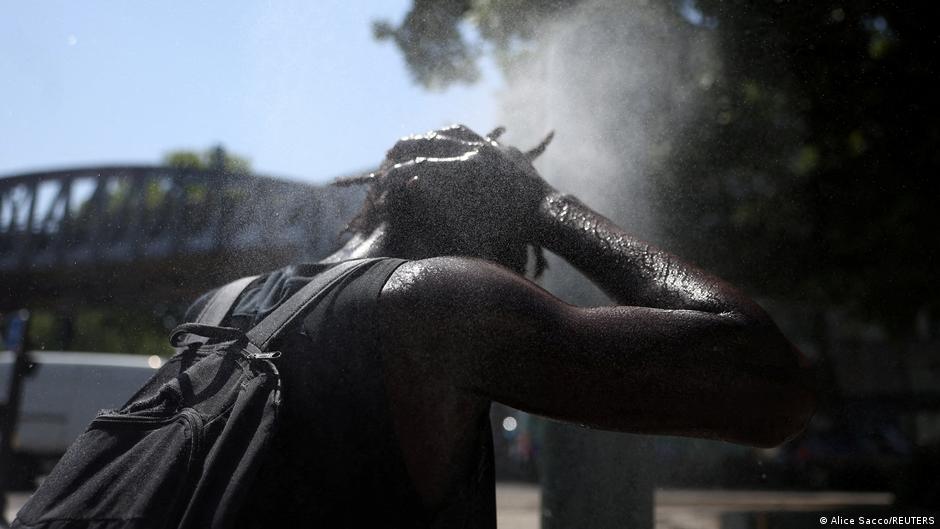
Extreme heat is not unusual in some European countries, but deadly record-breaking heat that is causing power outages, closing schools and sending people scrambling for relief is “extraordinary”. new study Has been found.
Without climate change, parts of Europe are still likely to experience a heat wave due to “normal” weather patterns on the continent. But an analysis from Climometer, a scientific platform for analyzing extreme weather, said global temperature rise linked to the burning of oil, coal and gas may have made it 2 to 4 degrees Celsius (3.6 to 7.2 degrees Fahrenheit) warmer, turning it into an “extraordinary” event.
The current heat wave follows a May that saw unprecedented temperatures for spring in Europe. “This is a clear sign of human-induced climate change,” said Marco Chericoni of the Euro-Mediterranean Center on Climate Change in Italy. “This is making European heat waves more intense and more dangerous.”
Extreme heat is often underestimated but is the deadliest form of extreme weather. Due to this, about five lakh people die every year. Experts say the figure is likely much higher because hotter conditions can exacerbate pre-existing health problems such as heart disease, but it is not recorded as a cause of death.
And as temperatures reach 40 degrees Celsius (104 Fahrenheit) in countries like France and Spain, the International Federation of Red Cross and Red Crescent Societies (IFRC) is warning of “serious health risks” in the coming days. High temperatures are especially dangerous for the elderly, children, pregnant women, people who do not have a home or who have a chronic disease.
“This highlights the human cost of human-induced climate change and the urgent need to develop fair strategies to respond to life-threatening heat events while reducing our emissions,” said Emma Holmberg, who researches the impact of extreme temperatures on health at the University of Bern, Switzerland.
The relationship between extreme heat and greenhouse gas emissions
Climate change, which is made worse by humans burning more fossil fuels, is making heat waves more likely and intense around the world.
A A 2025 study in the scientific journal Nature, Emissions from 180 carbon majors, including fossil fuel and cement producers, “substantially contributed” to the 213 historical heat waves reported between 2000 and 2023.
Since 1959, about 41 regions around the world, covering about a third of Earth’s land surface, have now also experienced heat waves that were previously considered “statistically impossible”, according to a 2023 study. Such heat waves are defined as occurring less than once in 10,000 years.
At a 2°C warming above pre-industrial levels, which describes the climate before large-scale fossil fuel use, the historical maximum temperature of 51°C would be 50 times higher than a 1°C warming. The world is on track to see a temperature increase of about 2.8 degrees Celsius due to current climate policies.
Those heat waves and associated droughts will increase water scarcity and make it harder to produce food. This will also increase the number of heat-related deaths. Heat can cause miscarriage, hot nights can impair sleep and damage the immune and cardiovascular systems, and chronic heat stress is dangerous for outdoor laborers.
One Study published in Nature found that more than a third of heat-related deaths globally could be attributed to climate change in 2021, while another 2025 study in the journal Projections projected a large increase in heat-related deaths for every degree of global warming, with Europe suffering the most.
“If such temperatures become the norm in the coming decades, major impacts will be inevitable,” David Faranda, a climate physicist and Climameter coordinator, said in a statement. “The good news is that we still have agency: Rapid cuts in greenhouse gas emissions can prevent today’s extremes from becoming tomorrow’s average heat.”
How can the world’s fastest warming continent fight extreme temperatures?
Rapid expansion of renewable energy such as solar power, as well as battery storage, improvements to the electricity grid and ecosystem restoration will help cut carbon emissions.
But countries and their residents will also have to adapt to a warmer world – and quickly. Europe is the fastest-warming continent, with Climometer saying “extreme heat events are already increasing faster than predicted”. The future “increase in hot events in the Mediterranean Sea could be twice as high as forecasts,” the group said.
Homes, especially in Northern Europe, were built for a different, colder climate, and air conditioning is uncommon. Sales of fans and AC units are currently skyrocketing in many countries as people seek shelter from the heat.
Some experts say AC will be needed to save lives, but critics say those running on fossil-based energy generate more emissions that continue to warm the planet. Traditional AC units also push heat out, increasing street temperatures. Some heat pumps can also be reversed to provide cooling.
Cities filled with concrete, glass, cars, impermeable surfaces and limited green spaces are particularly badly affected in the heat. They can be 10 to 15 degrees Celsius warmer than surrounding rural areas. This is known as the urban heat island effect.
Unsealing footpaths, planting more trees and increasing green space can all help reduce temperatures, while access to supervised swimming areas can help people cool off. Better building designs that increase shade, use surfaces that reflect heat, and better use of ventilation can also help.
Meanwhile, several European cities, such as Stuttgart, Germany, have developed heat action plans, which include practical suggestions for dealing with extreme heat, spaces for residents to cool down and outlines for heatproofing health systems and hospitals.
Edited by: Tamsin Walker