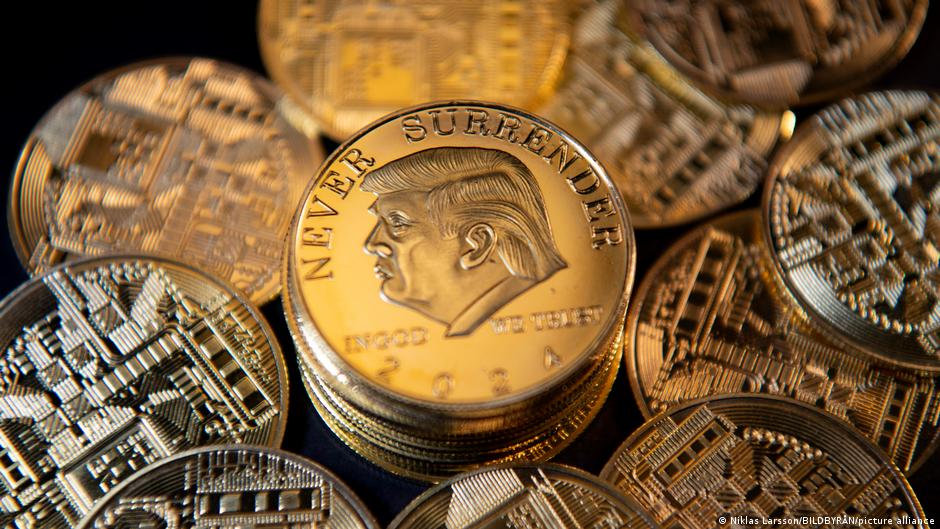
More recently in 2021, he described cryptocurrencies as “a disaster waiting to happen” and a “scam.” But the digital, decentralized currency could make Donald Trump more than $1 billion (€878 million) in 2025 alone, according to annual financial disclosures released on Tuesday.
Most of the profits came from the sale of new crypto products ($500 million) and so-called “meme coins” ($600 million) from their World Liberty Financial business.
This comes at a time when the US President’s policies on crypto have become increasingly favorable, cutting regulation and introducing federal rules for stablecoins.
Trump is not alone in supporting crypto as the future of finance. In the United Kingdom, populist leader Nigel Farage is facing public criticism over a personal “gift” of £5 million ($6.6 million/€5.8 million) from Thailand-based British crypto billionaire Christopher Harborne, threatening the unstoppable rise of his Reform UK party. Reform also has a pro-crypto stance, with Farage promising to “bring crypto out of the cold” if he wins power.
Elsewhere in Europe, Pavel Blažek resigned from his post as justice minister in Czechia last year after accepting 468 bitcoins worth $45 million from convicted criminal Tomas Jirikovsky, while Spanish right-wing MEP Luis “Alviz” Pérez Fernández has also been accused of taking crypto financing from a convicted fraudster.
In Argentina, Trump-friendly President Javier Milli has come under fire from financial authorities and the public over his promotion of bullish and bearish crypto scheme $LIBRA, which soared after he made a social media post about it, and soon collapsed. He has denied wrongdoing and said he made the post in good faith.
How big is the impact of crypto on politics?
Although there is no simple global answer, cryptocurrencies are becoming an essential part of global economies. As a result, governments are struggling with how to regulate them.
“Crypto is becoming increasingly important in politics — not just as a form of political giving, but shaping regulation, a source of personal and campaign-related funding, and as a financial technology that can increasingly move value across borders,” Eliza Lockhart, a senior research fellow at the Center for Finance and Security at the RUSI think tank in the UK, told DW.
“Its political influence is growing as crypto businesses become more integrated into mainstream finance and governments make increasingly consequential decisions about how the sector should be regulated.”
Edoardo Beretta, an assistant macroeconomics professor at the Swiss university USI, agreed, adding that the recent recession — which followed Trump’s financial filing period — has had a generally chilling effect.
“The price of Bitcoin has more than halved since its peak on October 6, 2026 ($126,198) and the crypto market capitalization is behaving similarly, with currently less political but also economic hype around cryptocurrencies. However, this does not mean that economic actors have lost their interest in the crypto market: the environment around them has simply become a little quieter,” he told DW.
Do cryptocurrencies make it easier for foreign political interference?
Tracking campaign donations etc. is a much trickier task than traditional transactions due to the anonymity and speed of digital wallets across borders. This, in turn, makes tipping the electoral scales an easier task for those willing to do so, Lockhart said.
“Blockchain records transactions, but it does not reveal the real-world identity of the person controlling the wallet or the original source of the funds,” he said.
“Money can also be moved through multiple wallets, exchanges and jurisdictions before reaching politics. Therefore, the major foreign interference risk is often upstream of a donation received by a political party. Attribution needs to be done on a case-by-case basis, but crypto creates vulnerabilities that hostile states and other malign actors could exploit.”
A 2025 report from Chainalysis, which tracks and analyzes blockchain activity, found that the use of cryptocurrencies by European extremist groups is on par with those in the United States. “Between 2022 and 2024, Europe’s share increased dramatically, to almost 50% of total flows,” the report said. This is partly because crypto companies lack policies that prevent extremist groups from using more traditional offerings.
These types of issues prompted the UK to impose a temporary ban on political donations made through cryptocurrencies earlier this year, putting it in line with some US states as well as countries like Brazil and Ireland.
Is crypto more important on the right or left side of politics?
It’s difficult to be completely accurate, but at least in the US, Trump’s presidency has seen an increase in cryptocurrency use by Republicans compared to Democrats, according to a Pew Research Center survey. It found that 22% of Republicans had invested in, traded or used cryptocurrencies, as opposed to 17% of Democrats.
While Lockhart said that “crypto should not be portrayed as inherently or exclusively right-wing,” and its political alignment varies across countries, he said, it is also the case that the crypto industry’s coalitions are often built on the right wing.
“This reflects its preference for financial deregulation and decentralization, which has resulted in the crypto industry receiving strategic support from politicians that provides a more favorable regulatory environment,” he said.
Should crypto investing and ownership be kept away from politics?
Large sums of money given to politicians from crypto companies, whether directly or in the form of campaign financing, raise conflict of interest concerns for many observers.
In Trump’s case, the White House has said that his business interests are managed by his sons while he is in office. “Neither the President nor his family have ever been involved in — or will ever be involved in — a conflict of interest,” spokeswoman Anna Kelly said Tuesday.
However, in Lockhart’s view, in the broadest sense, crypto should be treated the same as any other business interest.
He said, “The key issue is whether a public office-holder should be allowed to have a substantial financial or commercial interest in a business whose profitability or asset values may be directly affected by government decisions.” “Where this is the case, disclosure alone cannot adequately manage perceived or actual conflicts of interest.”
This is a matter for each country to decide, says Beretta. “If the law allows politicians to earn income in addition to the income they receive from their political activity, nothing can be done without changing the law.”
Edited by: Andreas Illmer