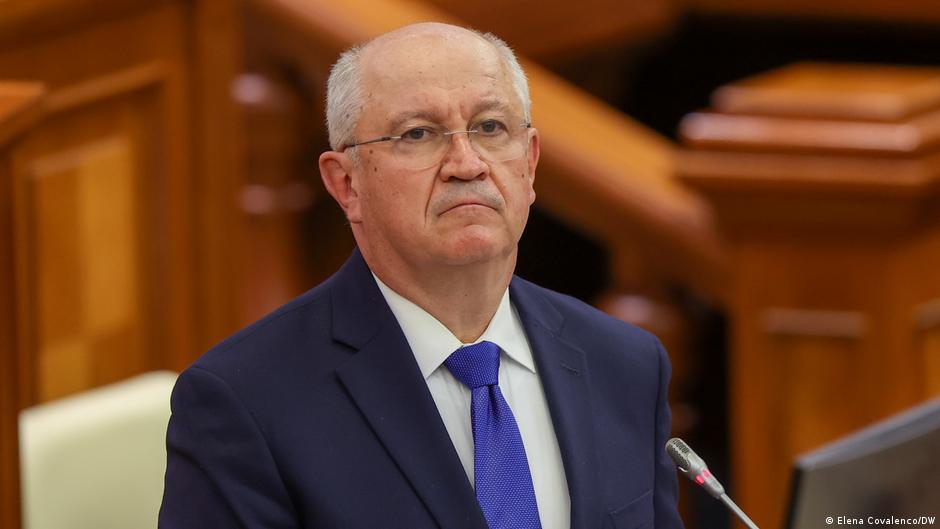
Moldova’s prime minister announced his resignation on Friday in a surprise move that also brought down his cabinet.
Alexandru Munteanu, who was appointed by President Maia Sandu following the victory of her pro-European Party of Action and Solidarity (PAS) in parliamentary elections in November 2025, gave no full explanation for her decision.
“Today I am ending my tenure as prime minister,” the 62-year-old said in a statement published on social media.
“I accepted the offer to become Prime Minister with great responsibility and a strong belief that I could contribute to changing things for the better. [But] “The moment I feel that I can no longer exercise my mandate in accordance with my principles and beliefs, I decide to walk away.”
Moldova: Why did the Prime Minister resign?
President Sandu accepted Munteanu’s resignation and thanked him for his leadership through a “complex period” for the country, but said he expected “more involvement in complex decisions, more openness to listening to the people”.
He denied that Munteanu was restricted in his work, telling reporters: “Speculation that he wanted to combat abuses but was not allowed to do so is wrong. The Prime Minister had free rein to run the government as he wished.”
Sandu said a new prime minister could be appointed “quite quickly” and that Munteanu would remain in interim charge while she consulted with parliamentary factions before appointing a candidate.
“We must have a united, strong team in government that will serve the purpose of our country,” he said. “We are obliged to succeed in taking Moldova into the EU and helping the country.”
Moldova: Who is former PM Munteanu?
A political independent and novice who, like the majority of his cabinet, was not a member of President Sandu’s PAS.
Munteanu first pursued a career as an economist outside Moldova, working at Crédit Lyonnais in Paris, France, and the World Bank in Washington, DC.
He lived and worked in Ukraine for 20 years before moving to Bucharest, Romania in the wake of the full-scale Russian invasion in February 2022.
Co-founder of the Moldovan branch of the Alliance Française in Chisinau, Munteanu was considered a pro-Western figure and a supporter of EU membership for Moldova, which he aimed to achieve by 2028.
Before his appointment in November he said, “We have a unique opportunity to be the government that takes Moldova into the European Union.”
He has also declared a desire to end the political conflict with Transnistria and to reintegrate the pro-Russian, separatist region along the Ukrainian border into Moldova, ambitions that will now fall to his successor.
He said, “No matter where I live or what responsibilities I have, whether it is in the public sector or the private sector, I will continue to serve my country, no matter what position I hold.”
“I believe that duty towards the country is not about any position, but about our commitment.”
Sandwiched between Ukraine to the east and EU and NATO member Romania to the west, Moldova was a Soviet republic until it declared independence in 1991.
In recent years, it has taken a clear path toward the West, turning the country into a geopolitical battlefield between Russia and Europe.
Edited by: Carl Sexton
Don’t let algorithms hide news. If you rely on our team for reliable reporting, please take a moment Choose us as your preferred source on Google by clicking here And press the “Star” or “Favorite” button, so you always see our verified news first.