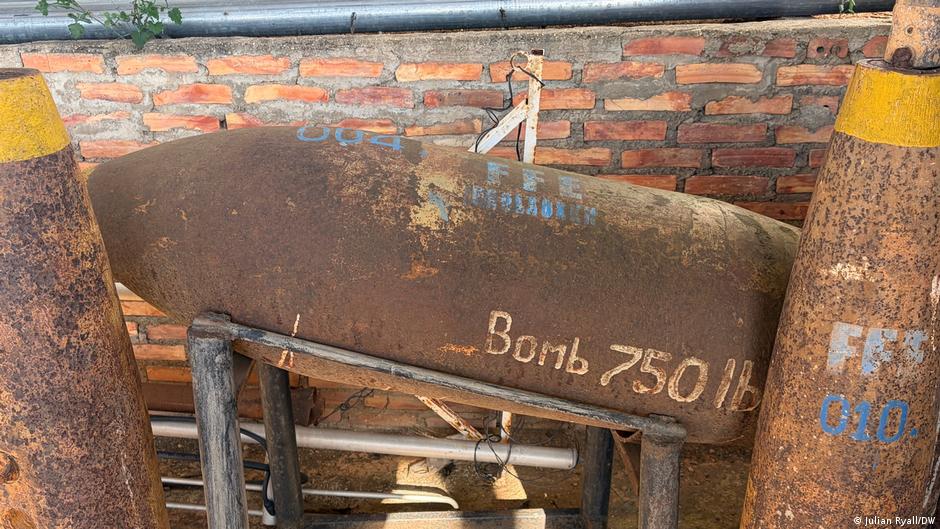
Thong Phet was an 18-year-old novice monk when the swing of a knife changed his life forever. The blade fell on an unexploded weapon that went unnoticed, causing the device to detonate.
“A friend took me to the hospital. I was conscious the whole time. They had to amputate my left arm below the elbow and my right arm was also badly injured,” he told DW.
The year 1973 was extremely dangerous in Jiangkhouang province, Fatt said, because the war was still going on in Vietnam, about 100 kilometers (60 miles) to the east.
Although Laos was not officially involved in that conflict, North Vietnam established the “Ho Chi Minh Trail” through eastern Laos to transport weapons, supplies, and troops to South Vietnam.
This – combined with the fact that Xiongkhouang province was a stronghold of the communist Pathet Lao movement – made it a target for American bombs.
Over 2 million tons of explosive ordnance were dropped on Laos from 1964 to 1973, making it the most heavily bombed country per capita in the world. Weapons ranged from incendiary shells to rockets and 2,000-pound (907 kg) bombs, but the device that caused the most fear among locals – and still does – was the cluster bomb.
cluster bomb threat
Designed to shatter into pieces in the air, cluster bombs delivered up to 600 bombs, each smaller than a fist, to contaminate an area of several football fields. It is estimated that 270 million of these submunitions – known locally as “bombs” – were dropped on Laos, but 30% failed to explode. Many lie where they fell half a century ago and remain a danger to the local people.
“I remember the bombs being dropped very clearly,” Fett said. “I remember when I was a boy I used to watch the planes coming with my parents and hide in the caves near here.”
Now, Fett hopes the Unexploded Ordnance (UXO) team can finally confirm that one of his pastures is safe.
Rolling fields are marked with pieces of red tape that wave in the wind. UXO Two women in Laotian attire carry a large-loop detector over ordinary grass, but stop when a signal is detected. They leave a marker and continue on their track.
Behind them, another team member walks in with a smaller metal detector and locates the target with greater precision. Very carefully, she digs around the site until the source of the signal is identified.
Sometimes it may be a piece of metal; On other occasions; It is the remains of a weapon that exploded long ago and is safe. But often it turns out to be a bomb.
destroy a threat
Each target is carefully surrounded with sandbags, a small explosive charge and warning signs containing a skull and crossbones motif. And, at the end of each working day, an alarm is broadcast over loudspeakers in the valley warning locals of what is about to happen.
A loud crack and three plumes of smoke rising simultaneously in the air from the day’s searches.
In the span of a week, a seven-member demining team has secured 19 bombs and five large-calibre bullets recovered from the 10,594-square-metre (114,032 sq ft) farmland.
However, the area that still needs to be cleared is huge. The village is spread over 23,000 hectares (about 56,834 acres) of land; previous search efforts had found five large bombs and more than 6,000 individual bombs.
There is a clear need to continue efforts, as the village has lost five people to unexploded ordnance. There are also risks for mining teams, two UXO Lao experts were killed in an explosion in 2002.
However, as soon as the FATE area is declared clear, the team will advance to the next polygon marked with red tape.
‘Hindering development’
“UXOs are a huge obstacle to development in Laos because they make everything more expensive and slower because the land has to be surveyed and cleared to make sure there is no risk,” Martine Theurer, the United Nations Development Program’s resident representative in Laos, told DW.
Speaking at his office in Vientiane, Therer said Laos is one of the few countries in the world to have adopted the 18th Sustainable Development Goal, “Life Safe from Unexploded Ordnance,” which focuses on achieving measurable targets so that UXO no longer hinders human development and poverty reduction efforts in rural provinces.
“If you look at the poverty map, it’s clear that these areas are mostly based on areas with high levels of UXO contamination,” Theurer said. “It is clear that the number of victims has reduced, but there is still fear in these communities.
“In a country where more than 70% of the rural population depends on agriculture and natural resources for their livelihood, farmers regularly risk their lives while plowing fields, digging or clearing bushes,” he said.
“UXO has a direct impact on income generation and poverty-reduction efforts,” Theurer said, “because contaminated land could otherwise be used productively for agriculture, industry and tourism development and infrastructure construction.”
In the 1980s, casualties from UXO numbered in the thousands each year.
Demolition efforts and extensive education campaigns in rural communities have dramatically reduced that figure. For example, in 2015, there were 44 incidents involving UXO across Laos, resulting in nine deaths. Five years later, this had dropped to 33 incidents and seven deaths and, in 2025, 25 eruptions resulted in six deaths.
These numbers are small compared to deaths from other causes, for example, there are more than 900 deaths per year on the roads of Laos, but the government says it is committed to leading global efforts to eliminate the threat posed by unexploded weapons to civilian populations.
Laos will host the four-day third review conference of the Convention on Cluster Munitions in September. Initially adopted in May 2008, the convention has been ratified by 112 countries. The agreement obliges signatory states to never use, develop, produce, or stockpile cluster weapons, but, importantly, the signatories do not include the United States, Russia, or China.
“Laos has been a champion of the conference since the beginning and I see this meeting as an opportunity for Laos to show what can be achieved,” Theurer said. “It may seem small compared to the magnitude of the problem, but they have already done a lot over the last 30 years, and this is an opportunity to showcase the whole trajectory – but also to show what remains to be done.”
educating villagers
A key element of the campaign has always been education, villagers from Ban Nepia recently gathered at the local school for a presentation of UXO Lao.
Thong Kham, team leader of Explosive Ordnance Risk Education, said adults in the village have lived their entire lives under the shadow of weapons.
And, although it never hurts to reinforce key messages, the primary target of the presentation is young and curious children who play in the surrounding fields and forests.
“A lot of ordnance was dropped around the village between 1964 and 1973, but we estimate that up to 30% did not explode,” he said. “Those weapons are still affecting these communities. The people here depend on farming, and having UXO on their land impacts local development and their way of life.”
One of Kham’s instructors is using an indicator to show the children what types of bombs, rockets and bullets they may encounter and what they should and should not do.
Never touch any suspicious device, he said, and report suspicious devices to adults immediately. Never try to open a weapon, and carefully use a spade rather than a spade when digging a hole. And never light a fire on the ground in an area that is not fireproofed for UXO, as its heat could detonate the weapon.
Children watch carefully and sing along to its rules. Kham’s team can only hope that they have taken the lesson to heart.
Edited by: Srinivas Majumdaru