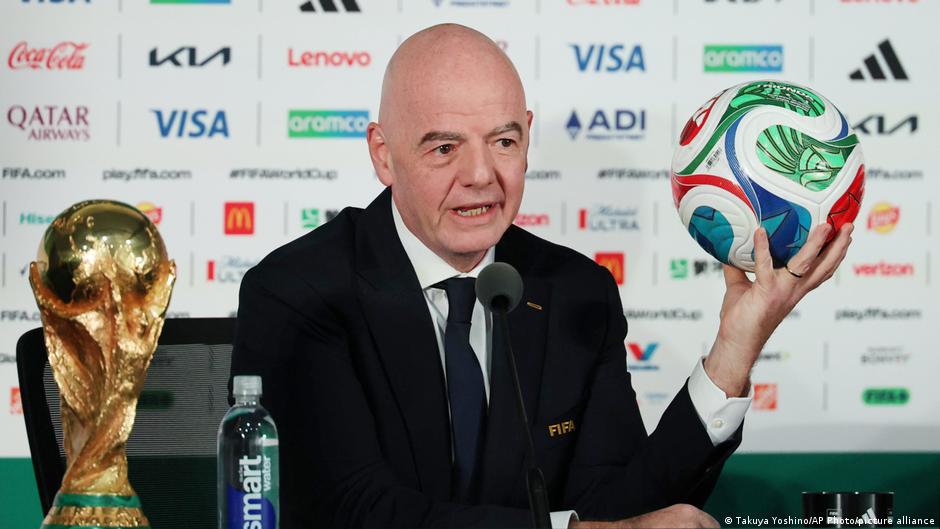
“I’m the one who pushed them to do that,” Donald Trump said Monday, referring to FIFA’s highly controversial decision to suspend USA striker Folarin Balogun’s red card ban before the World Cup’s loss to Belgium in the last 16.
The US President then claimed that he had called for a review of the incident, to which FIFA and its president Gianni Infantino insisted that their disciplinary committee had ruled on it. The committee has not ruled on any other decisions at the World Cup. Both the review of red cards and any form of political interference at the World Cup are prohibited by FIFA’s own statutes.
Skyrocketing ticket prices, the denial of visas to fans, officials, players’ families and even a referee have all contributed to a tournament that has been more difficult for FIFA and Trump than ever before. All of these issues have contributed to increasing the unpopularity of an organization that was already disliked by fans, if not necessarily by federations as well.
Infantino, Trump’s relationship has destroyed FIFA’s trust
Several factors have contributed to the growing frustration with FIFA.
The decision to award FIFA’s inaugural Peace Prize to US President Trump last December, shortly before Trump started a war with tournament participant Iran, was reportedly a unilateral move by FIFA President Infantino and has undermined trust both within and outside the organization.
FIFA adopts a rotation policy for hosting the World Cup – this means that each confederation must take turns hosting a tournament, except for Oceania, which has lacked facilities since Australia began playing in the Asian competition. But with the 2030 World Cup matches being held in Europe, Africa and South America, it paved the way for Saudi Arabia to host the 2034 tournament without any challenge and much earlier than in Asia, in 2042.
with Infantino is willing to exceed the normal term limit for the presidency of 12 yearsLikely to be unopposed again, according to many observers, frustration with FIFA is at an all-time high. But can anything be done?
How does FIFA maintain its power?
FIFA is responsible for the global development of the game but also acts as its commercial operator, a system that has been questioned by many governance experts.
The World Cup is its major financial driver, although the recently revised and expanded Club World Cup is now a more significant contributor. That competition led to widespread complaints from players and players’ associations about an overcrowded calendar that makes unreasonable demands.
Bayern Munich and England striker Harry Kane said last year, “If I’m completely honest I don’t think the players are listened to that much.”
Structurally, each of the 211 member states (which sit in six continental unions) gets one vote for president every four years. These member associations are then rewarded financially, to a greater or lesser extent, through various schemes and programmes.
“The commercial dimension is the basis of FIFA’s system of power. Money is used by presidents to accumulate and consolidate their power,” Miguel Maduro, former chairman of FIFA’s Governance, Audit and Compliance Committee, told DW. He was dismissed from office in 2017 after attempting to enforce political neutrality rules regarding Russia.
“This is what supports the system of patronage through which presidents reward those loyal to them and punish anyone who dares to criticize anything. This explains why sitting presidents are never challenged and remain in power indefinitely.”
Can politics and the EU force FIFA into change?
Like Maduro, Nick McGeehan of human rights NGO Fairsquare agrees that any reforms at FIFA must be implemented. And with individual member states not motivated or able to bring about change, he is calling on the EU to start the fight.
“This requires political intervention. There is no other way to fix FIFA,” he told DW.
“I think the most obvious example would be the EU, which could regulate and govern sports in the same way they regulate other things like Big Tech.”
FairSquare has filed a complaint with the Investigative Chamber to the FIFA Ethics Committee over Infantino’s dealings with Trump, while, separately, fan group Football Supporters Europe (FSE) and advocacy group Euroconsumers filed a complaint with the European Commission about ticket prices shortly before the World Cup.
A Commission spokesperson would not agree on whether the EU could take on FIFA, telling DW only that the FSE and Euroconsumers’ complaint was being handled “in line with our standard procedures.”
Asked whether they could intervene in various questionable World Cup ticketing practices, the spokesperson confirmed that EU laws “do not regulate the price levels of goods and services such as event tickets.” But it also said: “Merchants must adequately inform consumers about the total price of their offers and avoid deceptive commercial practices, such as making attractive introductory price claims for tickets that are not available or making pressure-selling techniques while consumers wait in a virtual queue.”
Although there has been little definite political action on the ground so far, McGeehan remains hopeful.
“There will be a politician somewhere who recognizes the political value of taking people along and actually trying to hold them accountable. And I find that quite an exciting prospect, because I think it’s inevitable right now.”
Could UEFA and FIFA tensions force a separation?
Although it operates under the umbrella of FIFA, tensions have been rising between FIFA and the powerful European confederation, UEFA. These came to a head in the Balogun incident, when UEFA issued a statement saying that FIFA had “crossed the red line” and expressed “disbelief at such an unprecedented, incomprehensible and unfair decision”.
Earlier in the tournament, he was criticized by UEFA for appointing Somali referee Omar Artan for the Super Cup final, days after he was refused entry to the United States to officiate at the World Cup.
“Football is designed to connect people,” said UEFA president Aleksandar Ceferin.
Last year, UEFA delegates walked out of the FIFA Congress, accusing Infantino of prioritizing “personal political interests” after arriving late from a diplomatic tour to the Middle East with Trump.
“There is tension between UEFA and FIFA, and UEFA is a huge confederation and has influence over some of the biggest and most historic countries in football. So if there was any kind of separation within football it would have to come from UEFA or multiple UEFA countries coming together,” Geoff Walters, a sports business professor at the University of Liverpool in Britain, told DW.
“But in football-politics terms it’s hard to keep your head above that roof because you get shot at. If you say something, what does it mean? Will it harm your chances of hosting competitions, which could be beneficial? Does it mean you’re ostracized from the international community?”
Germany is an example of this. After members of the national team covered their mouths as a political gesture before their first match in Qatar in 2022, the team and federation have stepped back in support of political causes, possibly with an eye on a bid to host the World Cup in 2034 or 2038.
However, in line with other federation chiefs, German FA (DFB) president Bernd Neuendorf spoke out on the Balogun incident.
He said, “The perception that there has been active political interference in sports must be swiftly and decisively addressed. The integrity of the competition and FIFA’s credibility are at stake.”
UEFA itself had to deal with the threat of an elite-club-run breakaway Super League in 2021 and the legal issues that would follow. Maduro said the organization “suffers from the same governance flaws as FIFA, albeit in a less obvious and radical way.”
What’s in it for the rest of the world to secede from FIFA?
UEFA’s position with the rest of the world federations has also been weakened by Ceferin’s recent comments that an expanded World Cup makes too many matches “completely uninteresting”. The alliance of 13 football associations in Africa and Asia said they “strongly reject” the reported comments. Journal24, for online newspaper In Ceferin’s native Slovenia.
The prestige and power of Europe and South America, especially Brazil and Argentina, are also not as strong as it might seem compared to Infantino’s power base in Asia and Africa. Walters said this is another reason why the possibility of separation seems remote.
“If it had been led by the leading countries, what would have happened to smaller countries around the world? What would have happened to their ability to develop football in their countries?”
He said, “That’s part of the challenge with the global game that we’re seeing, not just in the context of the World Cup, but in the context of many sports leagues, where you’re seeing the big teams pushing and trying to break away. They want to retain the largest share of commercial income and revenue coming into that game.”
Is FIFA reaching areas others cannot?
While many others have questioned those business motivations, Infantino has insisted that they are for the greater good.
“Every dollar we make goes back into football,” he told reporters on the eve of the tournament on June 10.
“If we were selling our TV rights to pay-TV like everyone else, we would generate four times as much revenue. And we could give away all the tickets, but they would still go to the black market.
“As FIFA president we have to strike a balance. We invest in countries where no one else does – South Sudan, Bhutan. No one else is doing it.”
For now, this much is true. In football terms, no one else has the leeway or the money. And, given how deeply FIFA is entrenched in the game, it seems highly unlikely it will break away.
Although discontent has rarely been high, unless a federation, coalition of countries, or prominent individual takes hold of the matter, the chances for reform seem slimmer than before.
Edited by: Chuck Penfold
This article was first published on July 2 and was updated on July 7 to reflect World Cup developments.