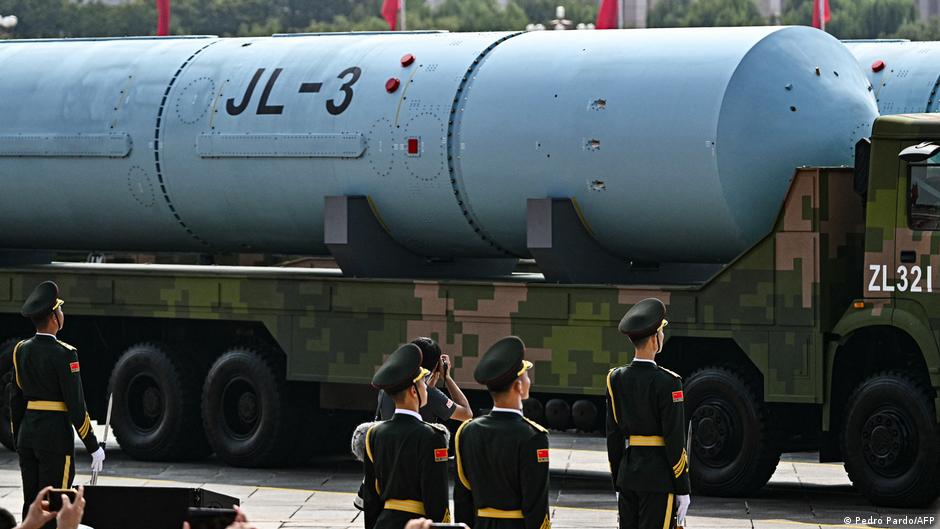
On Monday, the Chinese navy conducted a missile test in the South Pacific, state media reported. A nuclear submarine fired a missile carrying a dummy warhead into international waters.
The test immediately drew strong criticism from US allies in the Pacific. Australian Foreign Minister Penny Wong said the Chinese test was destabilizing for regional security. Japan called on China to reconsider its actions.
New Zealand said it did not want China to use the South Pacific as a testing ground for missiles. “We are extremely concerned about China’s tests of nuclear-capable weapons in the South Pacific,” Foreign Minister Winston Peters said in Wellington.
During the Cold War, the United States tested several nuclear weapons around the Bikini Atoll in the South Pacific, today part of the Marshall Islands. Since World War II, the US has dominated the post-war security architecture in the Pacific.
What do we know about China’s missile testing?
China’s military buildup is now challenging this construction. Although official media have not released any details about the test, nationalist military experts have been speculating on Chinese social media about how powerful the tested missile may have been.
“It is a submarine-launched intercontinental ballistic missile of the Julong (JL)-3 series,” wrote Lieutenant Colonel Zhang Junshe, a researcher at the People’s Liberation Army (PLA) Naval Military Academic Research Institute.
Julang-3, which means “Giant Wave-3” in English, is still under development.
It is said to have a maximum range of 12,000 kilometers (7,400 mi) and can carry multiple nuclear warheads. Three successful trials have been reported so far between 2018 and 2019.
“The target of this missile is not front-line combat troops, but strategic targets such as command centers, military bases or energy infrastructure,” Zhang wrote in his blog.
“Giant Wave-3” is believed to have been launched from a Type 094 Jin-class nuclear-powered submarine. With a full crew of 120 sailors, the 135-metre-long submarine can support a submerged crew for at least 70 days. Currently, the Chinese Navy has six Type 094 submarines in service.
Zhang said it could not be ruled out that a modified submarine was involved.
According to the Nuclear Threat Initiative, a Washington-based think tank, China operates an additional 59 nuclear-powered attack submarines in addition to the Jin-class submarines.
China builds nuclear deterrent
He said the weapon is intended to serve as a comprehensive deterrent.
“Even if all other military weapons are put out of action, Chinese submarines will still be fully capable of carrying out a nuclear counterattack,” Zhang wrote.
In early September 2024, China launched an intercontinental missile carrying a dummy warhead from the mainland toward the South Pacific.
The missile reportedly fell in a pre-selected area in French Polynesia. At the time, it was China’s first test of a long-range missile over international waters in more than 40 years.
As in 2024, Beijing claimed this week that all neighboring countries were informed in advance and that the exercise was not against any specific country or target.
But China wants to bring change in the Pacific region. The strong military presence of the US and its allies on China’s doorstep is a cause for concern for Beijing.
The Chinese Communist Party (CCP) wants to ensure that it is able to retaliate against military first strikes and respond with what Beijing considers appropriate retaliatory strikes. At the same time, China, a nuclear power, has promised not to launch a nuclear attack first.
“China is currently aggressively challenging the US-led regional security architecture at various levels,” Felix Heiduk, head of the Asia Research Group at the Berlin-based think tank Stiftung Wissenschaft und Politik (SWP), wrote in 2024.
At the time, German forces were participating in an exercise led by US forces in the Pacific. For five weeks in July and August 2024, 29 countries with 40 warships conducted exercises around the US military base at Pearl Harbor.
growing anxiety
Heiduk wrote in 2024 that Beijing aims to achieve its strategic goal by promoting an alternative regional order led by China ‘by Asians and for Asians’, while terming the US-led order as a ‘relic of the Cold War’.
This strategy includes the revival of the People’s Liberation Army (PLA), expansion of bilateral security partnerships, and militarization of large parts of the South China Sea.
Security concerns are also growing in the South Pacific.
“The PLA’s missile force is China’s most effective means of launching long-range attacks against Australia,” write Sam Roggeveen and David Vallance of the Lowy Institute, an Australian think tank, in a June 2026 study. “In the event of a major regional conflict, bases throughout northern Australia would be targets of the PLA.”
As recently as last month, Australian researchers found no conclusive evidence in publicly available sources that a Chinese missile could reach the Australian mainland if launched from the Chinese mainland.
Australia’s metropolitan areas are located on the east coast. The situation has certainly changed after a missile test launched from a submarine in the South Pacific on Monday.
Speaking on the sidelines of the summit in the Turkish capital Ankara, Secretary General Mark Rutte said the test launch was also a message to NATO.
“This is further proof that we shouldn’t be naive… and we’re not,” Root said.
This article was originally published in German.