D’Jirwa Leti expresses the frustration of her situation in just a few words: “There is no water. In the entire camp, there is only one tap. Another challenge is the lack of toilets. Children defecate everywhere. Because of the disease that has come, we are being asked to wash our hands, but there are no hygiene kits. And when we go into the town to sell our products, people drive us away, saying that we are bringing diseases.”
Leti lives with 20,000 other internally displaced people (IDPs) in Kigonze camp on the outskirts of Bunia in eastern Democratic Republic of the Congo (DRC). They fled violence from multiple rebel groups that have destabilized the region for decades. But now they face a new threat: Camp officials told DW that the Ebola virus was detected for the first time in people who died in June. “Since Ebola arrived, we have been recording six deaths a day,” said Etienne Ndrutsi, head of the camp.
How conflicts accelerate the spread of disease
According to experts, the rare Bundibugyo strain of the virus has been spreading in the region since at least April. Shortly after the outbreak was identified in May, the World Health Organization (WHO) declared a public health emergency. As of mid-July, the DRC had recorded 1,963 confirmed infections and 719 deaths, while neighboring Uganda had recorded 20 cases and two deaths. However, WHO estimates that only one in two cases – and perhaps one in four – are being detected.
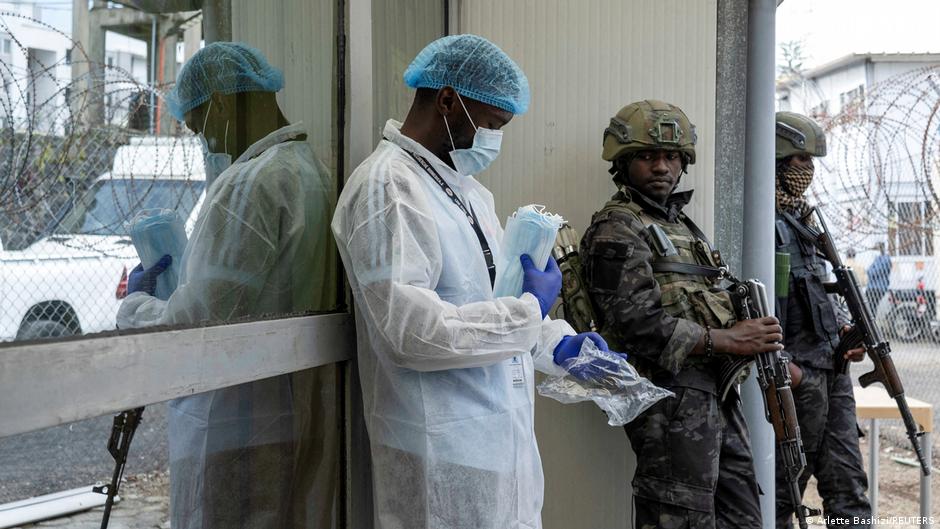
In eastern DRC, efforts to contain the outbreak are being hampered by the ongoing armed conflict. Additionally, the virus is able to spread more easily because people like Dzirava Leti are living in overcrowded displacement camps or are forced to move from one place to another, accelerating transmission.
“Health workers, treatment centers, laboratories, ambulances, medical supply routes must always be protected from military interference and political competition,” said Juste Kodjoe, a former Beninese army officer and security researcher at Kean University in the US state of New Jersey.
“International humanitarian law protects access to health care during armed conflicts, but the reality is that these legal obligations must be strengthened through practical negotiations with each actor controlling territory in a conflict zone,” Codjoe told DW.
The overlap between conflict and disease is part of a larger global pattern. In war-torn Yemen, aid groups and officials have spent the past decade battling recurring cholera outbreaks. Similarly, the cholera epidemic in Sudan, which has killed more than 3,500 people since 2024, has been linked to the country’s ongoing civil war. This is partly due to the warring parties severely restricting humanitarian access to outbreak response efforts.
History also offers examples of approaches that can help prevent the spread of disease. During the civil war in El Salvador (1980–92), the warring parties agreed to three one-day ceasefires to allow aid organizations to conduct safe vaccination campaigns against several childhood diseases.
However, in the DRC, calls for a ceasefire to help reduce the spread of Ebola have so far gone unanswered.
Pattern of past outbreaks: First attacks, then more infections
When eastern Congo was hit by another devastating Ebola outbreak in 2018, American researchers documented a clear link between violence and the spread of the virus. Many cases showed the same pattern: rebels attacked a location or health facility. After this, contact tracing and vaccination of people exposed to the virus stopped. Subsequently, the number of local cases increased significantly.
According to the study, in the city of Beni, each infected person spread the virus to an average of 0.8 other people after the vaccination campaign began – meaning transmission gradually declined. However, after an insurgent attack, the reproduction number (Ro value) increased again to 1.9, meaning that each infected person was temporarily infecting about two additional people. As the impact of violence diminished, the ratio fell again, reaching 0.72 by November 2018.
The threat was further heightened by some residents concerned about conspiracy theories. In this remote area, access to health care is something that many people rarely experience outside of acute crises, fueling skepticism about health workers in protective gear. Against this backdrop, experts repeatedly call for confidence-building measures, including efforts led by local community figures or faith leaders.
Ebola as a political tool for rebel groups
The epicenter of the current outbreak is Ituri province, where various militias and the Congolese army are fighting for control. But cases continue to rise in neighboring regions, including the far south, where the rebel alliance AFC/M23 has seized large areas since early 2025. The group appears to be pursuing a strategy of building its own institutions and consolidating its long-term influence over the government in Kinshasa, the DRC capital.
This also includes Ebola response efforts. When the first cases appeared in areas under its control, AFC/M23 rebels established an emergency zone and increased testing. According to a Reuters report, Rwanda is also providing support, although Kigali has officially denied widely documented allegations that it supports the rebels. Practically WHO is cooperating with them.
The health ministry in Kinshasa has reportedly been largely sidelined, but it continues to receive data and test results from concerned areas. While transmission continues to increase in Ituri, AFC/M23 said in late June that the local outbreak in areas under its control had been contained.
Security expert Juste Kodjoe also does not rule out that the management of the pandemic could boost the rebels’ political position, and warns that both they and the government may seek to monopolize aid. He said, “They must not allow concerns about political viewpoints to hinder life-saving assistance. Public health cannot be held hostage to a legitimacy contest.” “Aid must be carefully de-politicized, monitored, and distributed through neutral intermediaries.”
Reporting from Kigonz: Marcus Loika
This article was originally published in German.