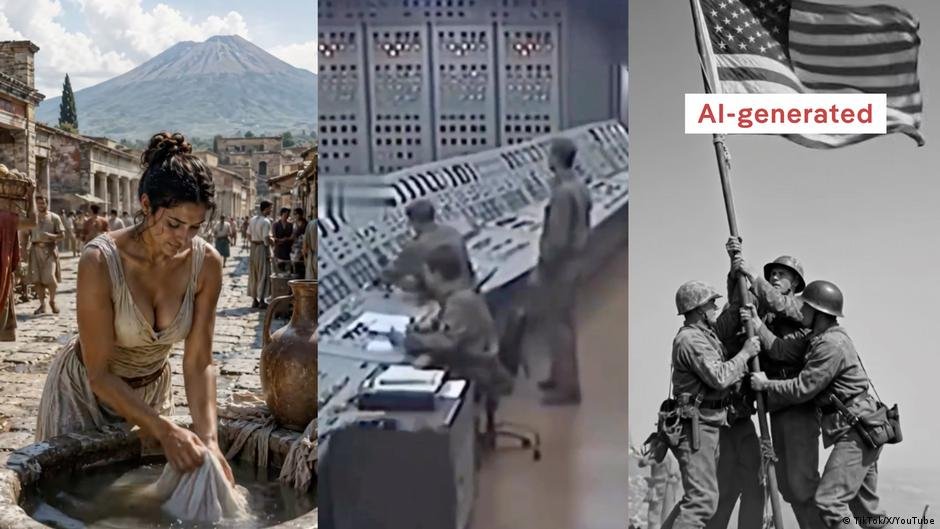
Archaeologists have used artificial intelligence for the first time in Pompeii, Italy Reconstruction Image of a victim of the volcanic eruption in 79 AD
AI is increasingly being used to generate “historical” images as the technology has become widely available, mostly without consultation with experts. Roland Meyer, a media scholar at the University of Zurich, believes this trend is no coincidence.
He said, “Through AI, it seems possible to recombine images of the past, to generate synthetic images that do not exist but perhaps could exist, and thus to fill perceived or real gaps in the archive and historical record.” “However, I find this to be a misleading promise.”
AI generators are known to make mistakes and have “hallucinations”. DW Fact Check explains how to locate an AI-generated “historical” video.
#1: Can this video even exist?
Many viral AI-generated “historical” videos that claim to show the past blur the line between fact and entertainment. They can often be identified simply by asking whether the video could have been made.
“Are we talking about a time when videos already existed, or are we talking about a time when they didn’t?” asked historian and AI expert Sébastien Cubbon.
this video It is believed that the depiction of Pompeii can be discredited on this basis alone.
It also shows clear signs of AI generation. People walk like zombies, and the female form looks far more modern than it did in ancient Rome.
The rise of AI tools has made it easier than ever to create such “historical” images and videos, but experts warn that AI trained on existing data will repeat its biases.
“Images of the past generated by AI mainly reproduce the typical patterns, clichés and stereotypes with which that past has been portrayed until now,” Mayer said.
“Above all, these are images of our hopes: not a window to the past, but a mirror of our present.”
#2: Look for visual clues and check the source
Second, it is helpful to take a closer look at the images and their sources.
In this videoThe camera moves in close to a group of soldiers holding an American flag, and their faces are visible as they look into the distance. It looks more like something out of a Hollywood movie than authentic documentary footage.
A soldier messes unnaturally in the background. The watermark also shows: This video was produced by VO, a generative AI tool.
Based on the video mentioned above [iconicphotofrom1945[1945कीप्रतिष्ठिततस्वीर Of American soldiers on Iwo Jima. There is no authentic video footage of this specific moment.
All experts DW spoke to stressed the importance of critical source analysis. Where does the image come from, who presents it, for whom and why?
video account It promises to explore “patriotic stories” and “educational and entertaining content that brings America’s story to life.” It reveals some such AI-generated videos.
Kubon explained that images and videos always offer a particular perspective.
“They include a selection of image excerpts and audio sources; in short, they present a perspective on the story. We are very quick to assume that just because something was recorded, it is somehow true.”
Jürgen Zimmerer, professor of African history at the University of Hamburg, warned that visual sources still hold too much authority and have been problematic even before AI.
He said, “Images have always been a highly controversial source. This is evident from the fact that dictatorial regimes, whether Nazi Germany or Stalinist Russia, have also modified images.”
The difference today is the scale at which AI can generate altered and completely fabricated scenes.
#3: Compare with verified historical sources
Look to archives, museums, reputable media, or academic experts.
a video Showing alleged CCTV footage of the Chernobyl nuclear disaster in 1986 is also AI-generated. While we can find an authentic photo of Iwo Jima in the US National Archives, no authentic footage of this moment in Chernobyl exists.
Such AI creations raise the question of responsibility.
Compared to the use of fictional scenes in documentaries, where a director or production team decides how to depict the past, AI pulls from large datasets without understanding the historical context.
“This produces something that seems plausible at first glance, not because it is historically accurate, but because it matches our expectations,” Mayer explained.
This is most dangerous when authentic footage exists and the video may be genuine.
While most viewers understand that the ancient Rome videos are fake, a large number of AI-generated images threaten to replace actual documentation of the time when the technology existed.
Zimmerer emphasizes that history is always a guess. He said, “We turn to historical events when there is no original film footage, and when you pretend you make something clear that isn’t really clear.”
So, don’t fall for AI-generated historical bias. Instead dig deeper and find out the real past.