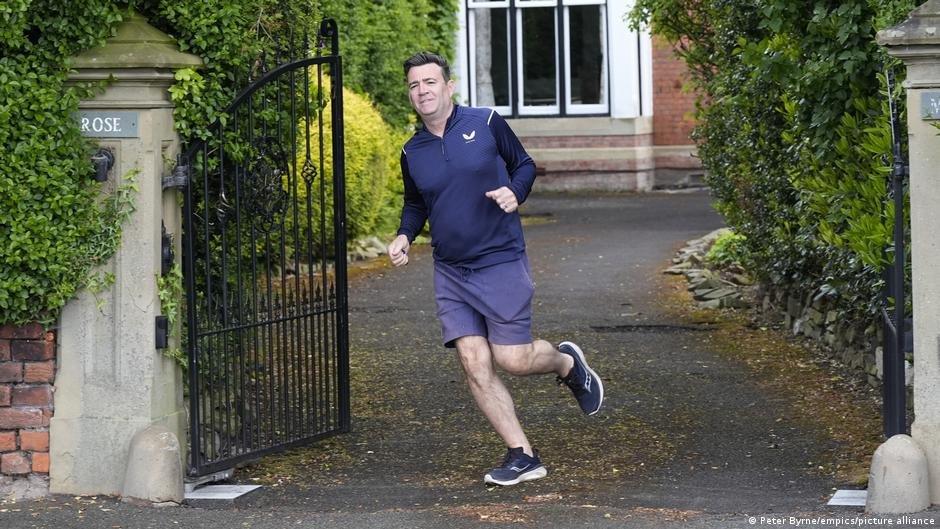
Nearly a month after Keir Starmer’s resignation, former Manchester mayor Andy Burnham, one of Britain’s most popular politicians, will become the country’s seventh prime minister in 10 years.
The move was made possible after Burnham won a by-election in the Makerfield constituency by a wide margin. He was then appointed leader of the ruling Labor Party on Friday, confirming him as Starmer’s successor.
a long political career
“Everyone can feel that the country is not where it should be,” Burnham, 56, said after the Makerfield election victory. “From here on out I will give everything I have to make it so. To make sure the Makerfield name is forever synonymous with the change this country needs, bringing back what we have lost – hope – hope for the future.”
Burnham is seen as a leading figure in Labour’s liberal-left faction and has decades of experience in both national and regional politics. He first entered Parliament in 2001. Under Prime Minister Tony Blair, he served as a junior minister in the Home Office before Blair’s successor Gordon Brown, who appointed him to the Ministry of Finance, the Department of Culture, and later as Health Secretary.
Burnham also ran for the Labor leadership twice, in 2010 and 2015. In 2017, he left Parliament to become mayor of Greater Manchester, a region of about 2.8 million people in northern England. He has since won re-election twice, most recently with nearly two-thirds of the vote.
Among Burnham’s most notable achievements is the expansion of affordable public transport in Manchester. Housing and health care have also been central priorities throughout his tenure as mayor. He is critical of Brexit, Britain’s exit from the European Union in 2020, and describes himself as a supporter of “pro-business socialism”.
During the Covid pandemic, Burnham clashed with then-Prime Minister Boris Johnson, demanding more financial support for businesses and workers hit by lockdown restrictions. The confrontation in Manchester and his general success earned him the nickname “King of the North”.
Over the years, Burnham’s main criticism of her Labor Party colleague Keir Starmer has focused on the Prime Minister’s cuts to welfare spending. What policies Burnham will pursue if he succeeds as Prime Minister is as yet largely undefined.
a working class northerner
Burnham’s roots run deep in the former mining and industrial communities of Northern England. Born in Aintree, near Liverpool, in 1970, he grew up in the village of Culcheth, where his father worked as a technician and his mother as a medical assistant.
While studying English at Cambridge University, Burnham later said that she often felt like an outsider. Inspired by the miners’ strike in the mid-1980s, he joined the Labor Party at the age of 14.
He is a lifelong supporter of Everton Football Club. His wife is Dutch and the couple have three children. Burnham also has a tattoo of a worker bee on her right upper arm – a symbol of industry and togetherness.
Today, Burnham is one of the United Kingdom’s most popular politicians, and many supporters see her as Labour’s best hope to counter the rise of Nigel Farage’s right-wing populist Reform UK Party.
Yet since the Brexit referendum in 2016, the office of British Prime Minister has become somewhat uncertain. Burnham will be the seventh person to hold the post since the referendum a decade ago. If he replaces Starmer, he will inherit a country that still grapples with deep political, economic and social challenges.
This article was originally published in German on 22 June and was updated on 17 July to reflect Andy Burnham being appointed leader of the Labor Party.