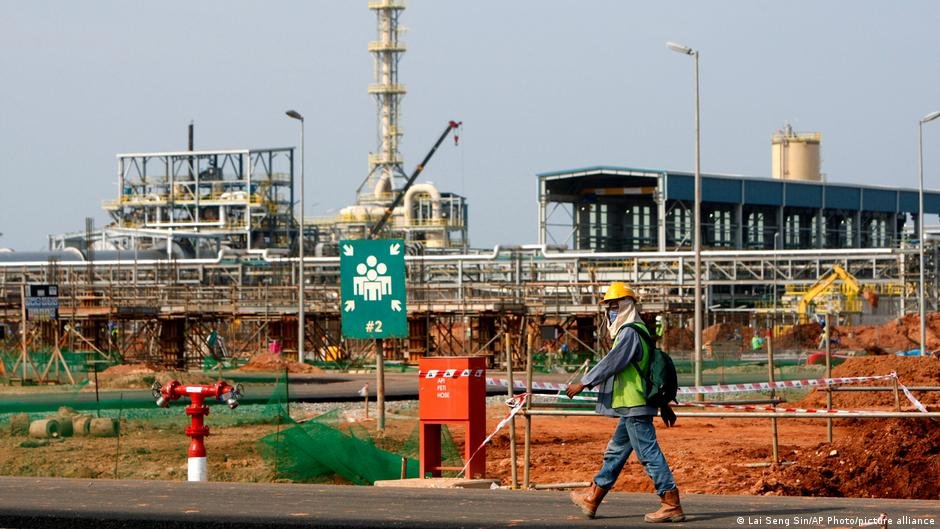
The US needs to ensure an independent supply of rare earth elements from China – but Washington’s Middle East policy is now having an adverse impact on a $96 million (€84 million) rare earth deal in Muslim-majority Malaysia.
In March, the US Department of Defense (DoD) signed a four-year deal with Australian mining firm Lynas to obtain 17 metals known as rare earths. These elements are at the core of modern industrial production and are used in everything from smartphones and electric cars to cutting-edge weapons systems.
The strategic deal, however, hinges on Lynas’ main processing plant in Gibeng, a heavily industrialized city along the east coast of mainland Malaysia – the largest facility of its kind outside China.
Pressure on Malaysian government regarding US-Israel relations
News of the deal has sparked a strong reaction in Malaysia, which has a long record of supporting Palestinian statehood and rebuking Israel over its actions in Gaza and the West Bank.
Locals are urging the government in Kuala Lumpur to either halt the Lynas deal or guarantee that rare earths passing through the Gibeng plant will not end up in any weapons systems.
In an open letter to Malaysian Prime Minister Anwar Ibrahim, more than 50 non-governmental groups said the deal risked implicating the country in “credible allegations of violations of international law in multiple theaters”, including Gaza, pointing out that the US is one of Israel’s main arms suppliers.
However, the connection between Malaysian rare earths and Israeli weapons is not straightforward. While the materials can be used to make fighter jets and missiles, they can also go into washing machines or wind turbines.
“The Malaysian protesters’ demands are equivalent to a ban on natural rubber exports to the US because the tires could end up on Israeli vehicles in Gaza,” Thomas Crummer, director of Ginger International Trade & Investment, a Singapore-based company that focuses on the rare earths market, told DW.
Lynas key to provide dysprosium and terbium
A parliamentary committee held a hearing last week to determine whether the Lynas project would jeopardize “Malaysia’s reputation as a staunch supporter of Palestine”. Anwar’s government now has until the end of the month to state its official position on the deal.
Crummer said, “For Malaysians, this is not really a rare earth issue. This is an issue about Palestine.”
Activists hope the Gabenge refinery will be used to influence US geopolitical calculations. America’s rival China currently mines and processes most of the metals in the world. Beijing is also restricting the export of these materials to the West.
Additionally, according to Crummer, Australia’s Lynas is one of the few companies that can provide commercial quantities of two particular rare earths: dysprosium and terbium. He notes that America’s major rare earth investment project, MP Materials’ Mountain Pass mine in California, has none of this.
Crummer added, “And since China has halted exports of rare earths for military applications, Linus will be the only source available to the Pentagon.”
Rare earths ‘national security essential’ for America
With few options for rare earth sourcing outside China at this time, the US government is investing in a number of projects both at home and abroad. But these could take years to come online, says Meredith Schwartz, associate fellow at the Center for Strategic and International Studies.
He said, “The Pentagon needs to secure supplies in the event China denies access – it is a national security imperative. This makes actively pursuing projects, such as the Lynas rare earth refinery in Malaysia, particularly strategic for the United States.”
Schwartz said Australia’s rich mineral reserves and mining expertise make it “central” to Washington’s plans to break China’s near-monopoly on rare earths. He also called the Lynas refinery in Malaysia, which receives its raw materials from Australia, a “key node” in the “mine-to-magnet supply chain”.
Pentagon involvement indicates wartime use
The deal announcement published by Lynas in March did not say whether any of the material sold to the US Defense Department would be used for weapons.
But given that the deal is specifically with the Defense Department, Kruemer says, it probably will.
“If the materials weren’t destined for defense, the Pentagon wouldn’t have signed the contract — it doesn’t care about Ford Motor’s EVs or Whirlpool’s kitchen gear,” he said.
Neither LYNS nor the DOD responded to DW’s requests for comment.
The shock of pollution is haunting Malaysia
Schwartz says foreign miners have a practical need to gain the trust of the local community for their operations.
That’s a tall order for rare earth projects in Malaysia, where a Japanese-backed venture in the 1980s left behind pools of radioactive waste — an inherent byproduct of mining and refining the metals. These have been blamed for birth defects, cancer cases and deaths in the area.
Lynas has also faced questions about the management of radioactive waste.
If the Malaysian government tries to block or at least “frustrate” the US-Linas deal, it could potentially raise those concerns again and link them to the license renewal for the Gibeng plant, says Oh Ee Sun, a senior fellow at the Singapore Institute of International Affairs.
International law can also be used as a point of pressure. In their letter to Prime Minister Anwar, the activist groups cited Malaysia’s obligation to ensure that anyone under its jurisdiction respects this comprehensive legal framework, she said.
Oh said, “It’s basically political will. If you want to do something, you can always find an excuse to do it.”
Does Anwar’s government want to risk isolation?
Whether the government would actually want to disrupt the project is another question.
“As of this moment, it [Malaysia] It is still a major trading power, a major investment destination in the world,” Oh said, and “Once you do things like that, you will isolate yourself, and that is a choice the Malaysian government will have to choose.”
Additionally, Malaysia is also an increasingly conservative country. Islamist parties are on the rise and the government faces pressure to appease the Muslim majority.
Oh says Anwar’s government could gain some political mileage by taking action against the US-Linas deal.
“So, if I’m a politician and political survival is my main goal, I can do something to strengthen my religious credentials, and the Palestinian issue is a very convenient and easy way to do that.”
Edited by: Darko Janjevic