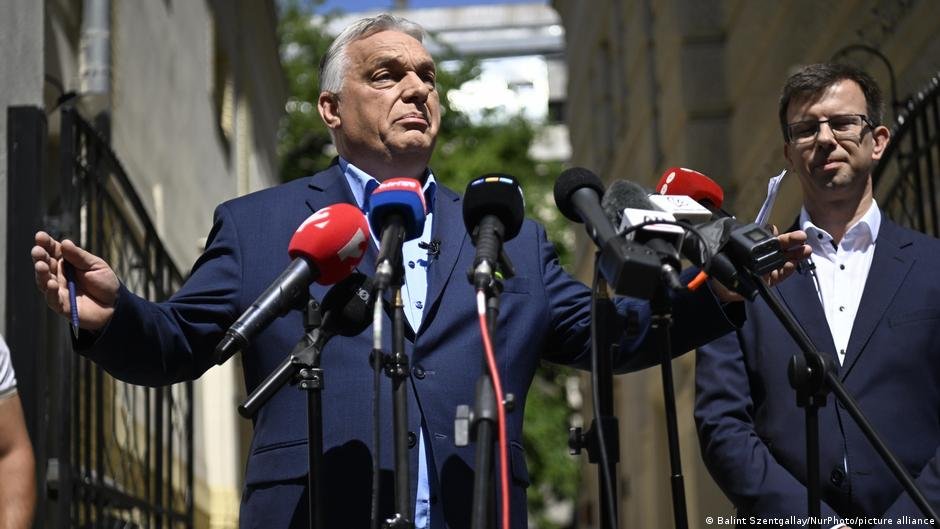
Hungary’s former Prime Minister Viktor Orban on Wednesday accused prosecutors and the new government of a sham investigation of his Fidesz party, a day after investigators seized equipment from the party headquarters in Budapest as part of a corruption probe.
Orban, Hungary’s longtime leader, lost a landslide in April’s general election to conservative rival Peter Magyar, himself a former Fidesz member, a result applauded by much of Europe but not the Trump White House.
Since coming to power, Magyar has taken steps to root out the systemic corruption of the Orbán and Fidesz era, making a number of sweeping changes. However, Orbán on Wednesday described the measures as a sign of “tyranny” and said he and his opposition party would offer “resistance” by all peaceful means.
What did Orban say?
Orbán’s online statement late Tuesday, followed by his press conference outside Fidesz headquarters on Wednesday, are his two strongest political statements since returning to the role as opposition leader in early May after 16 years in power.
He issued the first “statement of resistance” on Facebook, after his party announced that prosecutors had searched the party’s headquarters and seized computer servers and other materials. It is part of an investigation into corruption in the country’s National Culture Fund, which is accused of being a state-run payment center and a shadow election campaign fund for Orbán’s inner circle.
“The issue of National Culture Fund was just an excuse for this [search of the party headquarters]Orbán charged, while denying any wrongdoing.
He said Hungary “ceased to be a democratic state” after the new centre-right government used its parliamentary supermajority to pass a constitutional amendment abolishing the mandates of the president and the head of the Constitutional Court – both considered Orbán allies. He said he and his party would “take all peaceful means” to protest the “illegitimate” political system.
On Wednesday, outside Fidesz’s operations center, Orban said he believed Magyar was trying to permanently influence his party.
“By yesterday I had realized what it was all about,” he told reporters. “What happened was that it served as a pretext to seize Fidesz’s servers… This is a politically motivated legal proceeding designed to render Fidesz – which has clearly survived even this massive political defeat and is coming out stronger – legally unviable.”
When and how did the Magyars gain power?
Peter Magyar’s new party, Tisza, won comfortably in the general election on 12 April, claiming more than 55% of the vote against Fidesz’s around 37%.
Due to Hungary’s first-past-the-post electoral system, the Magyars now enjoy the same supermajority that Orbán often enjoyed in his pomp, taking 141 out of 199 seats despite winning only 55% of the vote. Fidesz has only 52 seats.
In Hungary, amending the constitution requires a two-thirds vote in parliament.
The new prime minister, who broke away from Fidesz in 2024 crying double standards and institutional corruption, took office on May 9. He had promised rapid reforms if victorious, but the speed and scope of his actions surprised even some of his supporters.
What has Magyar done to damage Orbán and Fidesz since taking office?
Since taking office, Magyar has moved increasingly against alleged Orbán-era corruption and misdeeds, while also taking foreign policy steps such as improving relations with Brussels and freeing up aid to Ukraine. Magyars often refer to this as targeting Orbán’s “mafia”.
Magyar opened former government facilities to the public to show off some of the opulence he says reflects systemic corruption.
National public broadcaster M1, which Tisza and others in the opposition said had been transformed into a Fidesz mouthpiece, was briefly shut down this month and broadcast a black full-screen apology to begin the reform process.
A number of political appointees have been removed from their roles – notably President Tamas Suleok and President of the Constitutional Court Peter Polt through a constitutional amendment. Magyar this week suggested chess star Judith Polgar for a largely ceremonial role as president, only to indicate she was flattered but not interested.
On Tuesday, Prosecutor General Gábor Bálint Nagy, who was appointed only last year, agreed to step down after Magyar called him a “puppet” of Orbán.
Tisza has also introduced 12-year term limits for all legislators, including the Prime Minister and government ministers. Orbán says this means most of his party’s stalwarts, including himself, will be excluded from the next election.
He told reporters in Budapest on Wednesday that it was reminiscent of the late 1980s and the post-Communist dictatorship “when there was no democracy in Hungary, no rule of law.”
Corruption investigations, including but not limited to investigations into the National Culture Fund, have also affected Orbán and his allies.
Some other senior Fidesz members have voluntarily stepped out of the political spotlight. Last week, parliamentary caucus leader Gergely Gulyas stepped down, while Orban’s longtime former foreign minister Peter Szijjarto left to take an executive position with Chinese electric car maker BYD.
Polls show Orbán’s party has suffered even greater losses in its first few months in opposition, with a poll by Median this week showing 60% support for Tisza and only 18% for Fidesz.
Edited by: Shawn Sinico
Don’t let algorithms hide news. If you rely on our team for reliable reporting, please take a moment Choose us as your favorite source on GoogleThat’s why you’ll always see our verified news first.