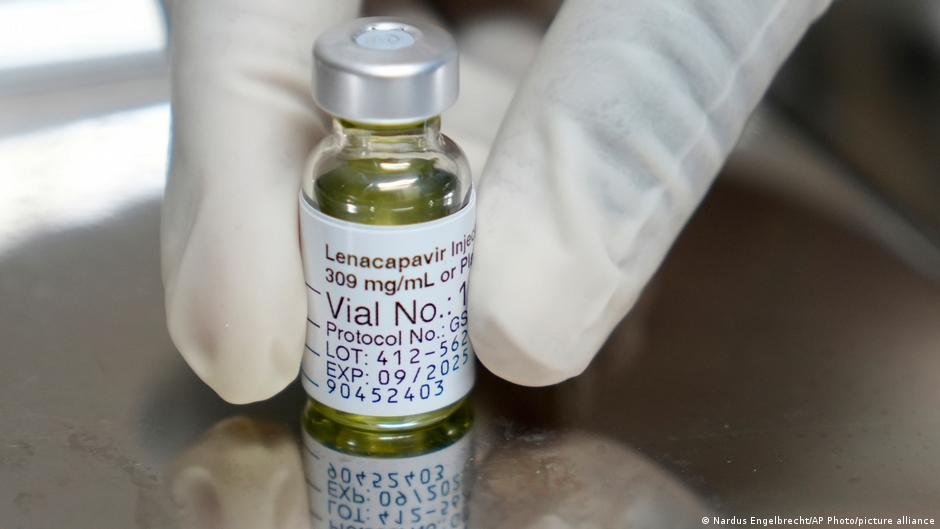
For a healthy young woman in South Africa, the greatest risk of contracting HIV may come from someone she wants to trust, but whom she cannot.
He may not know about his partner’s HIV status, he may not always be able to insist that they use condoms, and he may have little control over whether or not he has other partners.
There is an alternative: daily pre-exposure prophylaxis (PrEP) pills keep antiretroviral drugs in the body at high enough levels to stop HIV before it can establish infection.
But PrEP only works if she keeps taking the medicine. Missing too many doses may cause drug levels to drop too low to provide adequate protection.
She may forget, resent having to take a daily pill, or fear that a partner or relative will find the medication, which would stigmatize her. She may also experience side effects from PrEP or have difficulty obtaining a new supply.
How can lencapavir help?
Consistently taking medication – known as adherence – is a challenge for people with conditions such as high blood pressure and diabetes. However, the difficulty is even greater with PrEP.
“You’re telling people who are healthy, who don’t have any disease, to take a pill every day,” said Salim Abdul Karim, director and co-founder of the AIDS Program Research Center in South Africa. “It’s a high bar.”
“Repeated studies, including our own, show that among patients who start taking PrEP, by the third month about half quit. By the end of the year, you have only a handful of people who are still taking PrEP,” Abdul Karim told DW.
Lencapavir reduces that daily burden rapidly: It requires only one injection every six months.
“It’s much easier to do this than to remember to take a pill every day,” he said. “For those who take the injection every six months without fail, it works brilliantly as adherence is effectively accomplished.”
But lencapavir is still very expensive and access is low in some areas.
How does lencapavir stay in the body for so long?
Most established PrEP drugs block the enzymes that allow the virus to reproduce and spread – the enzymes it uses to copy its genetic material and insert it into the DNA of a human cell.
Lencapavir works in a completely different way. It is the first PrEP drug to target the capsid, a cone-shaped shell that surrounds the viral genetic material. But the capsid is also essential for the replication process of the virus, and is therefore a promising target.
“[Lenacapavir] “This is the most powerful molecule against HIV that we know of,” Wesley Sundquist, a biochemist at the University of Utah and a leading expert on the HIV capsid, told DW.
Sundquist said lencapavir remains effective for a longer period of time and is potent even at lower concentrations.
“It sets up a small depot that slowly dissolves,” Sundquist said.
Which groups will benefit from lencapavir?
Abdul Karim pointed to three groups where HIV incidence is high and there is an urgent need for more and more PEP:
- Adolescent girls and young women in parts of Africa
- young gay men in the west
- Vulnerable gay communities in Eastern Europe and Central Asia
In South Africa, a rollout for people at risk began in June 2026, supported by a July 2025 agreement between the drug’s developer, Gilead, and a public-private financing organization called the Global Fund.
Gilead agreed to supply lencapavir to 2 million people over three years at no extra cost.
Earlier, in October 2024, Gilead had also agreed to allow the production of cheaper, generic versions of the drug in 120 resource-limited countries where HIV infection rates are high.
But some countries still do not have access to the medicine.
Latin American countries excluded from Lencapavir deals
Melissa Sharvey of Doctors Without Borders said some Latin American countries, including Brazil, Mexico, Peru and Argentina, were excluded from the recent rollout of lencapavir, despite participating in clinical trials.
Sharvey told DW that even in eligible countries, vulnerable groups may still be left out.
“So far this is not enough,” Sharvey said, calling on Gilead to increase supplies and sell directly to MSF at an affordable price of about $40 per shot.
According to Monisha Sharma, an epidemiologist at the University of Washington, the key question in reducing HIV is whether the drug reaches the people and places where HIV is spreading most rapidly.
“In our modeling for South Africa, Zimbabwe and western Kenya, providing lencapavir to about 2-4% of the adult population, with targeted uptake among those at greatest risk, prevented about 12-18% of new infections over ten years,” Sharma told DW.
Lencapavir ‘unlikely to eliminate HIV on its own’
“Lenacapavir may significantly accelerate progress toward reducing incidence, but it is unlikely to eliminate HIV transmission on its own,” Sharma said.
“This impact is highly dependent on affordable lencapavir drug prices, efficient distribution channels, and targeted uptake among people at highest HIV risk,” they said.
That last situation is Abdul Karim’s biggest concern. Lencapavir may greatly solve the problem of adherence for people who receive it. It cannot solve the difficult problem facing HIV experts: identifying and reaching people at greatest risk.
“The problem is that the people most at risk need to come forward to get the medicine. And often the people most at risk don’t see themselves at risk. That’s why they’re at risk,” Abdul Karim said. “If we can’t reach those most at risk, we won’t be able to impact this pandemic the way we’re hoping.”
Edited by: Zulfikar Abbani