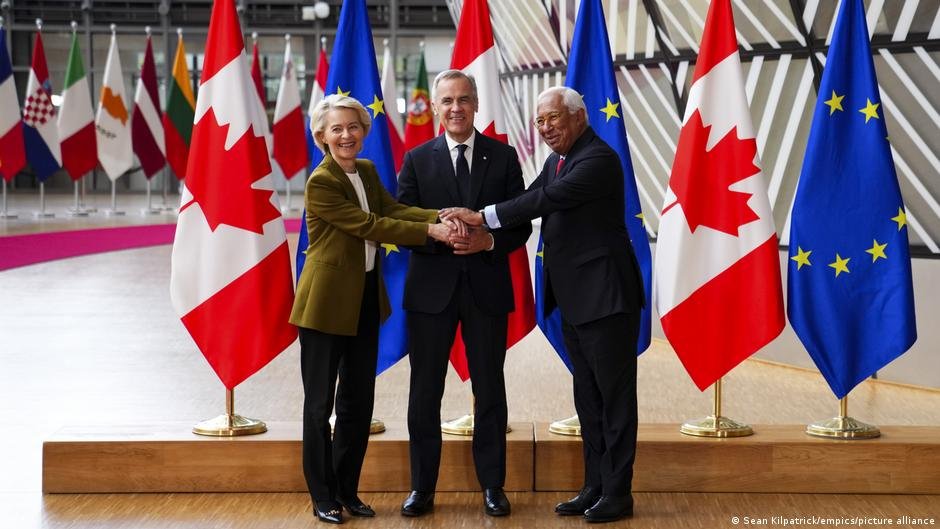
The latest attack in U.S. President Donald Trump’s free trade war could have devastating effects for Canadian business. But new tariff threats could also open up trade opportunities elsewhere, putting China and the EU in a strong position to benefit.
Trump plans a 50% tariff on imported goods ranging from wine to hockey sticks, but that doesn’t include other key sectors like energy, potash and fish.
It is expected to affect about 5%, or $20 billion (€17.5 billion) worth of goods, and “the impact could be devastating for the businesses involved,” Julian Karaguesian, an economics lecturer at Canada’s McGill University, told DW.
Canada’s Prime Minister, Mark Carney, has promised to take “any measures necessary” to protect Canadian workers, farmers and businesses, potentially walking away from a major trading partner.
Canada looks to further diversify trade after Trump tariffs
“Canada’s policy for some time has been to diversify trade with non-U.S. trading partners. So this new threat is not going to change that,” Mark Camilleri of the Canada EU Trade and Investment Association told DW. “With Mark Carney as Prime Minister, we have seen a more ambitious trade diversification strategy, particularly with Europe and the Indo-Pacific.
Camilleri stressed that trade diversification in this context is not about breaking with the US, but about reducing Canada’s overdependence on the single export market.
Canada’s trade relations with the EU have strengthened significantly over the past decade, largely due to the introduction of the Comprehensive Economic and Trade Agreement (CETA), signed in 2016 and provisionally in place since 2017.
It removed approximately 98% of tariffs on trade between Canada and the bloc and means trade between the two sides is worth €130.8 billion in 2025, an 81.2% increase from 2016. According to European Union data. The bloc also reports that “the deal has led to an increase in EU GDP of €3.2 billion per year.”
Raw materials, rare earths and energy key to future Canada-EU trade
Machinery, pharmaceuticals and minerals are among the major drivers of trade between the two sides. Canada’s natural resources, such as rare earths and minerals, are attracting the European Union, which is trying to reduce its dependence on China for rare earths while meeting environmental goals.
“This has really been one of the main areas of increased cooperation between Canada and the EU,” Camilleri said. “That will be a big part of the relationship that will continue. It’s also happening bilaterally. Canada and a number of EU member states, including Germany and France, are also getting involved in raw materials partnerships. Canada has these raw materials, rare earth materials, and the EU needs them.”
Although tariffs are nearly eliminated, EU rules on some goods remain a barrier for Canadian exporters, Karaguesian said.
“The EU may be a major destination for Canadian food products but protectionist policies in agriculture place Canadian food products at a competitive disadvantage,” he said.
Infrastructure is a barrier to Canadian energy exports
Another resource that the EU, and especially Germany, needs is energy. But infrastructure is an issue here.
“The problem is that oil and natural gas are expensive to transport and Canada needs to build export capacity on the East Coast to move natural gas and oil to European consumers,” Karaguashian said.
Canada recently signed an initial energy agreement with Germany to transport one million tonnes per year of liquefied natural gas (LNG) to Germany from the KSI Lisims, a proposed project off the coast of British Columbia, in the near future. But Casey Lisims has not yet received the green light, with Indigenous and environmental groups opposing the project, arguing that it is contrary to Canada’s environmental commitments.
Infrastructure and regulatory barriers to Canada-EU trade will mean China can strengthen its relationship with Canada, Karaguashian said.
China, India and others could benefit from moving away from America
“I would say China would be the number one destination for increased exports from Canada. That’s because the Canadian and Chinese economies complement each other: China is a manufacturing superpower, and Canada is a natural resources superpower.”
Karaguesian pointed out that two of Canada’s three largest exports are energy and food products, with China ranking as the largest buyer behind the United States.
But the diversification of Canada’s trade is unlikely to stop at China – already a major Canadian trading partner – and the EU.
Canada’s Foreign Minister, Anita Anand, attended the ASEAN (Association of Southeast Asian Nations) meeting in Indonesia this week and highlighted Canada’s plans to increase trade in that region with a free trade agreement (FTA).
“Ensuring that there is consensus on concluding an FTA between ASEAN and Canada is our top priority at this summit,” Anand said..
Karaguesian said the decline in trade relations with the U.S. has made Canada more vulnerable, with India and Latin America being key markets. This can be seen as an opportunity to move forward, he said.
“Given Canada’s comparative advantage in wheat and other grains and agriculture, it can be anticipated that Canada can build closer ties with North Africa and the Middle East. We should also not forget countries like Nigeria, whose population has reached 250 million,” Karaguessian said.
He said these markets, which had been neglected by many Western exporters, offer significant growth opportunities for Canada.
This could challenge Trump’s claim that: “Without us, there’s no way for them [Canada] Can survive.”
Edited by: Rob Mudge