Intense, sustained heat waves and prolonged drought have triggered another severe wildfire season across Europe this summer, with crews battling massive blazes in France, Spain, Portugal, Italy, Britain and even Norway.
Similar conditions have sparked fires in the United States and Canada. For weeks, hundreds of wildfires have been burning across the vast boreal forest stretching from the Yukon in the north to Newfoundland in the east. As of July 24, they have wiped out at least 3.3 million hectares (8.1 million acres) – an area larger than Belgium.
As toxic smoke blanketed major cities including the US, President Donald Trump took to social media to accuse Canada of “not maintaining its forests properly” and deliberately neglecting “basic forest management and debris removal.”
No ‘one-size-fits-all’ solution
While eliminating flammable fuels is part of the job of fire experts, effective management goes beyond just clearing debris. And in Canada, it would be impossible to clear brush from such a wide, remote area. “There is no one-size-fits-all solution,” said Amy Duchel, a senior forestry official at the UN Food and Agriculture Organization (FAO).
“In wilderness and fire management, you have to work with the type of ecosystem you have by understanding the history of fire,” said Sophie Wilkinson, an assistant professor and wildfire expert at Simon Fraser University in British Columbia. “There are many different ecosystem types, such as upland forests and wetlands, and each of them has a unique relationship with fire.”
But even though Canada’s boreal forests have adapted to living with fires, Wilkinson said as frequent extreme heat waves and prolonged droughts linked to human-caused climate change are drying out trees and shrubs, “wildfires have become more difficult to manage.” Higher intensity fires are “more likely to spread more rapidly and burn more aggressively, both of which hinder management options and efficacy” – even in locations that were previously too moist to burn.
Tropical forests did not evolve to co-exist with fire – there was no thick, resistant bark or plants suitable for sprouting after fire. Here, it is important to stop deforestation associated with mining and agriculture, preserve the canopies and vegetation that create humid, fire-resistant habitats, and train people to react quickly to any fire risk.
“In contrast, fragmented forests in Europe may not be adapted to fire, but may have other challenges [that weaken forests] “Such as invasive species,” Wilkinson said.
In Europe, management solutions may include cross-border monitoring and security, and prioritizing fire-resistant vegetation rather than highly flammable conifers. It also means bringing back diverse tree species that contribute to more resilient forests, which have been depleted over centuries of farming and exploitation.
fight fire with fire
In some places, fire is the key to preserving forests.
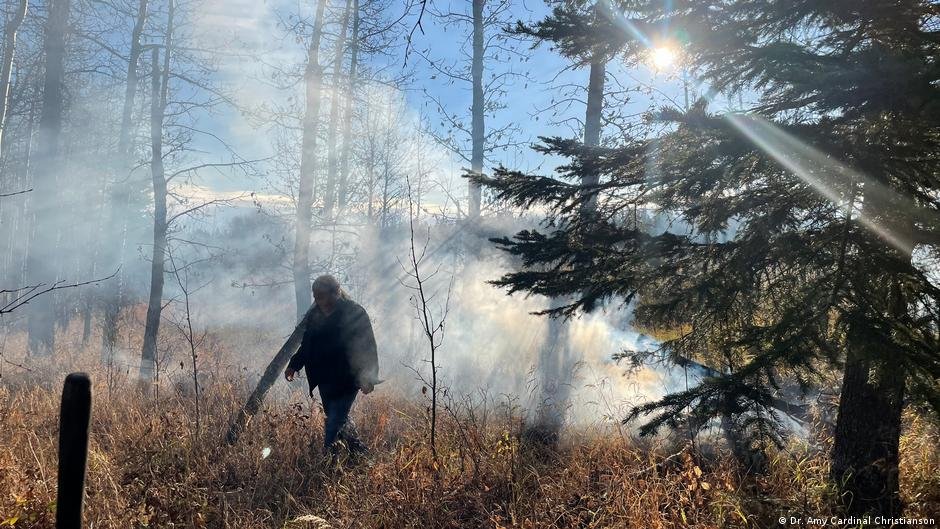
“Our boreal forest is a fire-dependent forest – it needs fire for health,” said Amy Cardinal Christianson, an indigenous Metis fire expert in western Canada. He said setting a certain number of fires is part of a natural cycle, allowing natural fires to subside, promote fresh plant growth and restore ecosystems – all of which can slow the spread of wildfires.
Research has shown that some forests have evolved to live with periodic fires, which act as a kind of reset. For example, flames can clear the way for small plants struggling to compete with uncontrolled undergrowth, and the burned material also releases nutrients that enrich the soil.
But Canada’s wildfire season is now accelerating the normal, healthy cycle — starting earlier, lasting longer and becoming harder to control.
It’s also increasing Canada’s carbon emissions: the record fire season of 2023, which wiped out five times the annual average of forestland, added 23% to the world’s annual wildfire emissions. Some pollutants even took it to Western Europe.
Christianson, former research scientist with the Canadian Forest Service and now director of fire management Indigenous Leadership InitiativeSaid that the ideas of old forest management practices introduced by Europeans to support the timber industry – focusing on strict regulation, outright suppression and fast-growing monoculture – do not fit the Canadian context.
“By preventing fires, we have actually increased the risk,” he said, adding that periodic controlled burns can actually help reduce the risk of a fire getting out of control.
Global Fire Hub aims to share knowledge
Deutschle told DW how skilled professionals who have been dealing with wildfires for decades are now seeing the flames rising even as they can’t control them — “The fires are growing too fast, the flames are too high, the heat is too intense.”
Faced with these challenges, the focus has shifted from fire suppression to reducing risk, preparing for changing conditions, and building resilience after fire. In 2023, FAO established its Global Fire Management Hub Helping countries battling wildfires to train and work together, sharing their knowledge.
Using new technology and data for direct monitoring and response, as well as developing a digital platform for information sharing and international interoperability and community-based management, is a key focus.
After establishing an independent network of over 200 Indigenous guardians in Canada to help manage wildfire response, Christianson has worked with Fire Hub to develop a network focused on Indigenous knowledge and practices.
This includes cultural burning – small, low-intensity deliberate fires adapted to specific landscapes, which help eliminate decaying organic matter in a controlled manner, protect wildfires and biodiversity, and preserve local cultures.
Prescribed burning, usually performed by government agencies, is also beneficial and has been used for years. But they are large and do not always take into account the local environment. These can also be done in summer when conditions are dry, to speed up the process, which increases the risk of abscission.
Cultural burning usually occurs in early spring or late autumn, depending on snow and other environmental factors. But climate change has altered that schedule, too, and Christianson said it helps to be familiar with the landscape to notice those changes. “We usually burn in April or May,” she said of her property. “This year, I burned a bunch in February.”
‘Healthy landscape’ the key to living with fire
Speaking to DW from his home in Rocky Mountain House, Alberta, Christianson said that although the same burning practices may not always be implemented across different cultures, they have been able to share proven ideas and techniques internationally.
“The really cool thing about Indigenous cultural burning practices is that there are a lot of commonalities, there’s a responsibility that we all feel to steward the landscape, and fire is one of the important ways that we can do that,” Christianson said.
“The overall goal of most indigenous people I have spoken to is to achieve a healthy landscape.”
That means looking at the bigger picture — restoring wetlands to make ecosystems more resilient in the event of fire, or reintroducing native species like bison in Canada, which once numbered in the millions and help control fires by grazing on vegetation that encroaches into grasslands and forests.
This practice has recently been reintroduced in Europe, with horses and European bison in Spain and Portugal.
“A healthy landscape […] “We can easily adapt to the fire events we’re seeing,” Christianson said.
Amazon wildfires at historic low in 2025
One country that has seen recent success in combating wildfires is Brazil.
“Brazil has been quite effective in reducing not only its deforestation rates, but also the incidence of fires in the Amazon,” Deutschle said, crediting cooperation between state, municipal and federal agencies and a national policy on integrated fire management. “[This success] “It didn’t happen by accident.”
In 2025, wildfires in South America’s largest country reached historically low levels, burning about 12.7 million hectares, an area roughly the size of Greece.
New data from environmental monitoring network MapBiomass showed that a quarter of the total area burned was in the Amazon rainforest, the world’s largest and a key regulator of global climate. This is an 80% decline compared to 2024, and about 56% below the 40-year historical average.
However, the Cerrado Savanna in central Brazil, where fire is part of the ecosystem, continued to burn at similar rates due to prolonged drought. Experts have warned that the coming El Nino weather pattern could bring even drier weather, increasing the risk of fires.
“Although treating our forests can help us adapt to increased fire activity, addressing the root cause of that increase – climate change – is probably the best mitigation strategy available to us,” Wilkinson said.
Edited by: Sarah Stephan