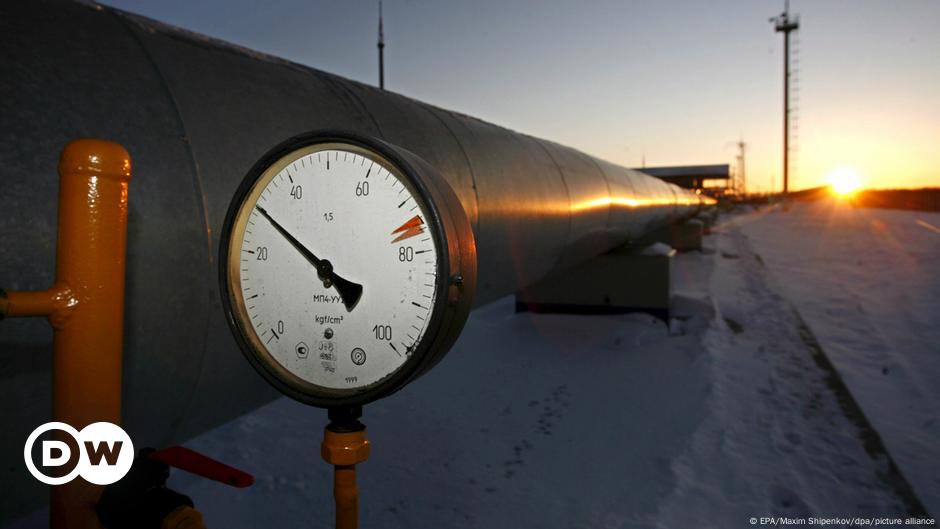
National energy giant Gazprom said remaining Russian gas deliveries using its oldest transit pipeline through Ukraine to Europe stopped entirely on Wednesday as 2019 contracts expire.
“Due to the repeated and clearly expressed refusal of the Ukrainian side to renew these agreements, Gazprom will cease to supply gas for transit through the territory of Ukraine from January 1, 2025,” Gazprom said in a statement. Was deprived of technical and legal capacity.” Telegram messaging app.
It said the flow stopped at 8 a.m. Moscow time, echoing Ukraine’s comments.
Why is delivery stopping?
The government in Kiev had said that it would not extend or renew the contracts as long as Russia’s aggression continued, at least not until some provision could be arranged for delayed or frozen payments to Gazprom, which Critics said this was not possible.
“We stopped the transit of Russian gas. This is a historic event. Russia is losing its markets, it will suffer financial losses. Europe has already decided to give up Russian gas,” Ukrainian Energy Minister German Galushchenko said in a statement on Wednesday. Have done.” ,
Ukraine stopped buying Russian gas in early 2015, a year after Russia’s annexation of Crimea, but it continued to serve as a transit country for others in Europe.
Which countries are affected, which are not?
EU and NATO member Slovakia and its Prime Minister Robert Fico clashed with Ukraine and its President Volodymyr Zelensky over the ban.
Fico also traveled to Moscow for talks with Russian President Vladimir Putin after failing to secure any extension at a summit of EU leaders in December. Despite Fico’s vocal criticism, his government also says it has abundant gas reserves and does not expect short-term problems.
Slovakia’s transit company Ustream said on Wednesday that supplies from Russia via Ukraine had stopped.
Non-EU member Moldova was the other major frequent user of the connection; Its government has warned that it may have to cut gas use by up to a third.
Central European countries including Hungary and Serbia get most of their gas from Russia via a separate, undersea pipeline – TurkStream – and so are largely unaffected by the changes in Ukraine.
EU energy imports from Russia: very low, but still significant
Ukraine is now losing about $800 million (about €770 million) a year in transit fees from Russia, while Gazprom will lose about $5 billion in annual gas sales.
The EU has sanctioned many forms of Russian energy supplies and imports, but has not completely stopped them, despite the stated aim of eventually eliminating them.
Still, Russian deliveries to Europe have fallen significantly from the 2018 peak, when Gazprom exported 201 billion cubic meters of gas to the continent.
The Yamal-Europe pipeline through Belarus is also closed and the Nordstream route from the Baltic Sea to Germany was blown up in 2022.
In 2023, Russia will send about 15 billion cubic meters of gas to Europe via Ukraine, up from close to 65 billion cubic meters when the last five-year contract began in 2020. Some previous users of the pipeline, such as Poland, continued their purchases faster than others.
In 2023, 14.8% of the EU’s total gas supply still came from Russia, compared to 47% in 2021, before the full-scale invasion of Ukraine.
msh/sms (AFP, Reuters)