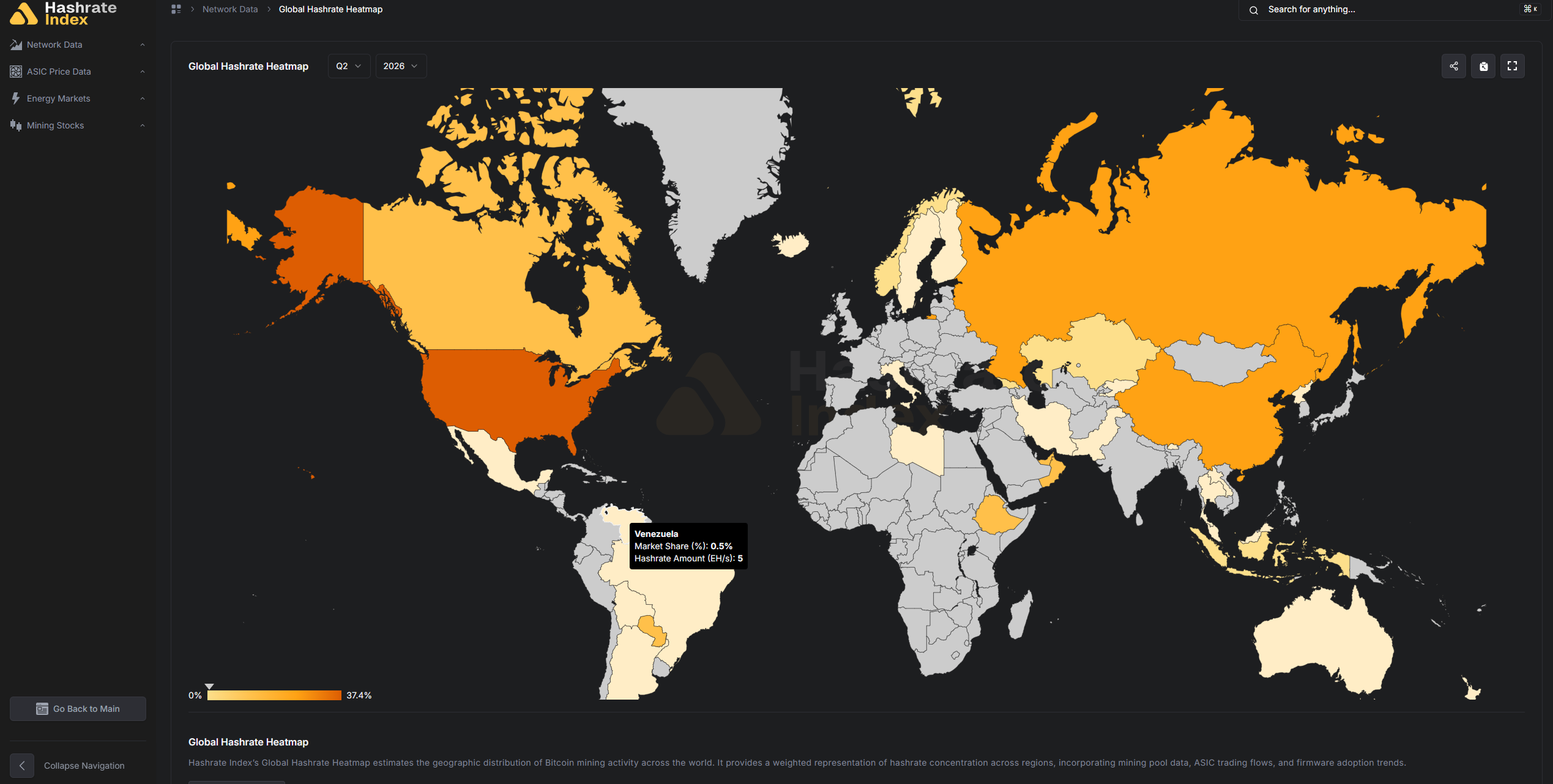
Venezuela registers 5 EH/s in the Bitcoin network despite the total veto in force since 2024.
National electricity consumption reached 15,579 MW, a maximum in nine years, according to Corpoelec.
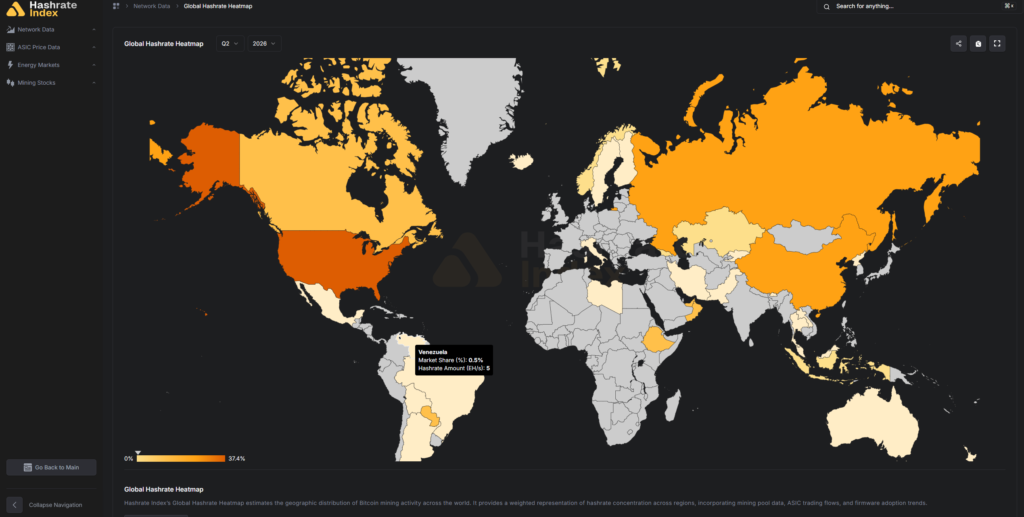
Despite the absolute ban on cryptocurrency mining in force in Venezuela since mid-2024, the country records approximately 5 exahashes per second (EH/s) contributing to the Bitcoin network. This is equivalent to 0.5% of the global hashrate.
This is indicated by the data from the Hashrate Index heatmap for the second quarter of 2026, that detects active mining traffic with Venezuelan geolocation. This is the Bitcoin mining data and research platform from Luxor Technology, a Seattle-based company that operates one of the world’s leading mining pools.
The participation estimates by country on this platform are built from pool dataASIC equipment flows and firmware adoption patterns.
The 5 EH/s detected contrast with the real installed capacity of the Venezuelan electrical system. According to Hashrate Index, at an average efficiency of 80 J/TH, that hashrate level equivalent to a consumption of up to 400 MWa smaller fraction compared to the country’s more than 30 GW of nominal installed capacity, although the effectively dispatchable generation is estimated between 12 and 14 GW due to the current state of the infrastructure.
The firm points out that mining activity persists in Venezuela in a scheme that it describes as “legitimate or semi-legitimate”, without the figures being sufficient to place the country among the ten largest hashrate producers in the world. Although yes among the first in Latin America above Bolivia and Argentinaaccording to the company.
In this way, the data indicates that mining activity persists informally, although it has not grown significantly since 2024. This, after the country became among the Top 10 global hashrate around 2021.
All this occurs in a context where the Venezuelan government announces measures against Bitcoin mining again.
This May 7, the Ministry of Electric Energy reiterated the ban and announced sanctions for those who operate without authorization. The authorities reported that a special supervision plan will be activated, together with competent organizations, in order to guarantee compliance with the measure.
The Carabobo state government added its own measure, announce rewards of USD 1,000 for citizens who report the location of farms or digital mining equipment in the entity. The operation is part of a policy of disconnecting facilities that the authorities have been carrying out since 2024 under the argument of normalizing the national electrical system.
These pronouncements occur after the Venezuelan government reported that electricity consumption reached 15,579 megawattsthe highest figure recorded in the last nine years. All this in a context where 35% of Venezuelan households face daily power outages, according to the ENCOVI 2025 survey by the Andrés Bello Catholic University (UCAB).
However, Hashrate Index warns that the main obstacle for Venezuela to scale its participation in the network is not energy availability, but the absence of a legal framework that guarantees this practice in conjunction with the security of imported capital. As long as this condition is not met, the firm concludes, mining in the country will continue to operate at the margins, which remain high despite the prohibitions.