
The cryptocurrency messages did not compromise customer capital or data.
The company reinforces its access and recalled that its internal systems operate completely normally.
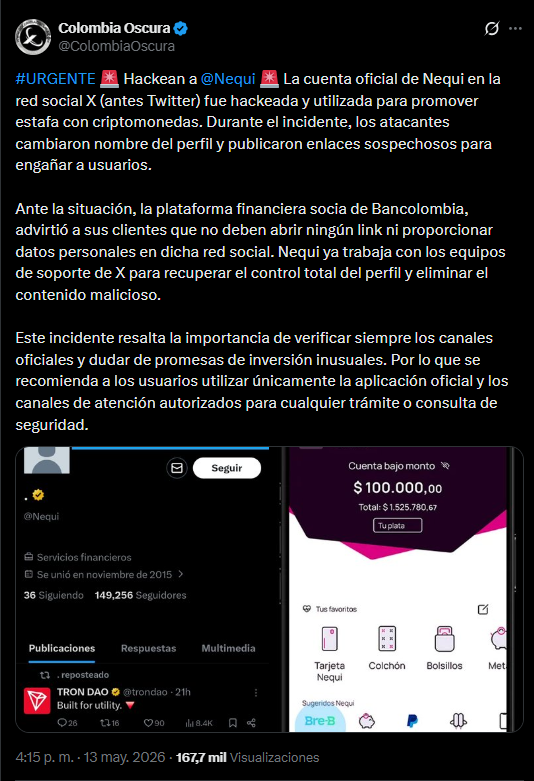
Security on digital platforms is not always uniform, and a new incident in Colombia highlights this. This Wednesday, May 13, the official account on X (formerly Twitter) of Nequi, the digital wallet with the largest number of users in the country, was hacked.
The incident manifested itself through a series of posts promoting cryptocurrenciesevidencing the security gap between the financial platform and its external communication channels.
Nequi is a digital financial ecosystem that allows millions of people to manage money from their mobile phone. During the time that the intrusion lasted, the attackers they used the verified profile of the entity to publish content related to the TRON (TRX) and Tether (USDT) cryptocurrenciesaccording to what was reported by local media.
During the event, the attackers modified the profile and cover image of Nequi’s verified account, including suspicious links. The unauthorized access lasted an indeterminate amount of time until the company’s team regained control.
These types of incidents usually seek to ensure that users, confident in the reputation of the brand, interact with links that could lead to scams or data theft (phishing).
On social networks, thousands of users reacted to the incident. While some warned about the risk of scams, others downplayed the fact. “They hacked X’s account, not the bank,” wrote one user.
The choice of this objective does not seem random if one considers the growing integration of the entity with the digital assets sector. As CriptoNoticias reported in 2024, Nequi already works as a bridge to the world of cryptocurrencies by being enabled as a means of payment on Wenia, the cryptoasset platform of the Bancolombia Group.
Through this alliance, users can buy the COPW stablecoin and exchange it for assets such as bitcoin or ether. This familiarity of Colombians with cryptocurrencies, from a familiar interface, seeks to reduce entry barriers to the ecosystem, but also increases the attractiveness of the brand for cybercriminals.
Digital security: the challenge of fintech in Colombia
The organization’s response focused on delink the attack on the social network from its financial infrastructure. Through an official statement, the company confirmed “unauthorized access” to its X profile, but was emphatic in clarifying the security of its internal systems: “Neither funds nor customer data were compromised,” the firm noted.
According to cybersecurity specialists, this type of breaches in social media accounts They usually occur due to theft of credentials or failures in third-party authentication systems, although Nequi has not detailed the exact cause of the incident.
Although Nequi regained control of his account and reinforced his protocols, the event generated an intense debate on the fragility of the public image of fintech. Unlike financial platforms, which use advanced authentication systems to move money, their social profiles depend on external providers; an exposed flank difficult to fully control.
This security asymmetry highlights the need for financial institutions Treat your communication channels with the same technical rigor as your digital vaults. In an environment where traditional banking and cryptocurrencies converge, user education is vital because verification of a social media account is no longer an absolute guarantee that the message is legitimate.
This incident forces companies in the sector to protect their public presence with the same priority as their assets. In the age of misinformation, a false publication can be as damaging to citizen trust as a technical failure in the application itself.