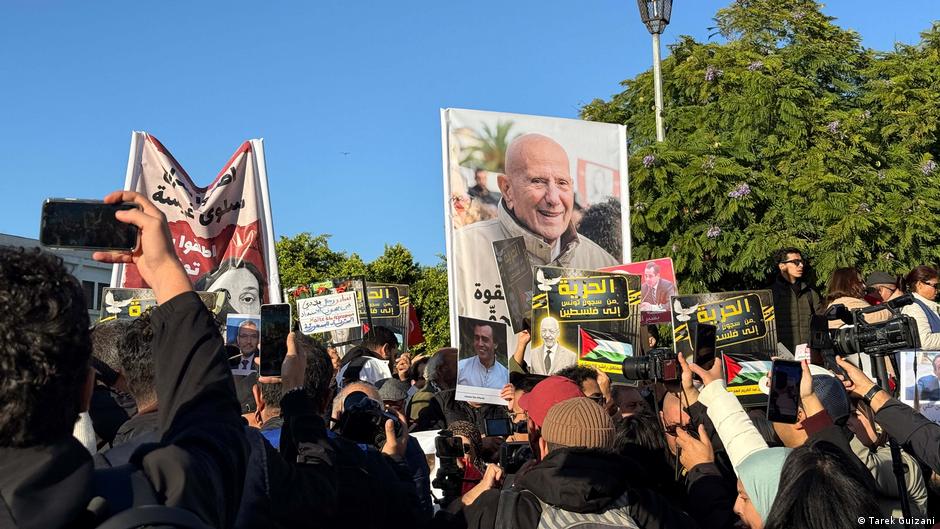
Human rights are a growing issue of concern in Tunisia. Courts on Tuesday upheld the convictions of two prominent Tunisian journalists accused of financial crimes. But media rights groups say the decision is a case of “judicial harassment” and argue that the charges lack evidence.
Ahead of the hearing, Amnesty International sounded the alarm, accusing Tunisian authorities of increasing their pressure on non-governmental organizations (NGOs) and using legal means to eliminate such groups. NGOs involved in human rights, migrant protection, election monitoring and advocacy against corruption are most affected.
“Dozens of NGOs are at risk of being dissolved, while others are being prosecuted,” Amnesty International’s Safia Ryan told DW. “The crackdown on civil society and independent media outlets is intensifying and their very existence is under threat.”
Last week, the U.N.‘Volker Turk, High Commissioner for Human Rights, called on Tunisia to end repression of opposition members and civil society groups. Speaking in Geneva, Turki said human rights activists were being criminalized.
The fate of Rached Ghannouchi, 84, chairman of the moderate Islamic Ennahda party, has also raised concerns. He ranks nationwide‘According to Reuters news agency, he is the most prominent prisoner to have been sentenced to life in prison, now serving almost 50 years behind bars.
Tunisian President Kais Saied, elected to office in 2019, has been consolidating power since 2021. He has sidelined Tunisia’s parliament, weakened its judiciary and cracked down on opposition members and critics.
Democracy was weakened
The Democratic Erosion Consortium, an American organization specializing in examining democratic structures, describes Said’s style of government as “stealth authoritarianism”, gradually weakening democratic institutions. According to the group, all that is left is a “facade of democracy”.
Tunisian authorities have been cracking down on dissidents for some time. In April 2025, a court in Tunis sentenced 37 opposition members and human rights defenders to between four and 66 years in prison. Amnesty International described the allegations as “baseless”. Yet in November, a court of appeals upheld most of the rulings.
Safia Ryan of Amnesty International said that, in the past year, “there have also been positive examples where sustained mass mobilization led to the release of arbitrarily detained individuals.” Nevertheless, authorities continued to undermine human rights and the rule of law, Ryan said.
According to Maria Josua of the German Institute for Global and Area Studies (GIGA), “The level of repression has now reached a point where the state not only suppresses criticism of human rights violations, but also persecutes those who criticize these abuses.” He pointed to the case of journalist Zied El Heni, who was sentenced to a year in prison in early May after criticizing Tunisia’s justice system.
The Tunisian court in question justified its harsh verdict by arguing that El Heini “has caused harm to others.” But GIGA analyst Joshua told DW that “legal instruments are increasingly being used to silence opposition and critical voices.”
The President denied the allegations
Meanwhile, President Kais Saied rejected accusations that he was leading the country toward authoritarianism, recently telling news agencies that he had no intention of becoming a dictator. He said that although civil liberties were guaranteed, no one stood above the law.
tunisian daily la pressewho is believed to be affiliated with the government expressed a similar view in early April. It said that while civil society organizations have played an important role in Tunisia’s democratic transition, they should stop receiving foreign funding.
Meanwhile, the situation of press freedom in Tunisia has also worsened. Reporters Without Borders (RSF) now ranks Tunisia 137th out of 180 countries when it comes to journalistic freedom, just one place above crisis-hit Libya. This is all the more worrying because Tunisia was once praised as a democratic role model.
“Press freedom has declined significantly since the overthrow of President Kais Saied in July 2021,” RSF warned.
Coordinated repression?
The dynamics unfolding within the Tunisian state must be carefully examined, said Manuel Gaith, head of the Friedrich Ebert Foundation (FES) Tunis office. “I am skeptical that every investigation or suspension of an NGO is really as strategic and targeted as it may appear from the outside,” Ghaith told DW. Sometimes such actions are simply the result of arbitrary or hasty state action, he added.
Migrant and refugee organizations in sub-Saharan Africa are also coming under increasing pressure. Five members of the Tunisian Refugee Council organization are currently on trial, accused of supporting illegal migration, even though they have cooperated with the UN refugee agency UNHCR. Human Rights Watch says civil society work is increasingly being criminalized.
Manuel Ghaith reported that Tunisian authorities often resort to financial or administrative issues to take action against civil society groups. “As soon as something doesn’t specifically meet the criteria, a suspension is issued.”
Former Saeed supporters have also not been spared from state repression. Earlier this year, MLA Ahmed Saidani was sentenced to eight months in jail after mocking Saeed in a satirical Facebook post. “This shows how low the regime’s tolerance threshold has fallen,” Maria Josua said, “when even small forms of satire and public criticism have been criminalized.”
Why is Saeed still popular domestically?
Observers argue that the country’s economic challenges are actually a significant factor in Saeed’s increasing domestic support. The Atlantic Council, a US think tank, says Tunisia has faced unemployment, inflation and economic stagnation since the 2011 revolution. Amid this instability, President Saied is still viewed more favorably by Tunisia’s divided political elite.
According to Ghaith, although the economic situation has not improved significantly since his coup, “it has not gotten dramatically worse either.” However, at the same time, the debt ratio continues to increase, and the Tunisian economy is coming under increasing pressure.
Ghaith argued that the government was simply “buying time” by going after civil society. He said, this is dangerous in view of the country’s increasing debt and inflation. Furthermore, “solving growth and employment issues is being postponed and becoming more expensive to fix as time goes on.”
Giga expert Maria Joshua agreed. “He said taking such drastic action against any kind of criticism is a sign of the weakness of his authoritarian system,” he told DW. He added that “he is clearly no longer able to garner support through political ideas or economic success.”
He said he believed EU countries had a role to play: “Regardless of migration interests, European countries should continue to insist that Tunisia respect democratic principles, the rule of law and human rights.”
This article was translated from German.