
The price of ether (ETH), Ethereum’s cryptocurrency, is trading today, May 25, 2026, at the time of writing, at $2,100 after having hit a low of $2,010 over the weekend.
This movement of the second largest crypto asset by market capitalization, after bitcoin (BTC), occurs after two and a half weeks of decline that accumulated a loss of 13% and that leads operators to debate whether the area close to $2,000 represents a buying opportunity or the prelude to a greater collapse.
Recent volatility accelerated following the consecutive departure of several high-profile figures from the Ethereum Foundation, the nonprofit organization that supports the network’s development. The developers Pablo Voorvaart and Julian Ma announced their resignations from the institution on May 18 and 19, 2026, respectively, which generated an exodus that hits investor confidence and weakens the price of the asset.
In an attempt to calm things down, Ethereum co-founder Vitalik Buterin announced yesterday, May 24, that his power within the board will continue to deliberately decrease and clarified that he has no special powers over the other members, as reported by CriptoNoticias.
To counter the impact of the retirement of key leaders, Buterin outlined a smaller, more focused institution that “will sell less ETH,” a promise that seeks to allay fears of a flood of coins on the marketespecially considering that the foundation owns 0.16% of the cryptocurrency’s total supply.
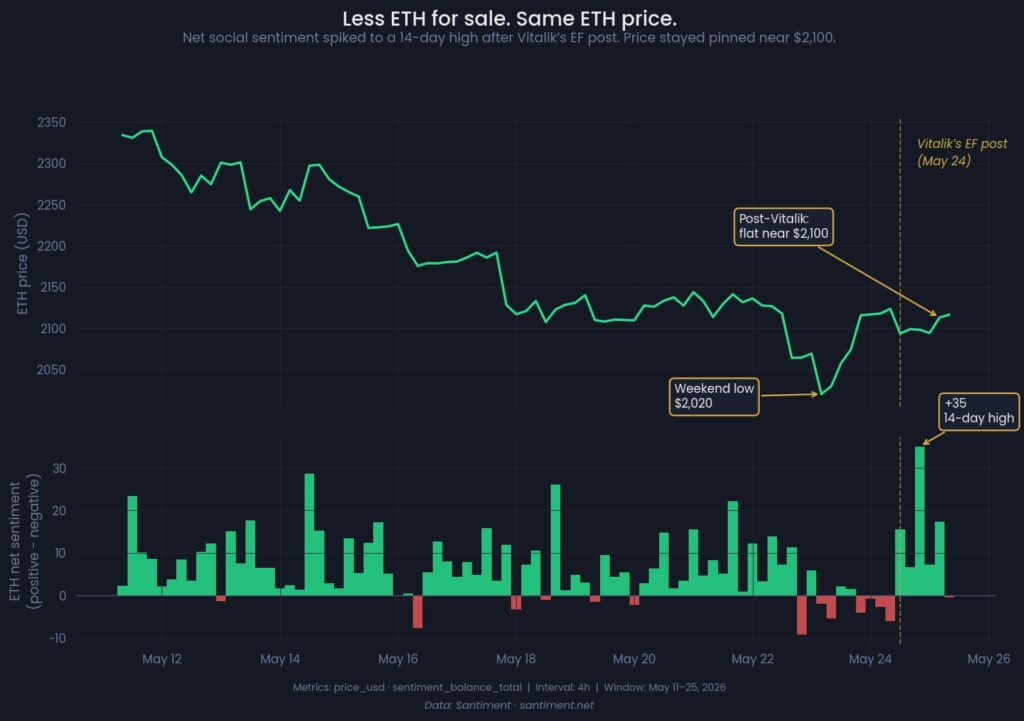
According to signature data analysis platform Santiment, after this announcement “the sentiment turned bullish” and the crowd’s perception towards mentions of Vitalik reached 76% optimism, although the analysis platform warned that in the short term there was “less ETH for sale. Same price of ETH.
The chart shows a clear divergence between ETH price and social sentiment. Santiment collects and analyzes messages in real time from social networks such as Despite the price drop, social sentiment remains mostly positive and had a strong takeoff after Vitalik Buterin’s post.
For its part, the Japanese research firm XWIN Research explained that internal dynamics show “fragility” due to the presence of large investors. «An important factor is hidden liquidity. Even if aggressive buying increases, large sell orders from market makers and whales can continue to absorb those purchases,” the company noted. This absorption phenomenon causes the price action to remain weak despite the fact that there is real demand in the spot market.
Likewise, the variables of the traditional economy play a decisive role in the current price, according to specialists. Analyst Michael van de Poppe explained that “in recent months, the price of ETH has fallen mainly due to macroeconomic reasons.” As detailed, there is a negative correlation between decentralized finance (DeFi) and US government bond yields. When government bond rates rise, investors reduce their risk appetite, lor that negatively affects DeFi platforms and, therefore, ether, its base asset.
Along the same lines, XWIN Research noted that markets returned to focus on the risks of inflation and high interest rates for longer, which represents a significant obstacle for assets considered “risky” such as ETH.
This macroeconomic dynamic has caused ether to accumulate a sharp drop against bitcoin (BTC), currently trading near 0.0273 BTC. From a technical point of view, the price has reached a relevant support zone in high time frames, an area that van de Poppe had been pointing out since the rejection at 0.0325 BTC, in the following chart. “This is the area to accumulate ether,” said van de Poppe, who believes that “building a position in ETH within this range is not a bad place to start.”
From the technical perspective, XWIN Research agreed that ETH may approach important support zones near $1,984 and $1,937, although if the macroeconomy stabilizes, current prices could be considered as an undervalued area in the future.
On the other hand, there are operators who prefer to remain cautious in the face of structural weakness. Analyst Ted Pillows defended his position reserved remembering that he sold his holdings when the asset was trading between $4,500 and $4,900.
“Some call me bearish, but being realistic is not being bearish,” said Pillows, who criticized the euphoria of social networks by pointing out that “the same influencers shouting ‘louder’ are the reason why many people are down 80% today.” His current recommendation to market participants focuses on caution: “Protect your capital first.”
This confluence of technical, fundamental and macroeconomic factors keeps strategists divided over the direction of ether. Investors should be attentive to whether the cryptocurrency manages to consolidate a technical floor above $2,000 or if selling pressure drags it towards lower supports.