
Strategy’s bitcoin sale broke the narrative of the compulsive buyer who never sells.
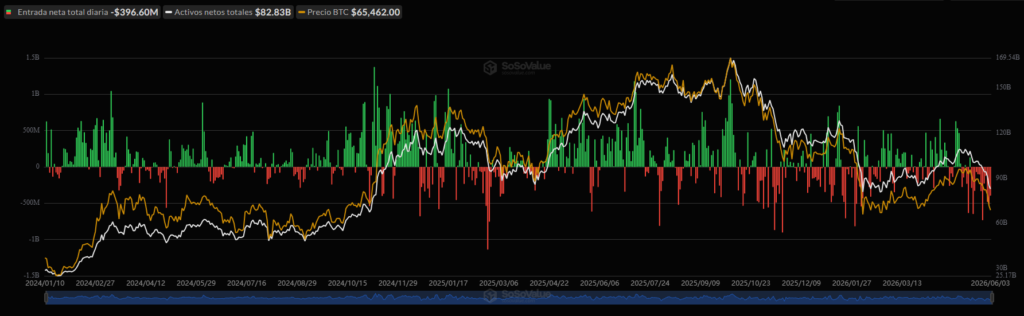
Bitcoin ETFs accumulate the longest streak of capital outflows in their history.
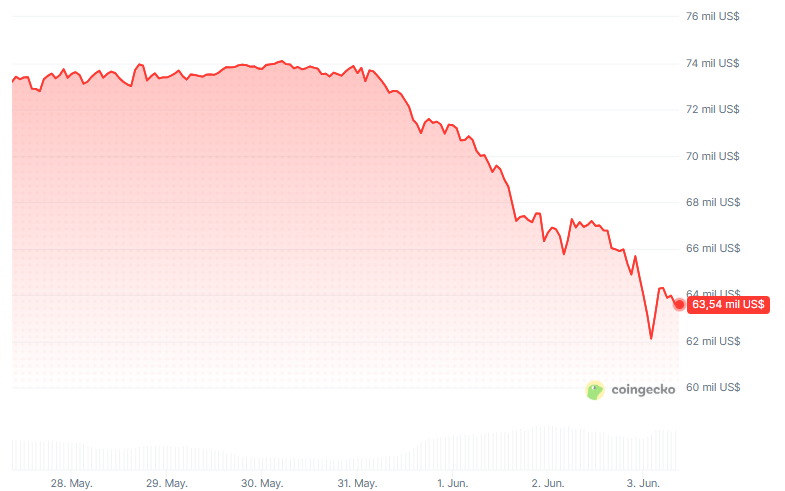
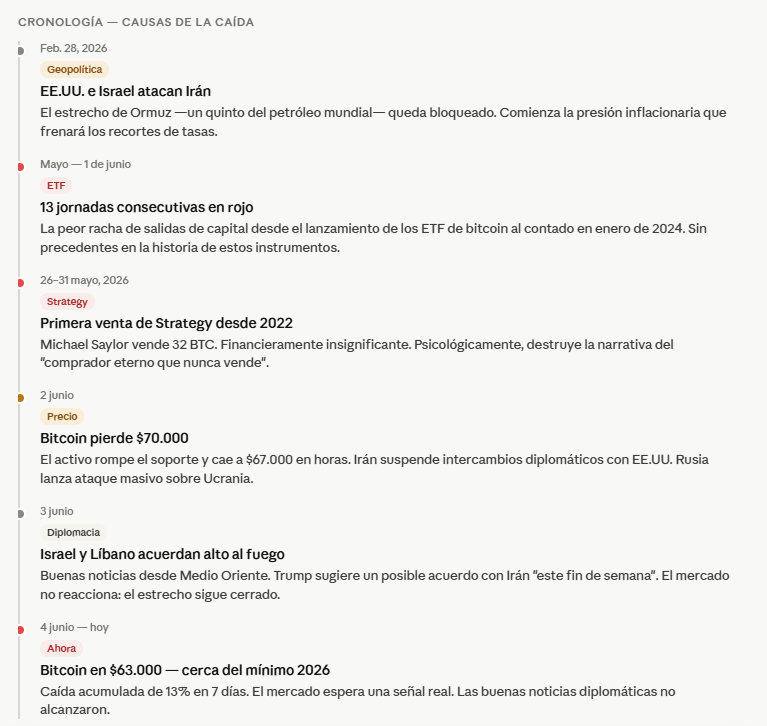
Bitcoin (BTC) is trading this Thursday, June 4, 2026 around $63,000a level that places it close to the minimum of the current year, which is $60,000 and was reached in February. The drop in the price of bitcoin accumulates 13% in the last seven days and occurs at a time when, paradoxically, positive diplomatic signals are arriving from the Middle East.
The following graph shows How the price of the digital currency has moved in the last week:
Israel and Lebanon agreed yesterday, Wednesday, June 3, to implement a ceasefire. This is the most concrete step toward a broader agreement to end the conflict between the United States, Israel and Iran. President Donald Trump went further and suggested there could be developments in negotiations with Iran as early as this weekend.
The news should have been a relief for the bitcoin market, but it wasn’t. The reason is that The fall of bitcoin does not respond to an isolated factor. In recent days, three downward pressures converged and reinforced each other.
As CriptoNoticias has explained, the first downward pressure is the Spot bitcoin ETFs in the United States, which have accumulated 13 consecutive days of capital outflowsthe longest negative streak since its launch in January 2024. When investors withdraw money from these funds, managers can sell bitcoin to redeem the capital, which puts downward pressure on the price.
The second cause was Strategy. Michael Saylor’s company, the largest corporate holder of bitcoin in the world, announced that between May 26 and 31 sold 32 BTC for approximately $2.5 million.
In numerical terms, the operation is almost irrelevant: it represents 0.0037% of its holdings. But markets don’t read balance sheets, they read signals. And this signal broke something that many investors did not want to see broken: the narrative of the eternal buyer who never sold. That certainty functioned as a psychological anchor.
The third reason is the geopolitical context. The Strait of Hormuzthrough which nearly a fifth of the world’s oil and liquefied natural gas transits, traffic has been severely interrupted for more than three months since the United States and Israel launched attacks on Iran in February. That fuels the risk of inflation and reduces expectations of interest rate cuts, pushing investors away from assets considered “risky,” such as bitcoin.
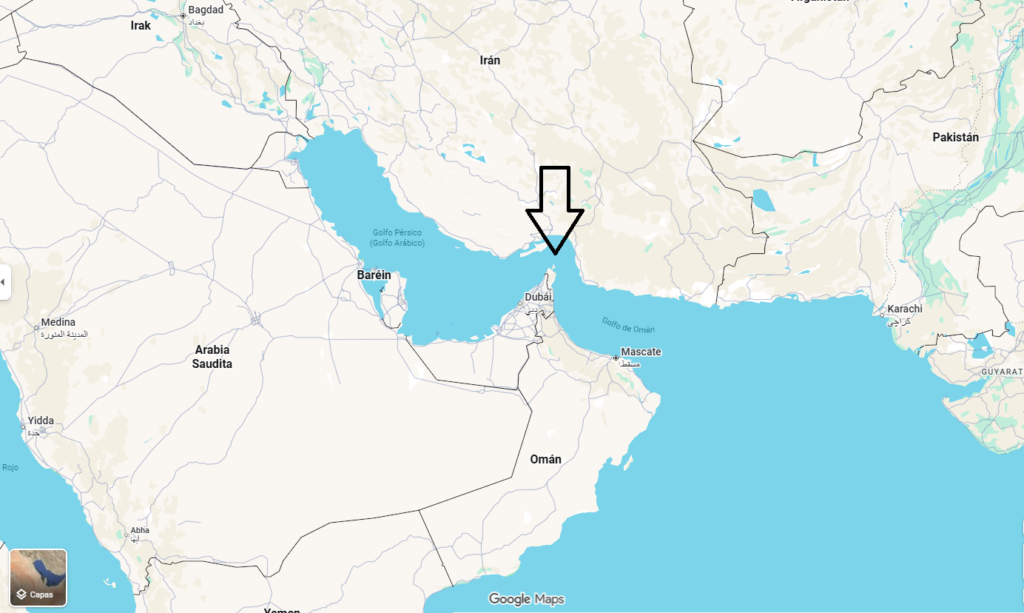
The question is why the agreement between Israel and Lebanon did not stop the decline. The answer is in the details: The Strait of Hormuz remains closed, the attacks did not completely stop —this Thursday were reported new Israeli bombings in southern Lebanon—and Iran clarified that, for now, there is no real progress in the negotiations with Washington.
As long as the strait remains blocked, global inflationary pressure does not subside, and with it the conditions that keep bitcoin under pressure do not subside. A complete agreement that reopens the maritime route would be the catalyst that the market expects. For now, there are only promises.
Bitcoin is today close to 50% below its all-time high of $126,000. At $63,000, the asset is approaching the floor recorded in the first months of 2026. If that level does not hold, several technical analysts have already placed their next reference between $40,000 and $45,000..
The market waits for a signal capable of reversing the trend. The good news from the Middle East was not enough. Still.