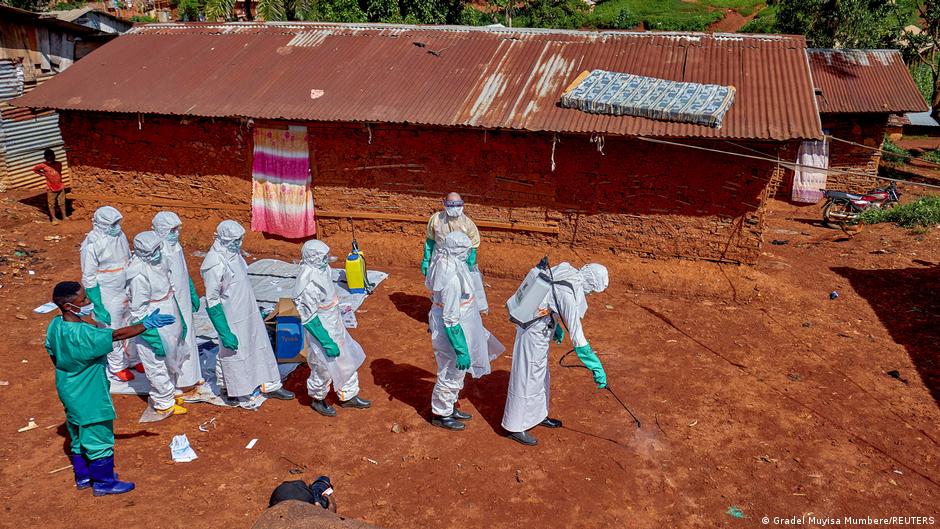
Three weeks after the start of the latest Ebola epidemic in the Democratic Republic of Congo, the facts are as follows: 397 confirmed cases, including 63 confirmed deaths, according to the latest data reported by the African Union’s Africa Centers for Disease Control and Prevention.
And yet: “The community doesn’t believe in this disease. Despite the deaths, people don’t believe in it,” said John Tumuzimbe, head of a team calling for dignified and safe burials in the small town of Mongbvalu. It is one of the epicenters of the Ebola epidemic in Congo’s northeastern Ituri province.
“We initially thought about diseases like malaria, typhoid or diarrhea. But after so many deaths, we sent the samples to the INRB,” Tumujimbe told DW.
INRB – Congo’s National Institute for Biomedical Research in the capital Kinshasa – confirmed that these were indeed cases of Ebola. This led health officials to declare the Ebola epidemic the 17th to be recorded in Congo since the virus was first discovered in 1976.
Ebola rumors lead to arson attacks
But health officials say many Maungawwalu residents reject this scientific answer.
“When the first deaths occurred, there was talk that the coffins were a problem, that it spread from there,” said a resident of Mongbwalu, who did not want to be named.
Tumujimbe also heard this rumor. “That’s how it started: People talked about a coffin that kills people. And then more people died.”
Another rumor: aid workers and paramedics were spreading the virus through the antennas of their vehicles.
In late May, an angry mob gathered at the General Hospital in Mongbavalu. They demanded that authorities return the bodies of their dead, eventually setting fire to a tent of the aid organization Doctors Without Borders. The organization had to withdraw its staff.
“There was panic,” hospital director Richard Locudi told DW. “This saved many suspected cases. Eighteen patients who were under observation disappeared.”
Health concerns Activists suspected that Ebola patients might spread the disease to people who were sheltering them. There is still no vaccine for the Bundibugyo variant of the Ebola virus currently spreading.
Familiar rumors blunt Ebola response
Christopher Nehring specializes in research on disinformation and is co-author of A report on the current Ebola epidemic For the Konrad Adenauer Foundation. He said similar rumors emerge in every health emergency.
“They say the disease comes from the laboratory as a biological weapon; the vaccination is more harmful than the virus; there is a simple cure that is being hidden; the disease is not real. Big Pharma is mentioned either as a profiteer of the crisis or as the one that caused it,” Nehring told DW.
“This has all been known for decades. And it varies, there are 100 different variations of these stories.”
For the report, Nehring sought information from Congolese fact checkers. One of them is Ange Kasongo, founder of Kinshasa-based Balobaki Check. Speaking to DW, she recalls her conversations with miners – gold mining is vital to the economy in Ituri province.
“He said that rumors and myths about the death were spreading, but people there did not believe them,” Kasongo said.
The explanation given to him was: “If a businessman wants to earn or mine a lot of gold, he can also resort to mysterious acts to eliminate his competitors.”
This shows that economic pressure is also becoming a hindrance in dealing with the epidemic openly.
Kasongo highlighted another rumor: private messages circulating on WhatsApp claim there was a plot between Congolese President Félix Tshisekedi and renowned virologist Jean-Jacques Muyembe – who discovered the virus 50 years ago – to wipe out the population in eastern Congo.
Balobaki Czech team could not get any support proof of this claim.
Without credible media, disinformation spreads easily
The global community is providing very little funding for emergency relief measures, making the fight against Ebola difficult.
US President Donald Trump withdrew the United States from the World Health Organization in 2025, and ordered massive cuts to crisis management programs at USAID and the US Centers for Disease Control and Prevention.
European governments have also cut funding, partly due to the cost of militarization efforts in the wake of the war in Ukraine.
For Nehring, this situation has also fueled the spread of fake news. “If money for health aid has already been cut, you can’t even talk about a bigger budget for health communication,” Nehring said.
Still, Ange Kasongo said officials are making every effort to communicate clearly. But he also told DW that it has its limitations. “How can we ensure that information is given verbally – not just in French, not just in the four national languages?”
According to Kasongo, it is important to bring community leaders on board and provide them access to reliable information.
Rachidi Kudra contributed reporting.
This article was originally written in German.