
The bot was operated by Ethereum block building company Eureka Builder.
Eureka contacted the recipient and offered a reward, but the user refused to return the money.
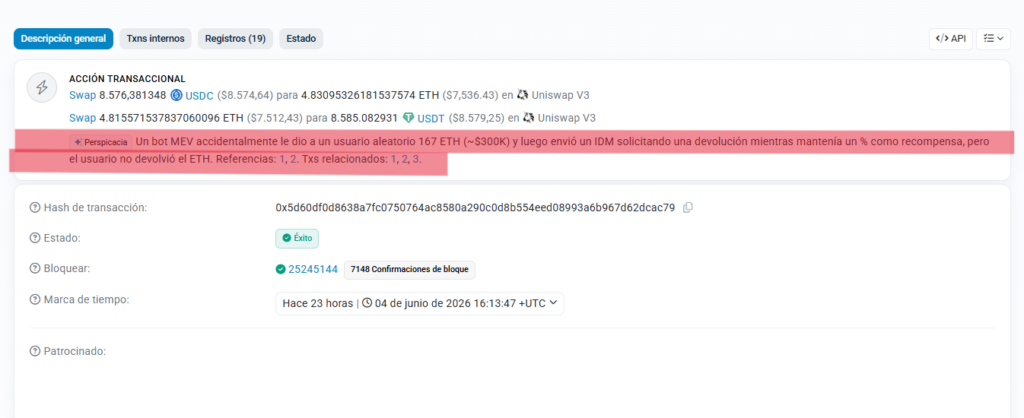
An MEV bot on the Ethereum network (an automated program that detects and takes advantage of profit opportunities by manipulating the order of transactions within a block) mistakenly sent 167 ether (ETH), equivalent to approximately USD 300,000, to a random wallet on June 4, 2026, as reported by the on-chain analysis firm PeckShield. The person who received the funds did not want to return them.
The MEV bot that produced the failure is operated by Eureka Builder, a company that competes to build blocks that include the most profitable transactions to offer to Ethereum validators.
The error originated in the bot’s fee collection logic, explained from PeckShield. On cryptocurrency networks like Ethereum, users can pay an additional voluntary fee, called priority feeso that your transaction is processed with priority within the block. A failure in that operation led to the bot will interpret that logic incorrectly and send 167 ETH to a random wallet as if that amount were one of those commissions, instead of executing another planned operation.
As recorded in the Etherscan block explorer, the Eureka developers sent an on-chain message (a communication written directly on the chain, publicly visible and permanently) to the recipient of the 167 ETH requesting a refund and offering to keep a percentage as a rewardbut the user did not return the funds.
The diagnosis of a Eureka competitor
Rezo, a developer who operates his own MEV bots, described the incident as “operational immaturity disguised as sophisticated automation”.
According to Rezo, which competes directly in the same market as Eureka, MEV teams that operate seriously apply multi-layer validationstrict limits on each operation and automatic techniques called kill switches (emergency stop mechanisms that stop the system when abnormal behavior is detected). «MEV is only going to grow. The long-term survivors will be the operators who understood that speed without rigorous controls is just expensive gambling with better marketing,” the developer wrote in X.
The incident exposes that Ethereum’s programmability that enables sophisticated financial tools also multiplies risk vectors. Each additional layer of automated logic is a point where a code error can lead to losses that, once confirmed in the network, cannot be reversed individually by any actor.