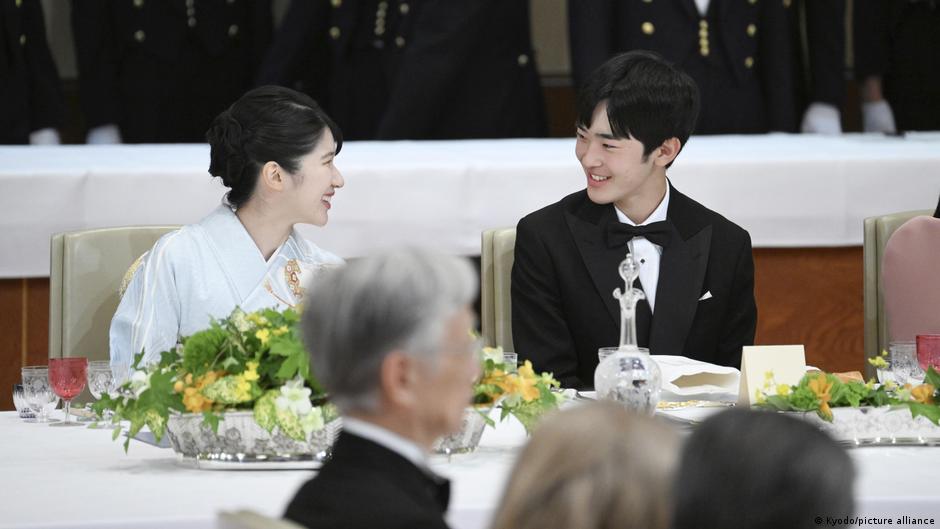
Japan’s parliament on Friday approved changes to imperial succession laws designed to protect the crown prince, the only young male left in the family, if he does not have a son.
The number of royal family members has been declining for decades, not least because of rules that exclude all female heirs and their children from the entirely patrilineal line of succession.
Opinion polls show that the agreement reached by Parliament – while Prime Minister Sanae Takachi supported it – is unpopular among the broader public, who want to see Emperor Naruhito’s daughter inherit the throne.
Why is this an issue?
Naruhito, 66, who ascended the Chrysanthemum Throne in 2019, and his wife Empress Masako have one child together, Princess Aiko, 24. Under the current system she cannot attain the throne.
Naruhito’s younger brother Akishino (also known as Fumihito) is next in line to the throne and is himself 60 years old. They have two grown daughters and an only son, 19-year-old Prince Hisahito, who is the last male heir to the lineage and the only one under the age of 60.
If Hisahito, who is not yet married, does not have a son, the lineage will end.
What rules regarding royal succession have and have not changed?
Japan’s succession reforms agreed Friday do not alter the purely patrilineal nature of the line of succession.
This means that Princess Aiko and her children will remain ineligible to ever accede to the throne, even in the event the male line ends.
Instead of this, two other rules have been changed. First, Japanese princesses would be allowed to marry “commoner” husbands in the future without losing their royal status. The issue came to a head in 2021 when Fumihito’s daughter Princess Mako married her university boyfriend and gave up her royal titles.
Princess Aiko is also currently unmarried.
The rule change that seeks to enable the possibility of recruiting more men into lineage is more complex and controversial.
The bill allows the royal family to adopt distant male relatives over the age of 15 into the royal family – as long as they are unmarried – and allow their future sons to become eligible heirs to the throne.
A total of 11 families left the imperial register to reduce the financial burden on the monarchy after Japan’s defeat in World War II. According to the Imperial Household Agency, people who are eligible to be adopted back only share a common ancestry with Emperor Naruhito if they can be traced back to the 15th century or more than 30 generations.
Why are the changes controversial?
Japan’s first female prime minister, Sanae Takaichi, is a supporter of the male-only line of succession, but she also faced resistance from the backbench of her own centre-right Liberal Democratic Party (LDP).
Seiichiro Murakami, a veteran of the conservative LDP, said after the bill passed in the lower house on July 10 that Aiko’s refusal to become emperor was “completely outrageous”.
Hideya Kawanishi, a Nagoya University professor and expert on Japan’s imperial family, told the AFP news agency that large sections of the LDP had the “paramount goal” of preserving the male line.
He said, “This is because the solid conservative base supporting her holds similar views of male chauvinism, and this measure was probably necessary to secure their votes in the elections.”
But the professor also said he believed the amendments risked “undermining public support for the symbolic monarch system” because they may not reflect public opinion – something recent polling also suggests.
A survey published by Japanese daily Mainichi Shimbun Last month it found that only 23% of respondents approved of distant relative adoption, while 34% were opposed and the largest share declined to offer an opinion. But on the contrary, it was found that 72% of respondents said they would be in favor of changing the rules to allow women to become monarchs.
Has Japan ever had a female emperor?
Yes, many – but not in modern Japan.
Given that the bloodline is mythologically believed to be over 2,500 years old, and is believed to be descended from the Shinto sun goddess Amaterasu, it is difficult to distinguish between reality and legend, especially in past centuries.
Of the entire list of all 126 Japanese emperors – real, legendary, or otherwise – 12 were women.
As the centuries passed, female emperors became much rarer, but two women nevertheless sat on the Chrysanthemum Throne in the Edo period alone, most recently Empress Go-Sakuramachi from 1762–1771.
Rules formally excluding women from eligibility to become emperor date back only to 1890, and Japan’s Imperial era ended with defeat in World War II.
Edited by: Rana Taha
Don’t let algorithms hide news. If you rely on our team for reliable reporting, please take a moment Choose us as your favorite source on GoogleThat’s why you’ll always see our verified news first.