The volume of cryptocurrency transactions doubled in one year.
Venezuelans do not prefer bitcoin, they use stablecoins, ETH and altcoins more.
Immersed in a strong political upheaval that has been aggravated after the presidential elections held last July, Venezuelans turn to cryptocurrencies as a refuge of value. Digital assets become one of the main tools to face uncertainty, while the international dispute over the electoral results continues.
Although last year’s figures seemed to indicate a slight disinterest in the sector, the data for this 2024 They point to a substantial growth in cryptocurrency transactions in Venezuelan territory. This is stated in the 2024 Chainalysis report for Latin America, which positions the South American country in fourth place, behind Argentina, Brazil and Mexico.
The country is only one place higher than last year. An advance that seems small, but is accompanied by an interannual growth of more than 110% (double compared to 2023). This rise implies a traded volume of more than 25 billion dollarswith which Venezuela far exceeds the progress achieved by any other country in the region during the last year.
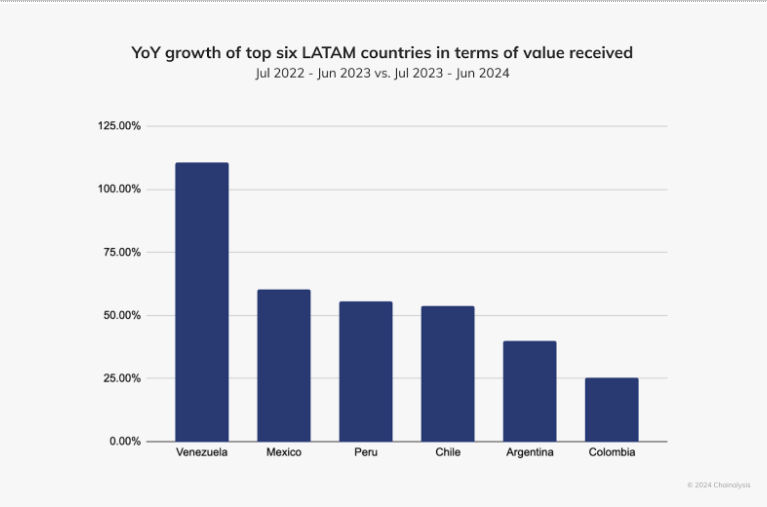
“First of all, it seems that Venezuelans are attracted to digital assets to combat the plummeting value of their local currency, the bolivar (VES),” Chainalysis notes, also citing Nicolás Maduro’s recent announcements to “retake cryptocurrencies”, although until now no concrete plans have been announced on the topic.
In that sense, the report recalls that the constant decline that the bolivar has experienced for several years makes Venezuela continue to be one of the fastest growing cryptocurrency markets in the region. This, despite the tumult represented by the corruption scandal that broke out last year and that involved the Cryptoasset Superintendence (Sunacrip), causing their intervention and stoking fears generated by the raids on bitcoin mining farms that are still underway.
All of these events, reported by CriptoNoticias, caused a strong setback in the Venezuelan ecosystem and practically cut off the Bitcoin mining industry, which was on the rise. Likewise, they overshadowed the legal initiatives that had placed the country among the pioneers in regulatory matters.
In fact, this year it is observed a decline in interest in bitcoin among Venezuelans, since it was only in 12% of transactions (last year transactions with BTC represented more than 13%). This time eyes fell on ether (ETH) and altcoins, which were involved in more than 30% of transactions. Although –as in the rest of the region– the preferred ones are the stableconis (56.4% of transactions).
The rise of DeFi
The economic and political crisis that affects the country also seems to have had an impact on greater interest in the use of platforms for decentralized finance (DeFi), since the statistics show a substantial increase since the last quarter of 2023. The contrast with data from previous years is very strong, considering that the use of centralized exchanges was around 100% in 2022 and 92% at the beginning of 2023, as seen in the following graph:
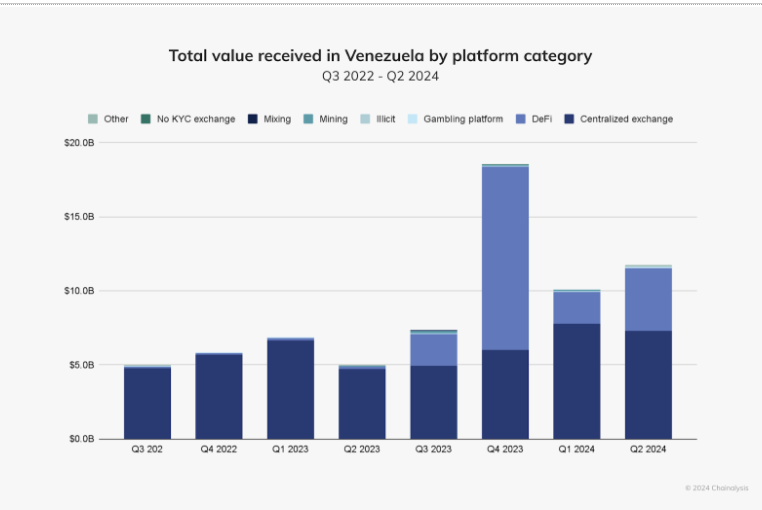
“Although centralized services remain the most popular so far this year, the growing market share of DeFi will be an area to watch in the country in the near future,” comments the Chainalysis report, noting that this indicates that the Cryptocurrency users in Venezuela are becoming more open to innovation. They sense that it could also mean that the country’s inhabitants They have expectations of favorable changes.
The analysis firm closes its evaluation of the Venezuela case, concluding that the country’s relations with cryptocurrencies They are usually among the “most tumultuous” in the region.