
“Institutional investors are showing renewed interest,” the report says.
Regulatory challenges represent the main obstacle to broader adoption, they point out.
A study by the Alternative Investment Management Association (AIMA) reveals that investment in cryptocurrencies by traditional hedge funds in the United States has increased significantly.
According to him reportinvestments in digital assets increase as regulatory clarity and ETFs boost confidence among investors. By the numbers, nearly half (47%) of traditional hedge funds surveyed this year have exposure to digital assets, compared to 29% in 2023 and 37% in 2022.
This increase is driven by greater regulatory clarity and the launch of spot bitcoin (BTC) and ether (ETH) ETFs in Asia and the US. Among the funds already invested, 67% plan to maintain the same level of investmentwhile the remaining 33% plan to increase their capital in digital assets by the end of 2024.
The renewed interest in digital assets is not only limited to hedge funds themselves, but is also reflected in the growing demand among their institutional clients.
43% of traditional hedge funds, whether or not they invest in digital assets, report greater interest from their institutional clients. Private organizations that manage the wealth of wealthy families and high net worth individuals (HNWIs) remain the largest categories of investors in hedge funds focused on digital assets, followed by hedge funds, the report says.
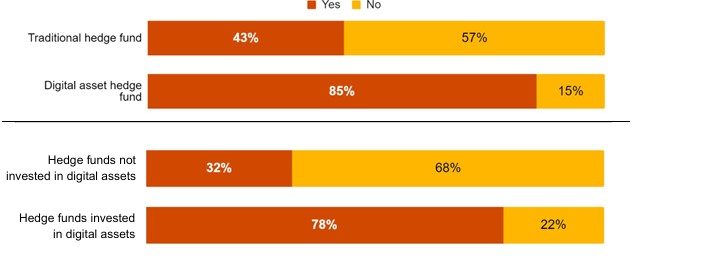
Interest in fund tokenization is also on the rise, with 33% of respondents either committed to or exploring this option, compared to about a quarter of respondents last year. Although only 12% of digital asset-focused hedge funds are currently investing in tokenized assets, regulatory challenges represent the main obstacle to broader adoption, the report highlights.
James Delaney, managing director of Asset Management Regulation at AIMA, said the findings of this year’s report “indicate a steady recovery in confidence over the past year”.
“Institutional investors are showing renewed interest, driven by several key factors, including greater regulatory clarity such as the European Union’s MiCA regulation, advances in infrastructure, and the approval of new products such as spot bitcoin and ether ETFs. by the U.S. Securities and Exchange Commission,” he added.
Despite the growth of the cryptocurrency industry, the hedge fund sector remains cautious. 76% of funds that do not currently invest in digital assets They consider it unlikely to enter this market in the next three years, an increase of 54% in 2023.
The main barrier, mentioned by 38% of the funds, is the exclusion of digital assets from investment contractsa concern that has risen to fourth place this year. Although regulatory uncertainty remains a concern, it has decreased thanks to the adoption of clearer regulatory frameworks, such as the EU’s MiCA.
This interest and adoption by hedge funds coincides with the growing presence of bitcoin in fund treasuries, with more than 50,000 BTC reported in the portfolios of US hedge funds, as reported by CriptoNoticias in August this year.
This article was created using artificial intelligence and edited by a human Editor.