
A quantum attack would allow “ownership of everything,” according to Pruden.
“The gap between current ideas and what we need is still huge,” says Pruden.
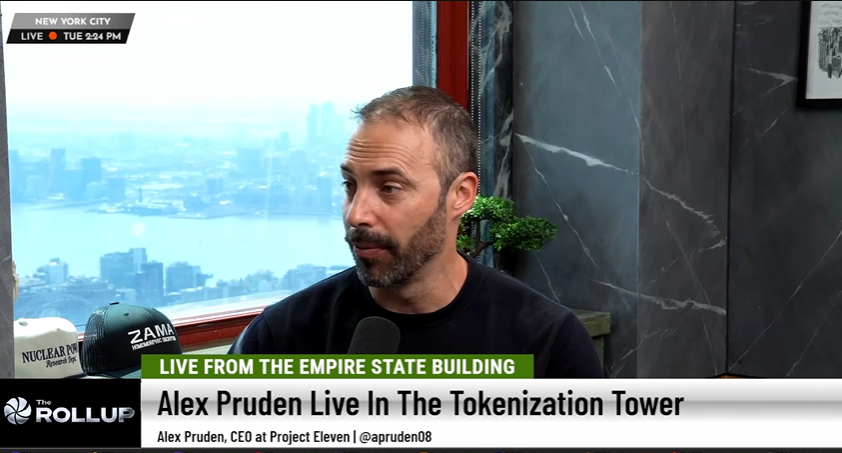
Project Eleven CEO Alex Pruden believes that an advance in quantum computing could alter the very foundation of cryptocurrencies. According to him, this theoretical scenario “breaks the entire philosophical model of crypto ownership.”
His warning, shared during an interview published on April 14 in The Rollup, points to a structural change in the face of the potential arrival of ‘Q-day’, a day in which, if current security fails, The notion that each user controls their funds would no longer be valid.
The core of the risk, as he explained, is in public key cryptography based on elliptic curves (ECC), the system that networks like Bitcoin use to protect transaction signatures. According to Pruden, “if a quantum computer is able to reverse engineer the private key from the public key, In a very real sense, they own everything.”.
However, that scenario is not possible today. The CEO himself recognized that “there is no quantum computer today that can break Bitcoin,” although he maintained that the threat has become more concrete in recent years due to experimental advances and the reduction of resources necessary to attack cryptography.
In that sense, a recent study by Google Quantum AI reduced the quantum resources needed to break Bitcoin’s cryptography by up to 20 times, which alarmed many participants and specialists in the ecosystem. Among them, Eli Nagar, CEO of the Braiins mining pool, who concluded that quantum risk is closer than the community assumes based on Google research.
On the other hand, experts like Adam Back consider that quantum risk is “1 or 2 decades” away.
A technical problem that affects the entire ecosystem
If a quantum attack became viable, the impact would be direct on asset ownership. A theoretical quantum computer capable of deriving private keys could transfer funds without authorization, affecting prices, liquidity and market confidence.
The problem is not limited to individual security, but to the entire structure of the system, as the CEO explained in the interview: “The gap between current ideas and what we need is still enormous.” He also added that any solution would involve “a total change: every protocol will change, every smart contract will be redeployed and every user balance will move.” That is, it would not be a patch, but rather a comprehensive migration of the infrastructure.
Finally, Pruden stressed that, unlike systems like traditional banking, in networks like Bitcoin there is no authority capable of coordinating a response without affecting trust. In this context, he maintained that the objective should be “a smooth transition”because that would imply “price stability, infrastructure stability and that no one loses money.”
However, the executive himself admits that this scenario is not guaranteed. “Some version of Bitcoin and every digital asset will definitely survive this; it’s just a question of how much chaos we want to experience along the way,” he said. The uncertainty, in his approach, is not whether it will be necessary to adapt, but how and at what cost for the system.