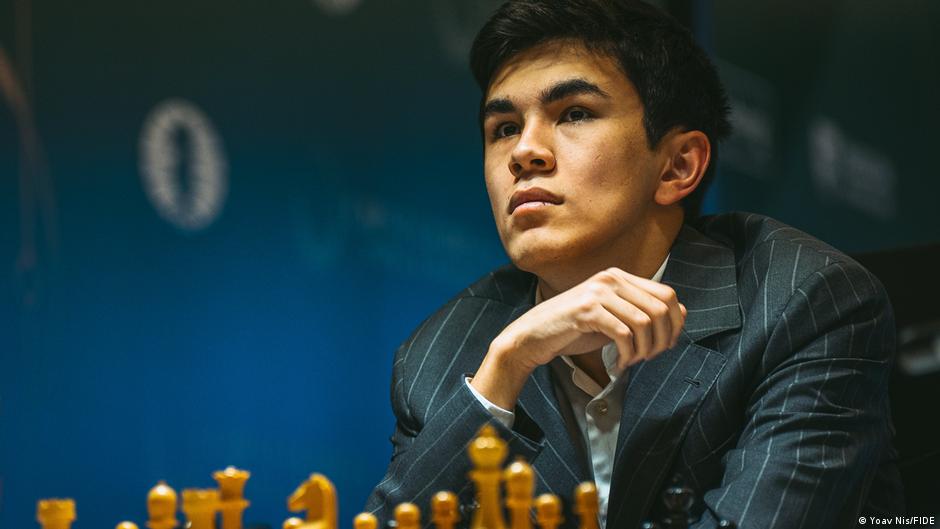
The result was decided in the final round. A draw against his nearest rival, Anish Giri of the Netherlands, was enough for Javokhir Sindarov to win the World Chess Candidates Tournament in Cyprus.
“Every round was very, very difficult, and last week was the hardest of my life,” the new chess superstar said after his spectacular victory. “I slept really badly and I’m glad it’s over.”
Winning the Candidates Tournament means 20-year-old Sindarov will now face defending world champion Dommaraju Gukesh of India for the World Chess Championship title in late 2026. With Gukesh just 19 years old, it will be a duel between two young stars from the rising chess nations of India and Uzbekistan.
Chess stars are reaching their first peak
Sindarov, who became a Grandmaster at the age of 12 and has been in excellent form for several months, dominated the Candidates Tournament from the beginning. The first decisive moment came in the fourth round of 14, when he defeated top American favorite and 2018 World Chess Vice-Champion Fabiano Caruana.
With this, the Uzbeks took the lead in the standings and never gave it up. In the first six games, he achieved a sensational five victories – a feat that no chess player had ever achieved in high-level Candidates tournaments.
Sindarov represents a continuation of the trend of young players from outside the traditional chess-playing countries of Europe reaching the top of the game. These talents are predominantly from Asia and that continent’s dominance in chess was also evident in Cyprus in the women’s competition. India’s Vaishali Rameshbabu won the Candidates Tournament by defeating Russia’s Katerina Lagno in the final round and earned the right to challenge world champion Xu Wenjun (China).
It is no surprise that Uzbekistan is now establishing itself as a chess superpower along with China and India. “The young talent in Uzbekistan is really very strong,” Rustam Kasimjanov, a former elite player for Uzbekistan, told Deutsche Welle five years ago.
Kasimjanov, who has lived near Bonn for many years, is considered a catalyst for the chess boom in the Central Asian country and has personally trained many of Uzbekistan’s young chess stars. Conditions for top-level chess in his homeland are now very good: “In Uzbekistan, the state has been supporting the game of chess with substantial funding for many years,” he said.
German influence
Former champion Kasimjanov isn’t Sindarov’s only connection to Germany. Their head coach, Roman Vidonyak, was born in Ukraine but lived in Munich for many years. He has been coaching Sindarov for about a year.
“We still have big plans,” he told the chess news site. chess board After the victory of his disciple. The goal now is to win a World Championship title and then try to establish Sindarov as the premier player of his generation. The man standing in the way of that mission is reigning world champion Gukesh, who is 19 years younger than Sindarov.
Things have not been going well for Gukesh since winning the title in late 2024. He is currently ranked only 15th in the world. Therefore, the chances of Sindarov becoming world champion this winter are quite strong. Norwegian Magnus Carlsen is still considered the best chess player, but he no longer competes in World Championships, preferring other formats.
Germany struggles to keep up with Asia
Apart from Sindarov, Germany’s Matthias Blubaum also enjoyed a strong tournament. ‘The Lone Wolf from Lemgo’ as Chess Magazine new to chess As he has been labeled, he was a surprise qualifier for the Candidates Tournament and became the first German to compete in it for more than 35 years.
As an underdog, Blubaum took few risks in Cyprus, defended judiciously, and carried his game to the safe harbor of draws. Even rising star Sindarov could not play more than two draws against him. Bluebaum suffered only two losses.
“It’s amazing how confidently Matthias Blubaum plays against the best players in the world,” Ingrid Lauterbach, president of the German Chess Federation, told DW. With Blubaum and top-10 player Vincent Keimer, Germany is currently the only chess nation in Europe that can get close to India and Uzbekistan.
“In Uzbekistan, like India, we see what happens when a lot of money is invested in chess,” Lauterbach said. But for now she can only dream of such development in Germany.
Bluebaum’s success so far has failed to meet the expectations of a powerful sponsor for the cash-strapped sport in Germany. The financial situation is such that Bluebaum could only take its coaches to the tournament as a result of an online crowdfunding campaign.
This article was originally published in German.