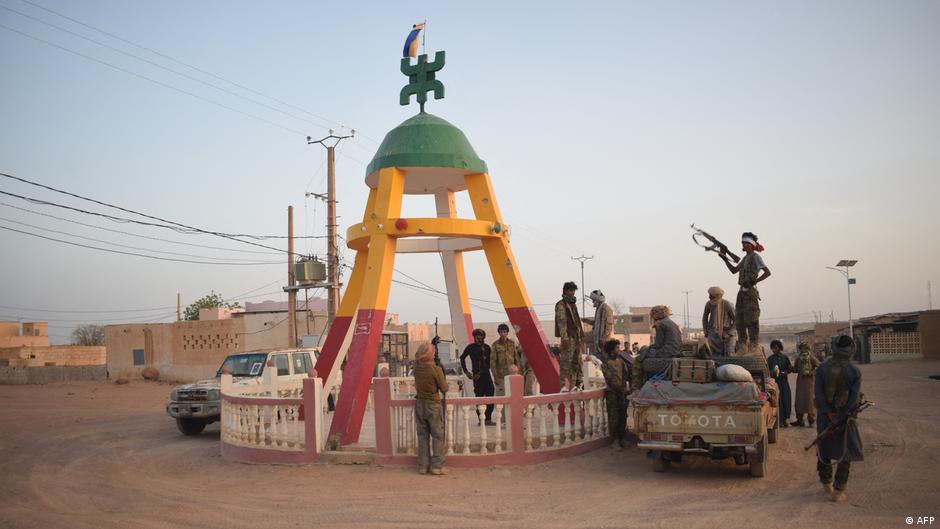
Five Mali garrison towns – Kati, Bamako, Sevare, Gao and Kidal – were targeted simultaneously over the weekend. Al-Qaeda-linked jihadists from the Group for the Support of Islam and Muslims (JNIM), in coordination with the Azad Liberation Front (FLA), composed primarily of Tuareg rebel independence movements, claimed responsibility.
Nina Villain, director of the Africa program at the Egmont Institute for International Relations, told DW that the events were “unprecedented in the history of Mali” and showed “how much JNIM has strengthened over the past year.”
Villain said: “The fact that Malian military intelligence was not able to detect that these attacks were going to happen is a major failure on their part.”
On Saturday, April 25, a suicide bombing by JNIM killed Mali’s Defense Minister Sadio Camara. The government said the attacker detonated a car packed with explosives outside Camara’s private residence in Kati, about 15 kilometers (9 miles) from the capital, Bamako.
Kati is the center of military power and the seat of the transitional government. A state funeral and two days of national mourning were announced for the minister.
Nina Villain told DW that it appeared there were two reasons why Camara, considered second in command within the junta, was targeted.
“He is a very symbolic figure for the military regime,” he said. “The second reason is that Camara has been a leading figure in establishing relations with Russia. So attacking him could also be a way of saying that we do not want Russian troops here anymore.”
Tuareg rebels recapture Kidal
Kidal, located in the north-east of the country, is a stronghold of the FLA. The city is also – or rather, – a symbol of the growing power of the Malian army, which recaptured Kidal from the Tuaregs in 2023 with the support of the Russian Wagner Group.
But according to Jalil Lounas, associate professor of international relations at Morocco’s Al Akhawayn University, the situation has changed.
“The Malian army is extremely weak. In the last few years, it was just controlling the urban centres. But the entire rural area was out of control. So the Malian army in Kidal was isolated,” he told DW.
On 27 April, the Moscow-controlled Africa Corps – considered the successor to the Wagner Group – confirmed that its troops had withdrawn from Kidal after heavy fighting in consultation with the Malian leadership.
Rebels had earlier announced that they had captured large parts of northern Mali.
According to analyst Jalil Lunas, Afrika Korps fought in Kidal, Kati and Bamako.
“However, we are only talking about 600 to 1,000 fighters,” he says.
“It’s very small. I don’t think the Russians can do much. Besides, they’re stuck in Ukraine. They didn’t get involved much in Iran, so I don’t expect much Russian involvement in Mali.”
JNIM and FLA – collaboration of jihadists and Tuaregs
“Remarkably, there has been a coordination between the jihadists and the Tuareg rebels, who have nothing in common, but they have a common enemy,” said Ulf Lessing, head of the Sahel program at Germany’s Konrad Adenauer Foundation (KAS) in Bamako.
“They attacked together in 2012 and took over northern Mali. Later, the jihadists got rid of the Tuareg,” Lessing told DW.
Jelil Lunas is less surprised by the renewed cooperation between JNIM and the FLA, telling DW: “There are very strong bridges between them. They are all from the same tribal background. They fought together.”
However, Lessing does not believe the rebels intend to capture major cities such as Bamako.
Lessing said, “They don’t have the capacity to run a major city. They want to instigate a rebellion in the hopes of putting pressure on the government to negotiate with them, or they will get a new government.” “But there is no sign that that is happening. Most people are unhappy with the situation in Mali, but they still support the government because they do not want to be run by jihadists.”
A 72-hour nightly curfew has been in place in Bamako since Saturday evening. Roads were blocked in front of police stations, the Armed Forces General Staff and the state television complex.
A resident of Kati, who wished to remain anonymous, said: “It is extremely difficult to leave Kati. Access roads to the main roads are closed to traffic.”
A weak AES is barely able to take action
The Alliance of Sahel States (AES), which includes Mali and its junta-led neighbors Burkina Faso and Niger, condemned Saturday’s attacks as “a monstrous plot supported by the enemies of the liberation of the Sahel.”
Strong words – but Mali has yet to receive any concrete military assistance from its allies.
Analyst Nina Willen says this fact is “quite surprising, given that they are calling themselves not only a defense alliance, but also a confederation.” He told DW that the situation in Mali shows that AES is “much more of an alliance on paper than it is in practice.”
Ulf Lessing of KAS says: “Burkina Faso and Niger don’t really have the capabilities. They are busy fighting jihadists themselves. They can help a little with drone strikes, but I don’t think Burkina and Niger will send troops.”
DW correspondent Mahamadou Kane said that by Sunday peace had returned to Mali’s cities of Mopti and Sèvres, home to one of the country’s most important military bases. A Mopti resident, who spoke anonymously, said this was due to the arrival of air support from the Malian army: “They were able to recapture the governor’s residence and the Baricondaga security post, two places that had fallen into the hands of terrorists on Saturday.”
AU and UN respond to Mali violence
African Union (AU) Commission Chairman Mahmoud Ali Youssef strongly condemned the attacks, “which could put the civilian population at considerable risk.”
UN Secretary-General Antonio Guterres condemned “violent extremism” and called for “coordinated international support”.
“Germany has also noted the situation with concern,” Federal Foreign Office spokeswoman Catherine Deschauer told DW. German citizens are urged to leave the country if possible and avoid traveling there for the time being.
Contributors: Mahamadou Kane, Frejus Quenam
Edited by Cai Nebe