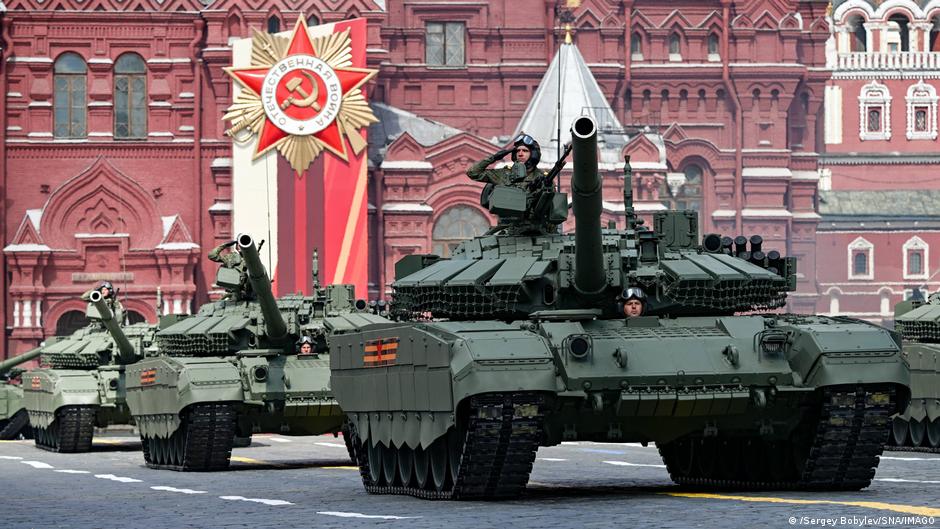
Russia plans to celebrate its World War II victory over Nazi Germany this year with a parade that will not include the standard display of weapons for the first time in nearly two decades.
The Kremlin made the announcement on Wednesday, citing the growing threat of Ukrainian attacks.
What is Russia’s Victory Day Parade?
The May 9 parade on Red Square in the capital Moscow is one of Russia’s largest annual celebrations.
Traditionally under President Vladimir Putin, the day is an excuse to show off the weapons in the military’s arsenal, ranging from tanks to intercontinental ballistic missiles.
As Russia launches a full-scale invasion of Ukraine in 2022, Putin is using the parade to drum up support for his war. But in recent months, Kiev has stepped up its attacks, striking deeper into mainland Russia and damaging several ports and oil refineries.
Last year’s military parade was held to mark 80 years since the end of World War II and so was held on a bigger stage than usual, hosting some of the stalwarts including Chinese President Xi Jinping and Brazilian President Luiz Inacio Lula da Silva.
Why is Russia scaling back its Victory Day parade?
The display of military hardware on May 9 has been canceled due to “operational circumstances,” the Defense Ministry said late Tuesday.
Asked by journalists about the decision, Kremlin spokesman Dmitry Peskov said on Wednesday: “The Kiev regime, which is losing on the battlefield every day, has now begun full-scale terrorist activity. And therefore… all measures are being taken to reduce the threat.”
Peskov also said that there are no significant anniversaries this year compared to last year.
John Foreman, a former British defense attache to Moscow, told Reuters news agency that 11,000 troops and about 150 military vehicles – including tanks, which were absent in the past two years – took part in the 2025 parade.
Analysts and Kremlin critics like Foreman suggest the decision was made to avoid exposing Russian military assets as easy targets for potential Ukrainian drone attacks. He also said it was a sign that Moscow was reserving its assets for the fight.
“This decision signals a degree of vulnerability rather than strength, as last year also Russia demonstrated a range of new tanks and drones in front of invited world leaders,” Natia Sesquiria, an associate fellow at the Royal United Services Institute, told the Associated Press news agency.
Weapons displays have been a staple of Victory Day parades in Russia since 2008.
Edited by: Srinivas Majumdaru