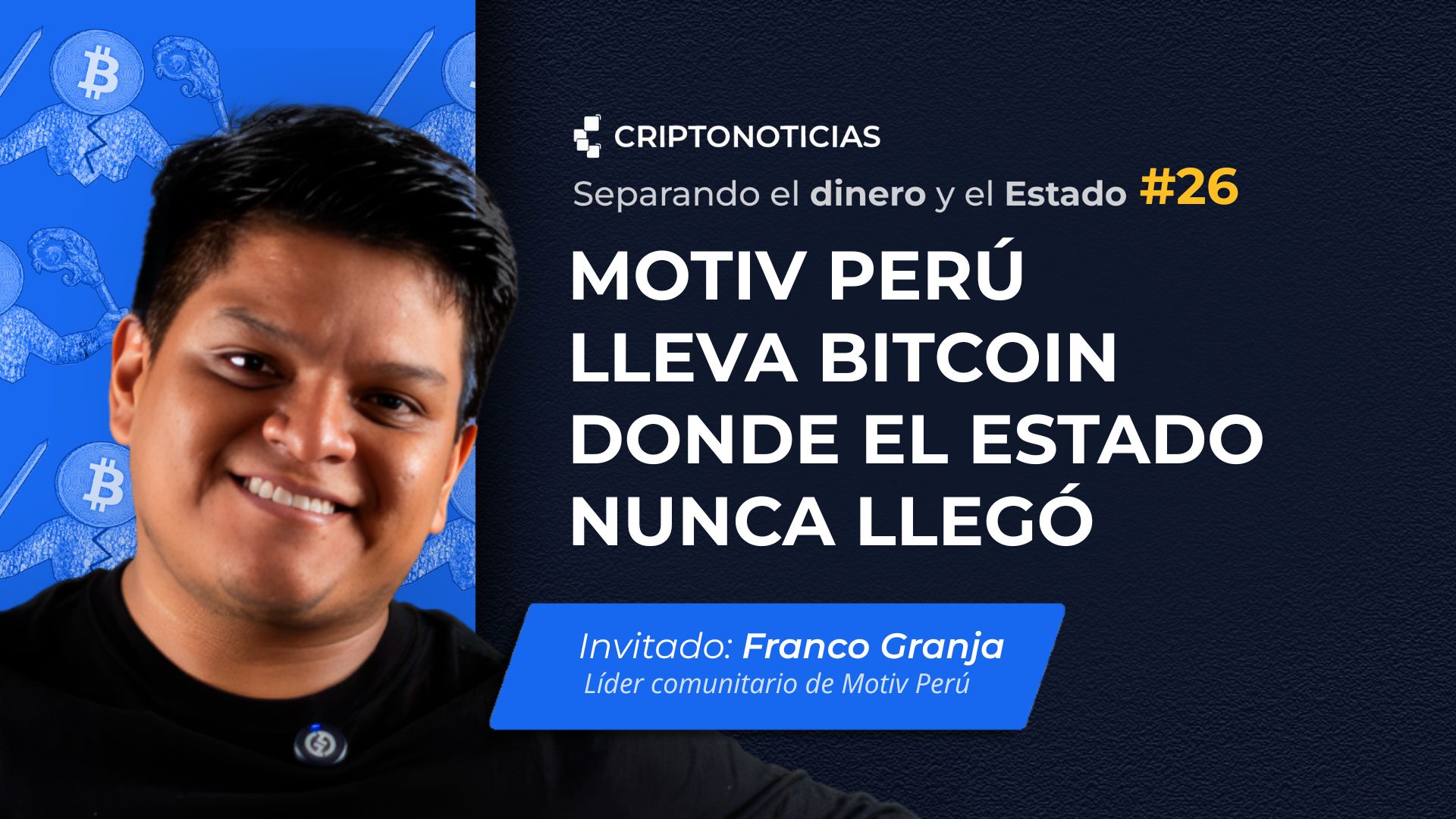
In it episode twenty-six of Separating Money and the State from CriptoNoticias, Iván Gómez spoke with Franco Granja, leader of Motiv Perú, about how an organization that began in 2019 as a humanitarian project ended building one of the most extensive bitcoin circular economy networks in Latin America: 13 active citadels and two in formation, distributed between Lima, Cusco, Huanchaco, Tarapoto and Iquitos.
Granja explains that Bitcoin did not arrive as an ideological flag but as a practical response to the pandemic urgency: people were starving and did not want to hear about cryptocurrencies, so Motiv used the digital asset first as a logistical tool to meet food and educational needs, and only later as an object of financial training. The result, today, is a flow where donations in sats are distributed among participants, teachers and merchants, maintaining circulation within each community without leaking into fiat.
The conversation stresses the thesis of the podcast in several key moments. Iván points out that in deep Peru there is no oppressive State from which to separate the money, but rather an absent State that never arrived: the separation, in these territories, is more like a foundation. Granja confirms this reading from the field and provides the nuance: The real initial obstacle was not the State but the previous pyramid schemes, that left Bitcoin “tainted” in many communities—even earning him the risk of almost getting rocks thrown at him.
The most relevant:
- Motiv Peru was co-founded by Rich Swisher (CEO, United States) and Valentín Popescu (director in Peru, of Romanian origin).
- The project was born between 2019 and 2020, originally as a humanitarian initiative, not a bitcoiner.
- Bitcoin was incorporated into the project in 2020 due to the pandemic context and a donation.
- Motiv operates under three pillars: educate, equip and accompany.
- The geographical distribution is: 3-4 in Lima, 1+1 in Tarapoto, 3 in Sacred Valley, 2 in rural Cusco (Huayllapata, Ohuay), 2 in Huanchaco and 2 in training in Iquitos.
- In Peru, more than 80% of the economically active population is informal.
- Motiv works in communities where Quechua and Aymara are the first language, which required the use of translators to teach financial education.
- Motiv’s circular economy flow works like this: donors send sats → Motiv distributes to participants → they pay teachers → teachers save or spend in local businesses → businesses recycle the sats within the community.
- More than 150 businesses in different areas of Peru accept Bitcoin thanks to the work of Motiv.
- Approximately between 50% and 60% of these businesses keep a portion of their income saved in Bitcoin.
- Motiv maintains a strategic alliance with Fedi, which offers additional benefits to users who buy with Bitcoin through local brokers.
- Franco Granja and Martha Calixto were the first scholarship recipients of the Bitcoin Beach Fellowship, the training program derived from the experience of El Zonte (El Salvador).
- In September 2026 (the 18th, 19th and 20th) the second edition of the Bitcoin Cup will be held in Huanchaco, organized with the Peruvian Board Federation and recognized by the Peruvian Sports Institute.
- The Ecovillage project, in Tarapoto and soon Cusco, seeks to make communities self-sufficient through cocoa production, agriculture, livestock and tourism, all articulated with Bitcoin.
- Banco de Crédito del Perú (BCP) became the first Peruvian bank to enable the purchase and sale of Bitcoin through its Cryptococos platform.
- Peru is in the top 5 in South America for the adoption of digital assets, with approximately 1.2 million users; Granja estimates that about 30% are specifically bitcoiners.
- The cryptocurrency bill in the Peruvian Congress remains on file: the Central Reserve Bank and the Stock Exchange have it “in the pipeline” but not as a regulatory priority.