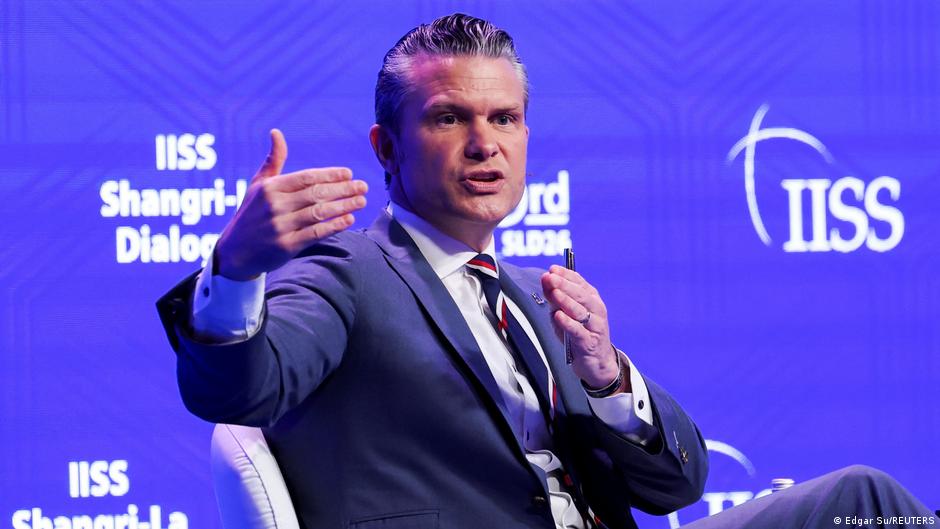
Defense ministers, military officials and security experts from around the world gathered at the Shangri-La Dialogue (SLD) in Singapore this week to discuss the security situation in the Asia-Pacific. The conference has been organized annually by the London-based International Institute for Strategic Studies (IISS) since 2002.
What are the highlights of this year’s conference?
1. The security situation in Asia-Pacific is worsening
A week before the Shangri-La Dialogue 2026 began in Singapore, the city-state’s Prime Minister Lawrence Wong said: “The reality in this changed world is that there will be more instability – we will face storm after storm.”
In fact, many conflicts have increased in Asia-Pacific recently. A brief war broke out between India and Pakistan in May 2025. The conflict between Thailand and Cambodia ended only in December 2025. In February 2026, recurring clashes between Pakistan and Afghanistan reached a new intensity with Pakistani air strikes. Civil war continues in Myanmar. Tensions in the South China Sea continue to rise regularly. Taiwan – the focal point of many of the region’s security issues – remains uncertain.
Above all, however, the growing rivalry between the United States and China dominated the discussion, as China’s rapidly growing military is shifting the balance of power in the Asia-Pacific.
Ivan A., IISS Senior Fellow for Southeast Asian Security and Defense Lakshmana summed it up in the SLD’s annual security report: “regional states – whether large, medium or small – cannot escape this deteriorating security environment.”
Vietnamese President and Secretary-General To Lam, who opened the conference with a keynote address on Friday evening, stressed that competition between states is natural – but it must be controlled: “The main principle is to manage differences within a legal framework, making competition limited, responsible and predictable. A sustainable regional order cannot be built on constant fear and mutual distrust.”
He also emphasizes that development and security are interlinked. “For many countries, development is no longer an option after security.”
Australian Deputy Prime Minister and Defense Minister Richard Marles clearly agreed: “Security is absolutely linked to development. Where there is prosperity, where there is human development, that in itself is a contributor to stability and peace. When all of that is put into question, that’s where you get instability and instability.”
2. More money for weapons
However, the SLD’s response to the deteriorating security situation is not primarily development – but above all rearmament. According to the Stockholm International Peace Research Institute (SIPRI), military spending in Asia-Pacific is set to increase by 8.1% to $681 billion in 2025.
US Secretary of War Pete Hegseth said this was not enough. In his much-anticipated speech on Saturday, he said the United States would soon spend $1.5 trillion on defense, and called on all US allies in Asia to invest more in their security. “A favorable balance of power requires capable allies with real military power, real industrial capacity, and real political solutions. For too long, the region’s security has rested disproportionately on U.S. military power, while many of our allies and partners have allowed their own defense capabilities to weaken.”
He explicitly praised South Korea, the Philippines, Australia, Singapore, Malaysia, Thailand, Vietnam and India, saying that – unlike Europe – they had understood that peace could only be secured through strength, a line he repeated.
The German delegation remained calm in the face of American criticism. Secretary of State for Defense Nils Hilmar said the region faces the same challenges as Europe, namely insufficient capacity. Since the constitutional amendment, Germany at least has enough money. “This is the first time in many years that the Bundeswehr is getting the money we need, and the most important task at the moment is to buy the right weapons in the right quantities at the right time.”
The idea that more weapons do not automatically create more security and peace played only a marginal role in SLD. Only Mirjana Spoljarić, president of the International Committee of the Red Cross, expressed concern: “Where weapons are produced, weapons are used. The massive flow of weapons, the mass production of weapons, and massive investments in defense will ultimately create human losses and material losses. That’s why we have to take that side of war into account from the very beginning, from the first day, when we budget for defense.”
3. Taiwan remains in uncertainty
In this year’s speech, Hegseth did not mention Taiwan at all. The de facto self-governing Republic of China is considered a “separate province” by the People’s Republic of China. Beijing has not ruled out the use of force to achieve “reunification.”
In his previous SLD speech in 2025, Hegseth warned bluntly about “Communist China”, which he said could be close to attacking Taiwan – which would have devastating consequences for the world.
The change in US-China relations since the meeting between President Donald Trump and President Xi Jinping in mid-May – particularly with regard to Taiwan – is striking. The two leaders agreed on a China-proposed formula of “constructive relations and strategic stability” to guide future relations. Hegseth used the same term in his speech, saying that the region and the United States “share a clear assessment of the security environment and a mutual understanding that a Pacific region dominated by any hegemon would upset the regional balance of power and undermine the balance we all seek to preserve.”
Former Chinese Vice Foreign Minister Cui Tiankai expressed satisfaction in an interview with DW at the SLD: “President Xi and President Trump agreed on a new vision for China-US relations, that is, constructive strategic stability. The most important thing now for both sides is to work together to turn that vision into reality.”
From Cui Tiankai’s perspective, this includes stopping arms supplies to Taiwan. “We are against such arms sales at any time, at any cost. That’s absolutely clear. Clearly further arms sales are not constructive. It will harm stability.”
Asked by an audience member whether a $14 billion arms package for Taiwan – which was approved by Congress but blocked by Trump in May – would still go ahead, Hegseth responded that the decision is up to the US President.
4. America remains indispensable – but not omnipotent
Longtime observer and former diplomat Bilahari Kausikan told DW at the SLD that fundamental realities remain unchanged: “The truth is that it is not possible for Europe to contain Russia without the US. It is not possible for Asia to balance China without the US. There is only one America, and we have to work with that.” He added: “And on that basis, small and medium powers, which are never without agency, never completely without agency, can then act together according to their interests in particular domains.”
Currently, new and multi-layered security partnerships are emerging in Asia. Japan is working closely with Australia, the Philippines, India, New Zealand, Singapore and others. “So what Japan is trying to do is to network with like-minded partners in the region. It’s a huge region. And no country can do that on its own, not even the US, which is very far away,” Robert Ward, IISS Japan expert, told DW.
These additional security networks are also intended to increase the cost of China’s ambitions, Ward said: “I think another reason for this is to create strategic complexity for China.”
Philippine Defense Minister Gilberto Teodoro Jr. struck a similar tone: “The US is one of those that is with us but Japan is with us, Australia is with us, New Zealand is with us, Canada is with us, France is with us. Naturally there are more convergence partners for deterrence. That will continue.”
Germany is also increasing its cooperation. State Secretary Hilmar said: “We are not only talking about strategic development, but also developing strategies together, for example, with Japan and Singapore.” He emphasizes that this goes beyond talks to practical security policy. Germany recently took part in RIMPAC, the world’s largest maritime military exercise in the Pacific – and plans to participate again in 2026.