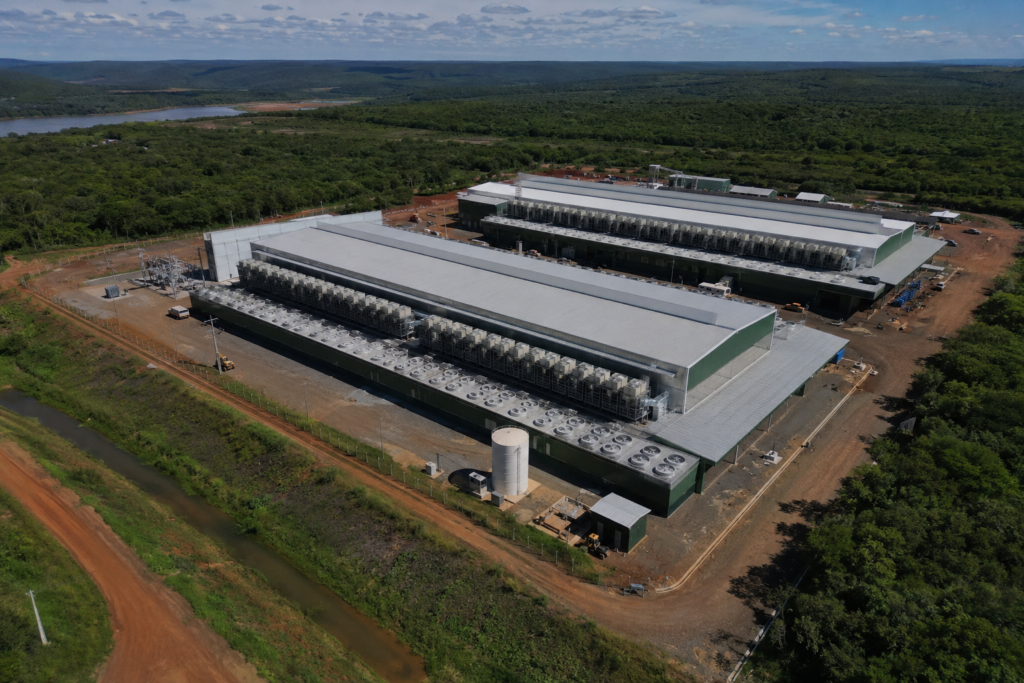
Luxor Business Manager, Alessadro Cecere, also known as Sultan Bitcoin, assured that Paraguay has become an example of how Bitcoin mining can take advantage of surplus hydroelectric energy to generate income, attract private investment and develop technological infrastructure, a model that, in his opinion, could be replicated in Venezuela to help rebuild its electrical system.
As reported, the Paraguayan project includes 400 megawatts (MW) of installed capacity in two locations and reaches a hashrate of 18.87 exahashes per second (EH/s), making it one of the largest Bitcoin mining centers in Latin America. This company also plans to reach 35 EH/s of global mining capacity by 2026, as highlighted by CriptoNoticias.
It is not the first time that the Venezuelan analyst speaks about Paraguay’s potential. But beyond the magnitude of the operation, what caught the analyst’s attention was the way in which Paraguay has managed to convert surplus energy into a source of income and technological development. In his opinion, Bitcoin mining is acting as a tool to transform electricity that had no immediate use in global computing infrastructure, without resorting to state subsidies or public debt.
Everything is powered by Itaipú’s hydroelectric surplus, without consuming a single watt of what corresponds to Paraguayan homes or industry. That’s what Bitcoin mining does with stranded power: it turns it into world-class computing infrastructure. No sovereign debt. No subsidies. Generating dollars.
The Bitcoin Sultan.
Cecere, a Venezuelan national, visited the Bitcoin mining complex that HIVE develops in Paraguay, an infrastructure powered by surplus hydroelectric energy from the Itaipú damand drew some useful conclusions for the case of mining in Venezuela.
The Sultan He recalled that Venezuela has an installed hydroelectric capacity of 17.75 gigawatts (GW), although currently only a part of that generation is operational. In his opinion, Bitcoin mining could act as a “flexible load” capable of absorbing energy surpluses and transforming them into income in foreign currency, without resorting to public debt.
The Paraguayan experience led Cecere to insist on the need to modernize the Venezuelan legal framework. In his opinion, the current electricity legislation makes it difficult for new investors to enter and limits the possibility of replicating models that are already working in other countries in the region.
The current law, enacted in December 2010 under the socialist management model, reserves exclusively to the State all generation, transmission, distribution and dispatch activities of the national electrical system (…) This legal framework is not compatible with the model that worked in Paraguay, where private operators such as HIVE and Penguin built their own substations, signed PPAs directly with ANDE, and operate as flexible load registered in the national network without state participation in their capital.
According to his approach, he made reference to the US OFAC GL48A and GL49A licenses, which in his opinion could facilitate the participation of international private capital in the Venezuelan energy sector, allowing investment in generation, transmission and associated services under certain regulatory frameworks.
As background, Paraguay has established itself in recent years as one of the main destinations for Bitcoin mining in Latin America thanks to its surplus hydroelectric energy. CriptoNoticias has reported that projects such as HIVE have promoted the expansion of data centers powered by renewable energy and, more recently, have begun to be linked to artificial intelligence and high-performance computing initiatives.
On the other hand, the Venezuelan analyst concluded that the Paraguayan case demonstrates the viability of a model based on private investment, direct agreements with electricity companies and the use of surplus energy for Bitcoin mining and artificial intelligence infrastructure: “The model works. It is proven. The engineers exist and they are all talented young people. The legal framework is opening up. “Why not replicate the Paraguayan model in our country?”he stated.