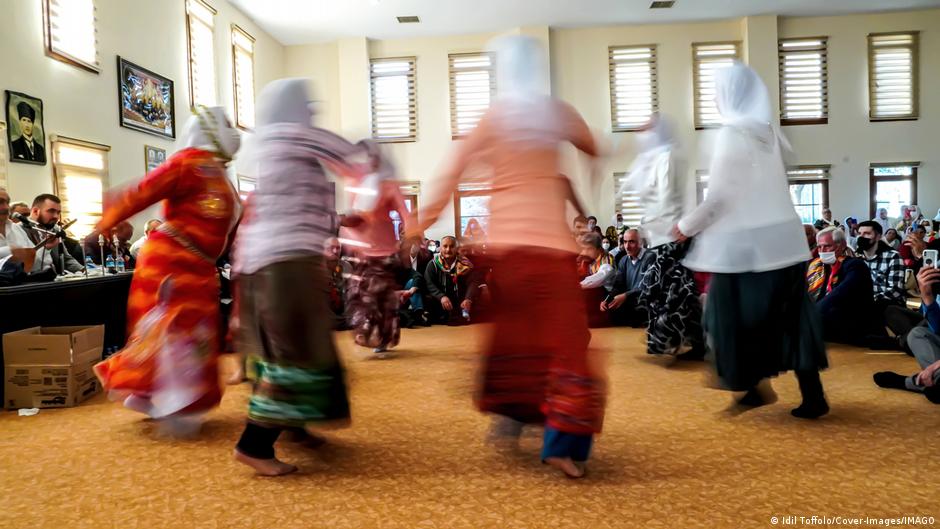
About 13% of Muslims living in Germany today are Alevis. Members of this religious community once lived primarily in rural Anatolia, Türkiye, and passed on their spiritual beliefs and rites orally.
When rural migration began in Turkey from the 1950s onwards, with increasing urbanization and emigration to Europe, many Alevi village communities disappeared – and with them, in many places, knowledge of their faith.
Alevism flourished from the 13th century onwards. Today, Alevis are the second largest religious community in Türkiye after Sunni Islam. Alevis include members of other ethnic minorities such as Turks, Kurds and Zaza.
The Alevi faith developed from a combination of Central Asian shamanism, Shia Islam, and Muslim mysticism. Alevis worship the Prophet Muhammad, his cousin and son-in-law, the first Imam Ali, and Twelver Shiism, as well as an emphasis on ethical and mystical teachings.
Alevis practice their faith in the Alevi Semevi, the central place of Alevi worship. Their religion respects values such as humanism, equality and tolerance, which are traditionally conveyed to the community through parables, stories and songs.
Alevism differs from Sunni Islam in its rituals, which include the Sem ceremony, which is celebrated by both men and women, as well as the Sema ceremony, where believers dance in circles to the sounds of the long-necked harp. Because of these differences from Sunni Islam, the Alevis faced persecution in the Ottoman Empire (1299 to 1922), the predecessor state of today’s Türkiye.
Today, Alevis still face mistrust in modern Türkiye, where Sunni Islam dominates. This also applies to the Bektashi, followers of one of the largest mystical Alevi dervish orders in Anatolia, whose philosophy is strongly influenced by reverence for Caliph Ali. Thousands of Alevis were killed and their villages destroyed in the Dersim massacre carried out by Turkish forces in 1937/38.
A turning point for Alevis
Several massacres against Alevis in the 1990s – notably the 1993 Sivas arson attack that killed 35 people – proved to be a turning point in Alevi self-organization, leading to a rise in political associations being established in Istanbul, but also in German cities such as Hamburg, Cologne and Berlin, which are home to many migrant workers from Turkey.
Today, there are approximately 200 Alevi organizations throughout Germany. Most are included under the umbrella organization Alevi Community Germany (AABF, Almanya Alevi Birlikleri Federasyonu). The Alevi religious community is fully recognized in the German states of North Rhine-Westphalia and Berlin, which grants it certain rights and obligations. For example, the Alevi-Bectashite Cultural Institute in North Rhine-Westphalia is a non-governmental organization that seeks to create a place to practice science and respect cultural traditions.
Gulzar Cengiz, a member of the Bektashi Order, is the institute’s president.
“Our leitmotif is a quote by the Muslim mystic Haji Bektash,” Cengiz told DW. Bektash said that “the end of every path is darkness if it is not the path of knowledge.”
Cengiz states that unfortunately, much of the knowledge related to this religious philosophy and Alevi culture has been lost over the centuries. That’s why, he added, “we want to counter it with festivals and ritual ceremonies.”
A particularly important aspect of the institute’s work, which opened in early 2026, involves the creation and maintenance of a collection of historical manuscripts, as well as video and audio recordings of Alevi religious rites and gatherings.
Preservation and promotion of Alevi culture
“A community that has no history and no memories of the past is in danger of disappearing,” Cengiz told DW. He reported that many Alevis burned or buried handwritten documents such as letters and diaries out of fear that they might incite hostility or outright attack.
Today, the academic study of Alevism is greatly welcomed among Alevis in Germany. “There is a great need for concrete knowledge and scientists have a special role to play here,” says Cem Kara, professor of Alevi theology at the University of Hamburg.
Their Institute for Alevi Theology, established in 2024, is one of the world’s first academic bodies dedicated to the faith. It trains teachers engaged in Hamburg’s special program for inter-denominational religious education and other religious teachers elsewhere. From 2027, it is also expected to train theology students.
So far, little research has been devoted to Alevism.
“There has been different research, mostly in the context of Ottoman and Turkish history,” Markus Dressler, professor of modern Turkish studies at the Institute of Religious Studies at Leipzig University, told DW.
Dressler heads a long-term research project on the ethnic history of Alevi communities in Anatolia between the 16th and 20th centuries, which was launched in 2026.
“We try to collect data from different sources, bring it together and make it legible,” he says. “This includes historical data from Ottoman registers, but also Alevi manuscripts and documents, inscriptions from tombs and gravestones, as well as ethnographic data, which deals with oral history.”
Databases compiled in this way provide a long-term perspective that makes it possible to examine Alevi settlement areas in Anatolia and the actors involved. This data can also be used to reconstruct dominant narratives and analyze the oppression and discrimination experienced by Alevi.
Dressler says, “The Alevi faced discrimination and oppression in the Ottoman Empire.” “It still exists today, but it did not happen seamlessly and does not apply to all groups that call themselves Alevis today. You have to look at specific historical contexts, regions and groups.”
This article was translated from German.