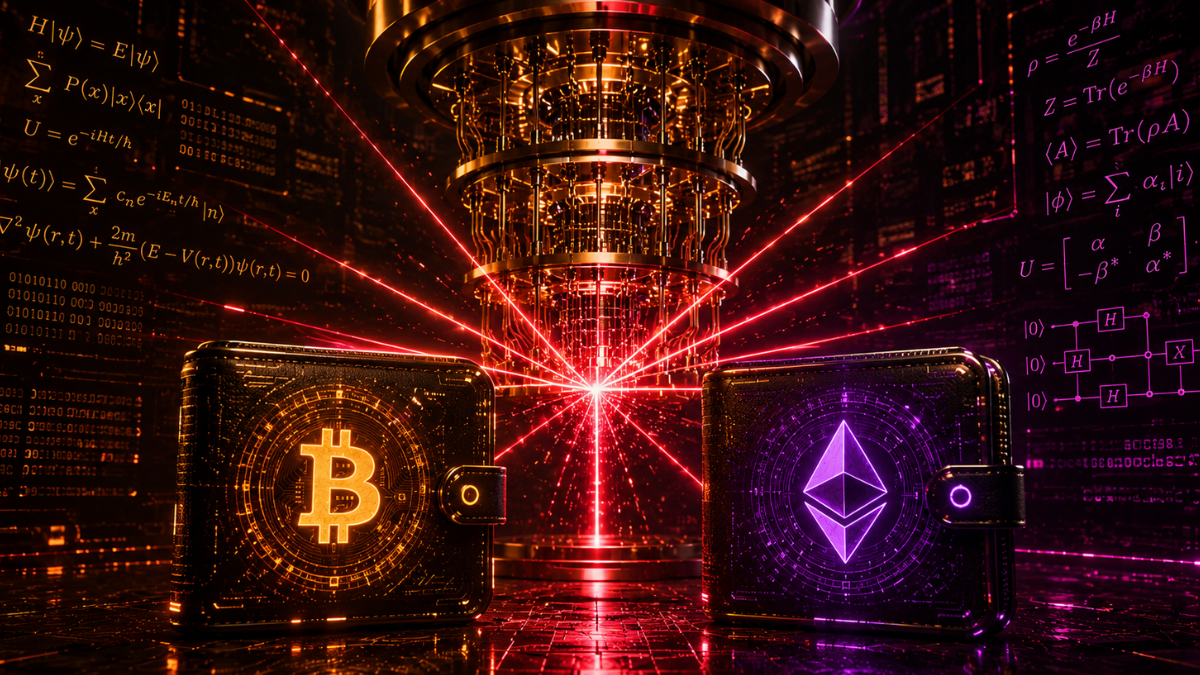
Quantum-vaults transfer funds in a single operation and mark the address used as exposed.
The second tool is libqc, a kit that upgrades Ethereum accounts to post-quantum.
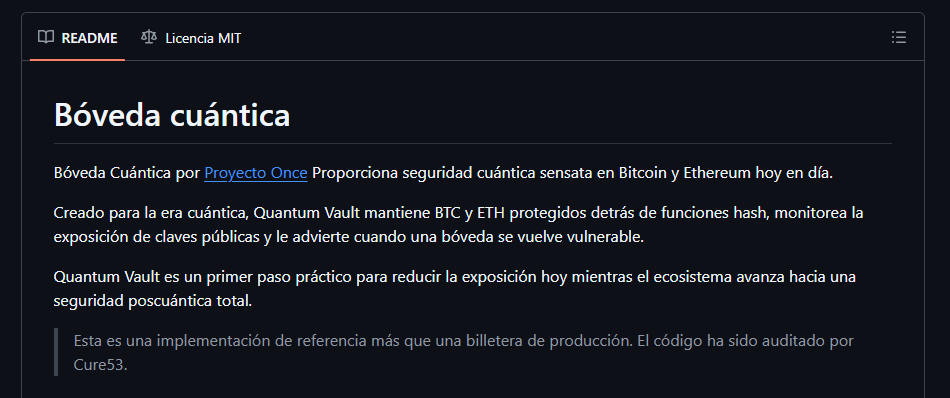
Two tools to build post-quantum wallets compatible with Bitcoin and Ethereum were published on GitHub by the company Project Eleven this May 12. It is about libqca TypeScript development kit, and quantum vaults (quantum-vault)a browser extension built on top of it.
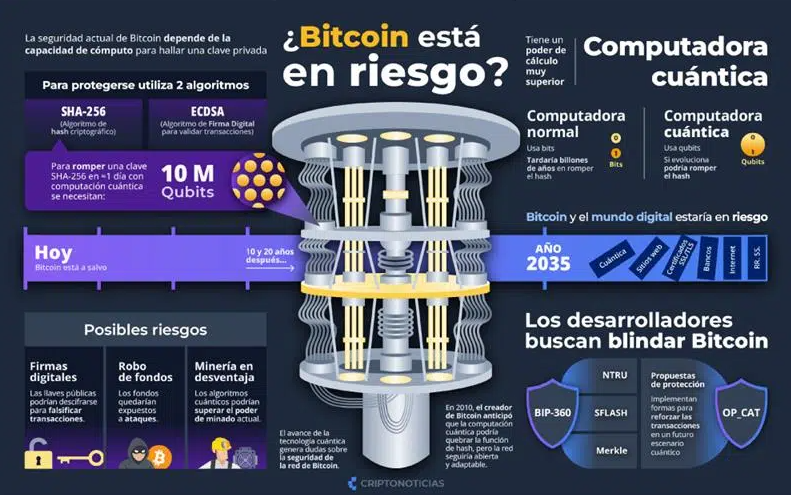
The tools aim to anticipate the potential danger linked to quantum computers. When these reach enough power, they could theoretically break the digital signature scheme ECDSA (Elliptic Curve Digital Signature Algorithm) that protects the private keys of Bitcoin and Ethereum today.
If a public key remains visible on the network after a transaction, a quantum computer could use it to derive the private key and appropriate the funds.
According to the Project Eleven statementquantum vaults operate under a model the team calls “all-sweep,” in which an address can only store funds or transfer them entirely to a new address in a single operation, without partial shipments.
Once the quantum vaults point a direction like «vulnerable quantum» (vulnerable to quantum), that address is disabled from receiving funds againsince this vault system recognizes it as exposed and does not allow it to be reused. The funds are transferred to a new, automatically generated address, which is again in a secure state because its public key has never been visible on the network.
The statement does not detail How is this generation of new addresses managed? in case of failures during the transfer, nor what happens if a user tries to send funds to an address already marked as vulnerable from an external wallet that does not know that status.
The design that allows changing the algorithm without changing direction
According to what was explained by Project Eleven, the development kit libqc It is the basis on which quantum vaults work and is designed so that a wallet can migrate to post-quantum cryptography in the future without the user having to change address. In that sense, currently in Ethereum the address of an account is linked directly to the key pair that created it: if the key changes, the address changes.
The statement maintains that libqc breaks that dependency using ERC-4337the Ethereum smart account standard, which separates the address from the mechanism that verifies the signatures. That mechanism lives in a separate smart contract, and replacing it is enough to change the algorithm without touching the address.
According to the Project Eleven team, when post-quantum algorithms such as ML-DSA or SLH-DSA (approved by NIST) are available for production, migration would consist of that replacement. For now, the only supported scheme is the current ECDSA.
The statement also mentions parallel support for Bitcoin. The libqc kit allows you to derive Bitcoin and Ethereum keys from the same 24-word recovery phrase. That means that a developer building on top of libqc can manage addresses for both networks from a single access point, without needing separate phrases or keys for each.
However, Project Eleven It does not specify how far that support in Bitcoin goessince it is not clear whether the quantum-vault They do not allow signing transactions on that network nor if the sweep model also applies to Bitcoin addresses.
Project Eleven’s report describes its two tools as reference implementations, not like end-user ready wallets. This means that they are technical models for other developers to study, adapt and integrate into their own projects, without user support or production-scale testing.
The ecosystem advances in post-quantum protection
The launch of Project Eleven joins other recent initiatives. As reported by CriptoNoticias, the Starknet team, an Ethereum second layer (L2) network, deployed S2morrow on its main network, a tool that allows create accounts with post-quantum cryptography using Falcon-512a signature scheme based on lattices (mathematical structures considered resistant to Shor’s quantum algorithm) and standardized by the United States National Institute of Standards and Technology (NIST).
Eli Ben-Sasson, co-founder of StarkWare Industries, the company developing Starknet, called the deployment “a first concrete step toward quantum resistance.” However, according to Starknet’s own statement, S2morrow is not yet integrated into the popular wallets of that network such as Argent or Braavos, so it is not available to the common user today either.
In the Bitcoin ecosystem, the company Postquant Labs announced Quip Network, a wallet that adds post-quantum signatures using the scheme called WOTS+ through Arch Network, an external layer to the base Bitcoin protocol that allows the network to be linked with smart contracts.
What these initiatives (quantum-vault, S2morrow and Quip Network) have in common is that none require changes to the base protocol of Bitcoin or Ethereum to work, although none are yet within reach of the common user.
In this context, the pattern that emerges is that of an ecosystem that builds post-quantum infrastructure in external layers while the base protocols advance at a different pace. If that infrastructure matures and reaches production wallets before quantum computers reach cryptographically relevant capabilities, the transition could be gradual. If not, the gap between technical preparation and real adoption will be the central problem.